
Trenchless Construction for Water Mains: When to Use Pipe Jacking vs Open-Cut





Choosing between pipe jacking and open-cut is rarely a simple cost comparison. For water main delivery, the method shapes permit risk, traffic disruption, stakeholder pressure, ground exposure, and the long-term reliability of the installed asset. In trenchless construction for water mains, the real decision starts with corridor constraints, burial depth, surface sensitivity, and the consequence of getting access wrong.
Why this choice matters more now
Water utilities are renewing aging networks under denser streets, busier logistics corridors, and stricter environmental controls. That is why trenchless construction for water mains is moving from a niche option to a mainstream planning discussion.
Urban projects now face tighter noise limits, shorter possession windows, and stronger public scrutiny. A method that reduces excavation can protect schedule certainty even when direct construction cost looks higher on paper.
UTMD has long tracked this shift through trenchless engineering equipment intelligence. The same market pressure driving smarter TBMs and automated underground systems is also pushing pipe jacking into more municipal decisions.
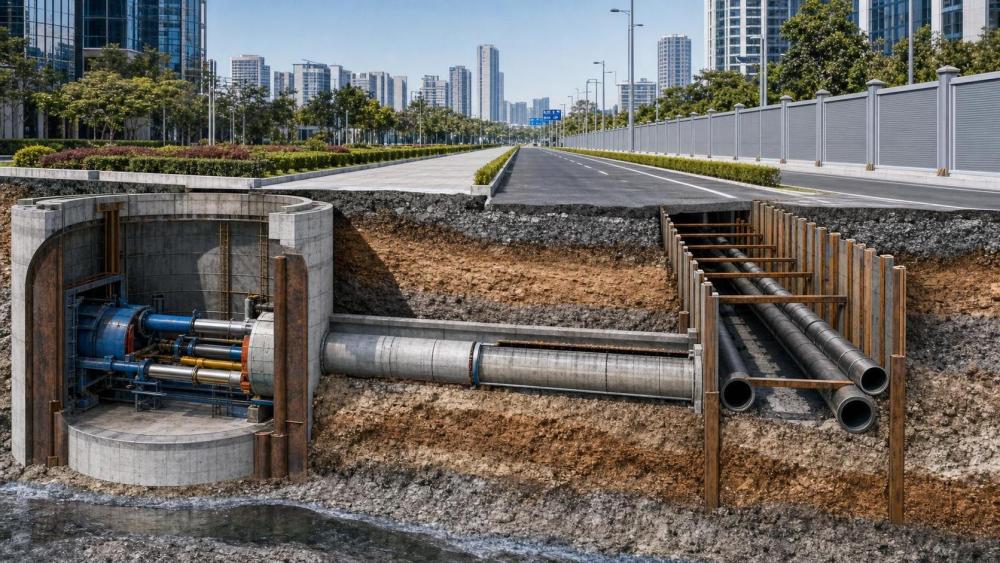
That matters because water main work is no longer judged only by excavation output. It is judged by how well the installation fits a constrained underground ecosystem.
Two methods, two different project logics
Open-cut installs pipe by excavating a continuous trench from the surface. It remains familiar, flexible, and efficient when access is easy and the corridor can tolerate disruption.
Pipe jacking installs a pipe or casing from a launch shaft to a reception shaft. Hydraulic jacks push the line forward while excavation occurs at the face, often with controlled guidance.
In practical terms, open-cut exposes the full alignment. Pipe jacking limits surface disturbance but concentrates planning effort around shafts, alignment control, geotechnical behavior, and machine selection.
That is why trenchless construction for water mains should not be framed as a universal replacement for open trenches. It is a strategic option for specific constraints and risk profiles.
A quick comparison
When pipe jacking becomes the stronger option
Pipe jacking performs best when the surface cannot be repeatedly opened. City centers, rail crossings, arterial roads, airport approaches, industrial plants, and environmentally sensitive zones are common examples.
It also gains value when the line runs deeper. A deep open trench can trigger complex shoring, dewatering, spoil handling, and restoration obligations that quickly erase the apparent simplicity of excavation.
In trenchless construction for water mains, pipe jacking is especially attractive where buried utilities are dense but poorly mapped. Passing below conflict layers may reduce interface risk, claims, and redesign loops.
- Long stretches beneath roads that cannot close for extended periods.
- Crossings under rivers, rail corridors, or major junctions.
- Sites with high reinstatement costs for premium pavements or landscaped surfaces.
- Programs where social disruption is a measurable project risk.
Another advantage is reputational. Quiet, minimally invasive work aligns with modern ESG expectations and low-emission underground operations, a theme UTMD continues to observe across infrastructure equipment markets.
When open-cut still makes solid business sense
Open-cut remains the practical choice on many water projects. If the alignment is shallow, access is straightforward, and the corridor allows excavation, it may still deliver the fastest and lowest-risk outcome.
This is often true in greenfield developments, wide road reserves, or rural sections with manageable traffic controls. It can also be preferable where frequent service connections require repeated tie-ins along the route.
Open-cut is also more forgiving when alignment changes are likely. If field conditions remain uncertain and design flexibility is critical, continuous excavation gives crews direct visibility and adjustment capacity.
The key is not to treat trenchless construction for water mains as inherently superior. A simple corridor with low social cost can still favor open-cut on total project value.
Typical signs that open-cut may be enough
- Shallow burial depth with stable excavation conditions.
- Low consequence of lane closures or temporary access disruption.
- Short installation lengths with many branches or service taps.
- Adequate space for trenching, spoil storage, and reinstatement works.
The decision usually turns on hidden costs
Direct construction price is only one line in the equation. The more reliable comparison includes traffic staging, utility relocations, stakeholder management, pavement restoration, settlement risk, and program exposure.
Pipe jacking can look expensive at tender stage because shafts, specialist crews, and machine systems are visible costs. Open-cut can look cheaper because its external impacts are often underestimated early.
That gap matters in trenchless construction for water mains. A route under a live boulevard may create months of indirect cost through diversions, noise complaints, business disruption, and night work restrictions.
By contrast, in an open reserve with low reinstatement sensitivity, those hidden costs may remain modest. The same method can be excellent in one corridor and inefficient in another.
Questions worth testing early
- What is the full cost of restoring the surface, not just excavating it?
- How certain is the utility record along the proposed alignment?
- Which method creates the smaller schedule risk under local permits?
- How much public or operator disruption is contractually acceptable?
- What happens if groundwater or settlement behaves worse than expected?
Ground conditions can override early preferences
Geotechnical conditions do not just affect production. They affect method viability, machine wear, lubrication strategy, shaft design, dewatering requirements, and tolerance control.
Mixed ground, abrasive soils, cobbles, and variable groundwater can complicate pipe jacking if not properly investigated. UTMD’s broader coverage of rock-cutting mechanics highlights the same lesson across underground works: subsurface uncertainty punishes weak planning.
Open-cut is not immune either. Unstable trench walls, contaminated soils, or high inflows can create major safety and schedule consequences during excavation.
For trenchless construction for water mains, geotechnical data should be tied directly to decision gates. Borehole spacing, groundwater interpretation, and expected face behavior deserve as much attention as unit rates.
A practical way to structure the choice
A useful approach is to screen the alignment in layers rather than debate methods in the abstract. Start with non-negotiable constraints, then test technical fit, then compare total delivery impact.
This kind of structure keeps method selection from drifting into habit or preference. It turns trenchless construction for water mains into a traceable project decision.
What to do before locking the method
The strongest next step is to build a corridor-specific option review. Map traffic and utility constraints, check shaft feasibility, quantify reinstatement cost, and stress-test geotechnical assumptions against both methods.
Where conditions are sensitive, ask for a delivery model that compares total impact, not just excavation productivity. That is often where pipe jacking reveals its value.
Where the route is shallow and forgiving, confirm whether open-cut retains enough schedule and stakeholder resilience to stay ahead. Good decisions in trenchless construction for water mains usually come from disciplined screening, not ideology.
For teams tracking underground delivery trends, UTMD’s equipment and infrastructure intelligence can also help benchmark how evolving trenchless practices are changing acceptable risk, productivity expectations, and urban construction standards.
Related News
How to Evaluate European Drill-and-Blast Tunnelling Contractors for Complex Projects
Drill and blast tunnelling contractors Europe: learn how to assess geology expertise, blast control, equipment reliability, safety, and programme resilience for complex projects.
Which Trenchless Construction Technique Fits Your Utility Crossing Conditions?
Trenchless construction techniques compared for utility crossings: choose HDD, microtunnelling, pipe jacking, or auger boring based on ground, accuracy, access, and risk.
What Is Driving Metro Tunnelling Demand Across Southeast Asia’s Major Cities?
Metro tunnelling Southeast Asia is accelerating as major cities tackle congestion, flooding, and connectivity. Explore the market forces, technical risks, and opportunities shaping demand.
Hard Rock Tunnelling in Australia: Selecting Methods for Variable Ground Conditions
Hard rock tunnelling in Australia: compare TBM, drill-and-blast and hybrid methods to manage variable ground, reduce risk and protect project costs.
Hydropower Tunnel Excavation: Selecting Methods for Variable Rock Conditions
Hydropower tunnel excavation methods for variable rock conditions: compare TBM, drill-and-blast, and hybrid strategies to improve safety, progress, and project control.
How to Select Underground Safety Equipment for Tunnelling by Hazard and Work Zone
Underground Safety Equipment for tunnelling: match protection to hazards, work zones, compliance, and emergency needs with this practical selection guide.
EPB or Slurry Shield? Selecting Soft-Ground Tunnelling Equipment by Soil Conditions
Tunnel Excavation Equipment for soft ground: compare EPB and slurry shields by soil, groundwater, settlement risk, and project logistics to choose confidently.
How to Specify TBM Backup System Parts for Reliable Long-Distance Tunnelling
TBM backup system parts: learn how to specify reliable spares for long-distance tunnelling, reduce downtime, ensure compatibility, and speed underground recovery.
How to Size Open Pit Mining Trucks for Haul Distance, Grade, and Payload?
Open Pit Mining Trucks: learn how to match payload, haul distance, grade, road resistance, and loading capacity for safer, lower-cost mine operations.
Related News
- 00
0000-00
How to Evaluate European Drill-and-Blast Tunnelling Contractors for Complex Projects - 00
0000-00
Which Trenchless Construction Technique Fits Your Utility Crossing Conditions? - 00
0000-00
What Is Driving Metro Tunnelling Demand Across Southeast Asia’s Major Cities? - 00
0000-00
Hard Rock Tunnelling in Australia: Selecting Methods for Variable Ground Conditions - 00
0000-00
Hydropower Tunnel Excavation: Selecting Methods for Variable Rock Conditions
Weekly Insights
Stay ahead with our curated technology reports delivered every Monday.