
When Is Trenchless Tunnelling the Best Choice for Urban Utility Projects?





Start with the question that actually decides the method
In urban utility work, the wrong comparison is usually trenchless versus open cut on pure excavation cost. The right comparison is total project impact: traffic disruption, business access, utility conflicts, reinstatement risk, public complaints, permitting pressure, and what happens when a city street has already been opened too many times.
That is why Trenchless Tunnelling becomes the best choice in some city projects and an unnecessary complication in others. If you are managing scope, schedule, and stakeholder risk, the decision usually comes down to a short list of practical checks. Run these before the procurement route is locked in, because by the time construction staging is fixed, the cheap-looking option can turn into the expensive one.
Check whether the surface is harder to disturb than the ground is to bore
This is often the deciding point.
If the alignment runs under arterial roads, tram corridors, hospital access routes, rail interfaces, dense commercial frontage, or recently restored pavement, open excavation may trigger more cost and delay above ground than the underground work itself. In those conditions, trenchless methods usually earn their place fast.
What to look at:
- Can the road be partially or fully closed without crippling traffic operations?
- Will surface excavation cut pedestrian access to shops, schools, stations, or emergency routes?
- Does pavement reinstatement have a high standard, long approval chain, or long-term defect liability exposure?
- Are there political or public-facing sensitivities around repeated street opening?
A common mistake is to price trenchless against a simplified open-cut section without pricing the city around it. If traffic management, night work, access decking, temporary diversions, and permanent reinstatement are heavy, trenchless usually starts looking much more rational.
Map the underground congestion before you assume any method is straightforward
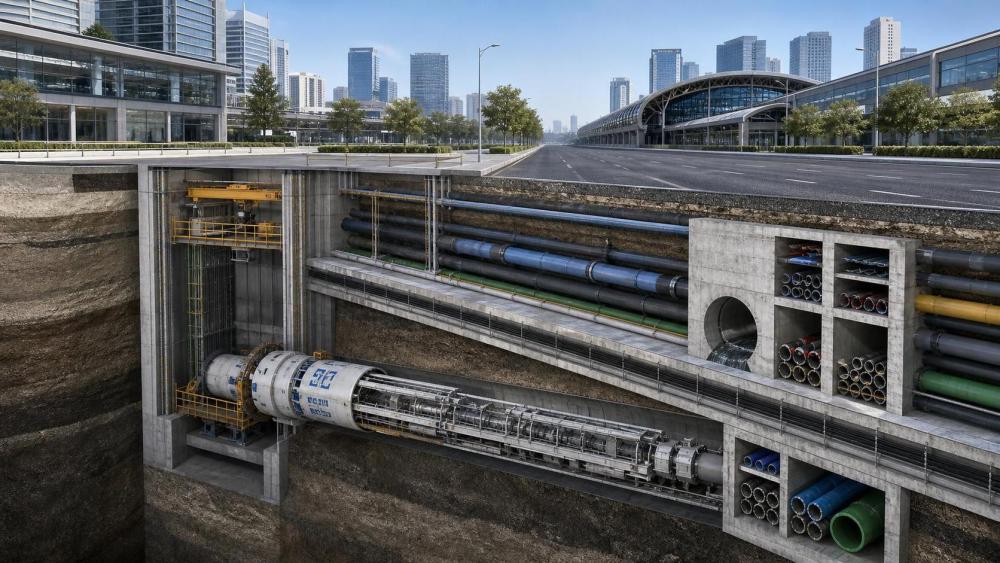
Urban utility corridors are rarely empty. Existing sewers, water mains, power ducts, telecom banks, gas lines, foundations, basements, and abandoned assets can turn open-cut construction into a slow conflict-resolution exercise.
Trenchless Tunnelling is usually the better choice when the proposed utility can be taken below the most crowded zone with controlled launch and reception points. That does not mean “no risk.” It means the risk shifts from constant surface conflict to alignment control, ground behavior, and shaft planning.
Before deciding, check three things:
- How reliable is the utility record set compared with actual survey and potholing results?
- Can the proposed invert pass below the worst congestion without creating unreasonable shaft depth or connection complexity?
- Are there structures with settlement sensitivity along the route?
If your utility mapping is weak, do not assume trenchless is automatically safer. Poor records can hurt either method. The difference is that trenchless needs a cleaner understanding of vertical and horizontal clearances before the drive starts, because mid-course changes are limited.
Look at alignment length and geometry, not just total route distance
Some projects are ideal for pipe jacking or microtunnelling because the route is long enough to justify setup, straight enough to control accurately, and constrained enough that open cut becomes painful. Others fail the trenchless test because the alignment is broken into awkward short segments with too many connections, bends, or intermediate tie-ins.
Ask these questions early:
- Can the route be delivered in practical drives between launch and reception shafts?
- Are connection points limited and manageable?
- Does the design depend on frequent geometry changes that suit open trenching better?
Projects with long, consistent runs under built-up corridors are often good trenchless candidates. Short fragmented utility relocations with constant service tie-ins often are not. The method has to fit the route shape, not just the corridor sensitivity.
Do not separate geotechnical conditions from method selection
Ground conditions do not simply decide whether trenchless is possible. They decide which trenchless method is realistic, how stable the drive will be, what the shaft design becomes, and how much tolerance you have for settlement or face instability.
From a project leadership perspective, the important question is not “Can a machine bore here?” The better question is “Can we control risk here without introducing a bigger schedule or claims problem than open cut would create?”
Ground and groundwater deserve special attention when:
- the route passes under older structures with low tolerance for movement;
- mixed ground is expected;
- high groundwater pressure may complicate shafts or face support;
- obstructions such as old foundations, piles, or buried concrete are likely.
One of the more expensive errors in city utility work is choosing trenchless because the street is crowded, then underinvesting in subsurface investigation. If the route needs trenchless, it also needs better ground intelligence, not less.
Test the shaft strategy before you approve the method
A trenchless route can look elegant on plan and still fail in delivery because launch and reception shafts are badly placed. In city work, shafts are where logistics, neighborhood impact, dewatering, spoil handling, and safety management all show up at once.
You need to know whether there is enough physical room, whether utilities can be protected or diverted around the shaft box, whether crane and spoil movement are realistic, and whether nearby properties can tolerate the construction period.
If shaft sites are only available in highly constrained corners, next to sensitive structures, or inside heavily trafficked junctions, the trenchless advantage can erode quickly. By contrast, if the route is difficult but shafts can be placed in workable zones such as road reserves, utility compounds, or redevelopment parcels, trenchless often becomes much more buildable.
Check whether the real driver is schedule certainty
Some project teams pick trenchless to shorten the schedule. That can be true, but only in the right conditions. The stronger argument is often schedule certainty, especially where open-cut work would be exposed to rolling utility conflicts, traffic staging changes, business access restrictions, or seasonal moratoriums.
If your completion window is tight and the corridor is politically sensitive, a controlled trenchless operation may reduce the number of external variables that can stop the job. The setup is heavier upfront, but the execution path can be cleaner once the drive begins.
Still, do not oversell this internally. Procurement lead time, specialist availability, machine selection, shaft construction, and spoil handling can all add time before tunnelling starts. Trenchless helps most when it removes a long chain of uncertain surface-stage interfaces, not when it is used to wish away front-end planning.
Use a simple decision table before design freeze
Watch for the red flags that mean the decision is being made for the wrong reason
A few patterns show up repeatedly in troubled utility projects:
- The team chooses trenchless because “the city wants minimal disruption,” but there is no realistic shaft plan.
- The alignment is forced too deep just to avoid every existing utility, which then creates difficult downstream connections.
- Open cut is assumed to be cheaper because the method is familiar, while utility relocation and traffic control are still under-scoped.
- Ground investigation is treated as a late-stage design formality instead of a method-selection input.
When those signs appear, the problem is usually not the technology. It is that the delivery model has not been tested against site reality.
What project leaders should decide before moving forward
Before you commit to trenchless or reject it, make sure your team can answer these points clearly:
- What is the biggest project risk: surface disruption, underground conflict, ground behavior, or schedule exposure?
- Does the proposed alignment suit a practical trenchless drive and workable shaft arrangement?
- Have reinstatement, traffic management, and stakeholder constraints been priced realistically in the open-cut alternative?
- Do available surveys and investigations support method selection, or are you still guessing below ground?
If most of the pressure sits above ground, and the route can be driven below the congestion with manageable shafts and controllable geotechnical risk, Trenchless Tunnelling is often the best choice for urban utility projects. If the route is broken, shafts are unworkable, or subsurface uncertainty remains too high, forcing trenchless can create exactly the kind of delivery risk you were trying to avoid.
A sensible sequence is simple: test the corridor constraints, verify the underground picture, prove the shaft sites, and only then compare cost and schedule. In city utility work, that order usually leads to better decisions than starting with the method and trying to make the site fit it.
Related News

How to Evaluate European Drill-and-Blast Tunnelling Contractors for Complex Projects
Drill and blast tunnelling contractors Europe: learn how to assess geology expertise, blast control, equipment reliability, safety, and programme resilience for complex projects.

Which Trenchless Construction Technique Fits Your Utility Crossing Conditions?
Trenchless construction techniques compared for utility crossings: choose HDD, microtunnelling, pipe jacking, or auger boring based on ground, accuracy, access, and risk.

What Is Driving Metro Tunnelling Demand Across Southeast Asia’s Major Cities?
Metro tunnelling Southeast Asia is accelerating as major cities tackle congestion, flooding, and connectivity. Explore the market forces, technical risks, and opportunities shaping demand.

Hard Rock Tunnelling in Australia: Selecting Methods for Variable Ground Conditions
Hard rock tunnelling in Australia: compare TBM, drill-and-blast and hybrid methods to manage variable ground, reduce risk and protect project costs.

Hydropower Tunnel Excavation: Selecting Methods for Variable Rock Conditions
Hydropower tunnel excavation methods for variable rock conditions: compare TBM, drill-and-blast, and hybrid strategies to improve safety, progress, and project control.

How to Select Underground Safety Equipment for Tunnelling by Hazard and Work Zone
Underground Safety Equipment for tunnelling: match protection to hazards, work zones, compliance, and emergency needs with this practical selection guide.

EPB or Slurry Shield? Selecting Soft-Ground Tunnelling Equipment by Soil Conditions
Tunnel Excavation Equipment for soft ground: compare EPB and slurry shields by soil, groundwater, settlement risk, and project logistics to choose confidently.
How to Specify TBM Backup System Parts for Reliable Long-Distance Tunnelling
TBM backup system parts: learn how to specify reliable spares for long-distance tunnelling, reduce downtime, ensure compatibility, and speed underground recovery.

How to Size Open Pit Mining Trucks for Haul Distance, Grade, and Payload?
Open Pit Mining Trucks: learn how to match payload, haul distance, grade, road resistance, and loading capacity for safer, lower-cost mine operations.
Related News
- 00
0000-00
How to Evaluate European Drill-and-Blast Tunnelling Contractors for Complex Projects - 00
0000-00
Which Trenchless Construction Technique Fits Your Utility Crossing Conditions? - 00
0000-00
What Is Driving Metro Tunnelling Demand Across Southeast Asia’s Major Cities? - 00
0000-00
Hard Rock Tunnelling in Australia: Selecting Methods for Variable Ground Conditions - 00
0000-00
Hydropower Tunnel Excavation: Selecting Methods for Variable Rock Conditions
Weekly Insights
Stay ahead with our curated technology reports delivered every Monday.