
Battery Electric Mining Equipment Cost Breakdown: CAPEX, Energy, Maintenance, and ROI





Battery Electric Mining Equipment Cost Breakdown: CAPEX, Energy, Maintenance, and ROI
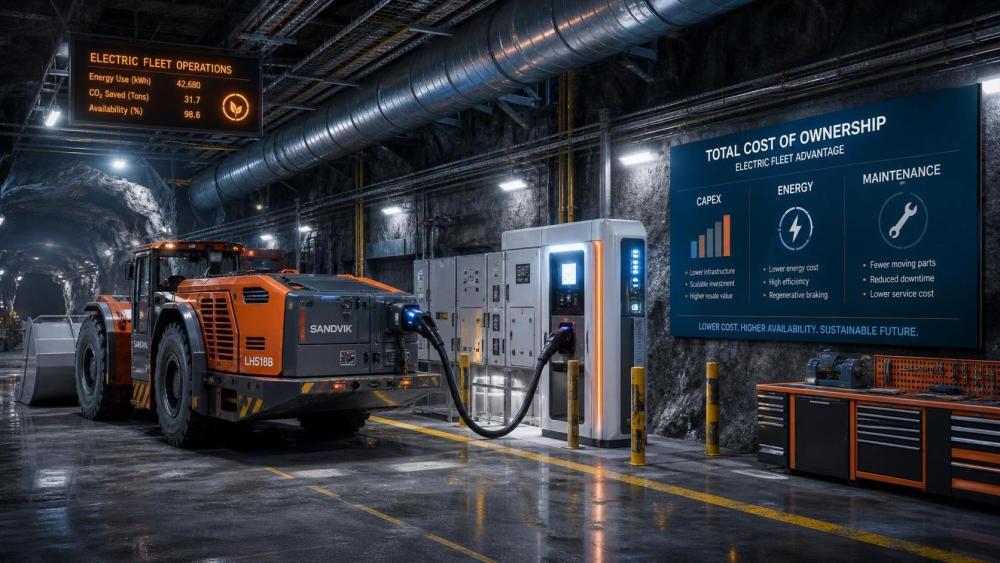
For finance approvers evaluating fleet electrification, understanding battery electric mining equipment cost is essential to making a defensible investment decision.
Purchase price matters, but it is only the starting point.
The bigger picture includes infrastructure, energy use, maintenance, uptime, ventilation savings, and asset productivity across the full operating cycle.
In underground mining, that picture becomes even more important.
Confined spaces, ventilation loads, heat control, and safety compliance can turn a higher upfront spend into a stronger long-term financial case.
This article breaks down battery electric mining equipment cost into practical decision categories, helping teams compare diesel and electric options with clearer assumptions.
Why battery electric mining equipment cost needs a full-cycle view
A common mistake is comparing only machine purchase prices.
That approach often makes battery units look expensive and diesel units look simpler.
In practice, the real battery electric mining equipment cost sits inside total cost of ownership.
That includes direct cash outlays and indirect operating effects.
More clearly, the decision should cover five cost buckets.
- Initial machine CAPEX
- Power and charging infrastructure
- Energy consumption and electricity pricing
- Maintenance, parts, and labor
- Productivity, uptime, and residual value
Once these are modeled together, the cost story usually changes.
That is especially true for underground LHDs, haul trucks, and drilling support fleets working in ventilation-constrained mines.
CAPEX: the most visible part of battery electric mining equipment cost
Upfront CAPEX is usually the first concern in an approval process.
Battery electric machines often carry a premium over diesel equivalents.
That premium reflects battery packs, power electronics, thermal systems, and vehicle control software.
Still, CAPEX should be separated into equipment CAPEX and site CAPEX.
Equipment CAPEX
This includes the machine itself, onboard batteries, charging interface, spare packs if used, and digital monitoring systems.
For some mines, battery-swapping systems add capital but improve availability.
Site CAPEX
This covers charging stations, transformers, substations, cable upgrades, energy management software, and workshop adjustments.
Some operations also need battery handling areas, fire protection upgrades, and technician training spaces.
A useful approval question is simple.
Is the mine buying isolated machines, or building an electrified operating system?
The answer changes the real battery electric mining equipment cost significantly.
Energy cost: where daily savings start to appear
From a finance perspective, energy is one of the easiest variables to model.
Diesel price exposure is familiar, but often volatile.
Electricity pricing can also vary, yet it is usually more predictable under long-term contracts.
That predictability helps budgeting and scenario planning.
How to compare energy cost correctly
- Measure diesel cost per operating hour and per ton moved
- Measure electric cost per kilowatt-hour and charging losses
- Include peak demand charges where relevant
- Account for regenerative braking benefits on declines
- Adjust for seasonal ventilation and cooling loads
In many underground mines, the financial impact goes beyond fuel replacement.
Battery fleets can lower ventilation demand because they remove diesel exhaust and reduce heat in active headings.
That can reduce fan energy, air handling costs, and future ventilation expansion spending.
So when estimating battery electric mining equipment cost, energy should include both charging power and ventilation offsets.
Maintenance cost: often the strongest operating advantage
Maintenance is where many electric fleet cases become compelling.
Battery electric drivetrains have fewer moving parts than diesel systems.
They avoid engine oil changes, fuel system servicing, exhaust treatment repairs, and some transmission-related wear.
This usually lowers both planned maintenance and unplanned downtime.
Typical maintenance savings areas
- No engine overhauls
- Lower fluid and filter consumption
- Reduced brake wear through regeneration
- Less heat stress on nearby components
- Better condition monitoring through onboard diagnostics
However, the maintenance picture is not one-sided.
Battery systems require thermal management, software support, electrical safety procedures, and eventual pack replacement planning.
That means the maintenance model should shift, not simply shrink.
The best budgeting approach is to compare lifecycle service cost by hour, not only annual workshop invoices.
The hidden variables inside battery electric mining equipment cost
Several cost drivers are easy to miss during procurement reviews.
Yet these hidden variables often decide whether ROI arrives in year two or year five.
Battery replacement timing
Battery degradation depends on duty cycle, charging behavior, ambient heat, and depth of discharge.
A realistic model should include expected replacement year, residual battery value, and second-life or recycling pathways.
Utilization rate
A high-utilization machine recovers premium CAPEX faster.
A lightly used support unit may not justify the same investment pace.
Charging strategy
Fast charging, opportunity charging, and battery swapping produce different labor patterns and infrastructure costs.
The right method depends on haul distance, shift pattern, and mine layout.
Ventilation deferral value
For deeper mines, delayed ventilation expansion can be a major economic benefit.
That value should appear in the business case, not stay hidden in engineering notes.
A practical ROI framework for finance decisions
A strong approval case needs more than a technology narrative.
It needs a disciplined ROI framework with transparent assumptions.
In practical terms, the model should test base, upside, and downside cases.
Key ROI inputs
- Incremental purchase premium versus diesel
- Infrastructure investment by phase
- Annual energy savings
- Annual maintenance savings
- Ventilation and cooling savings
- Downtime reduction and productivity uplift
- Battery replacement and residual assumptions
This approach gives a more credible view of battery electric mining equipment cost over five to ten years.
It also helps explain why similar equipment can produce very different payback periods across different mines.
Simple decision table
How to reduce procurement risk before approval
A careful process can improve results before purchase orders are issued.
This is where many strong projects separate themselves from expensive pilots.
- Model cost by application, not by fleet average.
- Match charging strategy to shift design and traffic flow.
- Request battery warranty terms in operating-hour language.
- Include ventilation engineers in financial modeling.
- Stress-test electricity tariffs and diesel volatility.
- Check OEM support depth for software and safety training.
These steps make the battery electric mining equipment cost discussion more grounded and easier to defend internally.
Final takeaway
Battery electric mining equipment cost is not just a higher sticker price.
It is a layered financial equation shaped by CAPEX, infrastructure, energy, maintenance, ventilation, and utilization.
For underground operations, the most valuable insight is often indirect.
Cleaner fleets can improve cost stability, reduce operating constraints, and support longer-term mine development strategies.
In real procurement work, the best decision comes from comparing lifecycle economics, not headline prices.
When that analysis is done carefully, battery electric mining equipment cost becomes easier to justify, easier to manage, and more likely to deliver measurable ROI.
Related News

How to Evaluate European Drill-and-Blast Tunnelling Contractors for Complex Projects
Drill and blast tunnelling contractors Europe: learn how to assess geology expertise, blast control, equipment reliability, safety, and programme resilience for complex projects.

Which Trenchless Construction Technique Fits Your Utility Crossing Conditions?
Trenchless construction techniques compared for utility crossings: choose HDD, microtunnelling, pipe jacking, or auger boring based on ground, accuracy, access, and risk.

What Is Driving Metro Tunnelling Demand Across Southeast Asia’s Major Cities?
Metro tunnelling Southeast Asia is accelerating as major cities tackle congestion, flooding, and connectivity. Explore the market forces, technical risks, and opportunities shaping demand.

Hard Rock Tunnelling in Australia: Selecting Methods for Variable Ground Conditions
Hard rock tunnelling in Australia: compare TBM, drill-and-blast and hybrid methods to manage variable ground, reduce risk and protect project costs.

Hydropower Tunnel Excavation: Selecting Methods for Variable Rock Conditions
Hydropower tunnel excavation methods for variable rock conditions: compare TBM, drill-and-blast, and hybrid strategies to improve safety, progress, and project control.

How to Select Underground Safety Equipment for Tunnelling by Hazard and Work Zone
Underground Safety Equipment for tunnelling: match protection to hazards, work zones, compliance, and emergency needs with this practical selection guide.

EPB or Slurry Shield? Selecting Soft-Ground Tunnelling Equipment by Soil Conditions
Tunnel Excavation Equipment for soft ground: compare EPB and slurry shields by soil, groundwater, settlement risk, and project logistics to choose confidently.

How to Specify TBM Backup System Parts for Reliable Long-Distance Tunnelling
TBM backup system parts: learn how to specify reliable spares for long-distance tunnelling, reduce downtime, ensure compatibility, and speed underground recovery.
How to Size Open Pit Mining Trucks for Haul Distance, Grade, and Payload?
Open Pit Mining Trucks: learn how to match payload, haul distance, grade, road resistance, and loading capacity for safer, lower-cost mine operations.
Related News
- 00
0000-00
How to Evaluate European Drill-and-Blast Tunnelling Contractors for Complex Projects - 00
0000-00
Which Trenchless Construction Technique Fits Your Utility Crossing Conditions? - 00
0000-00
What Is Driving Metro Tunnelling Demand Across Southeast Asia’s Major Cities? - 00
0000-00
Hard Rock Tunnelling in Australia: Selecting Methods for Variable Ground Conditions - 00
0000-00
Hydropower Tunnel Excavation: Selecting Methods for Variable Rock Conditions
Weekly Insights
Stay ahead with our curated technology reports delivered every Monday.