
U.S. Cuts EV Mining Truck Battery Module Tariff





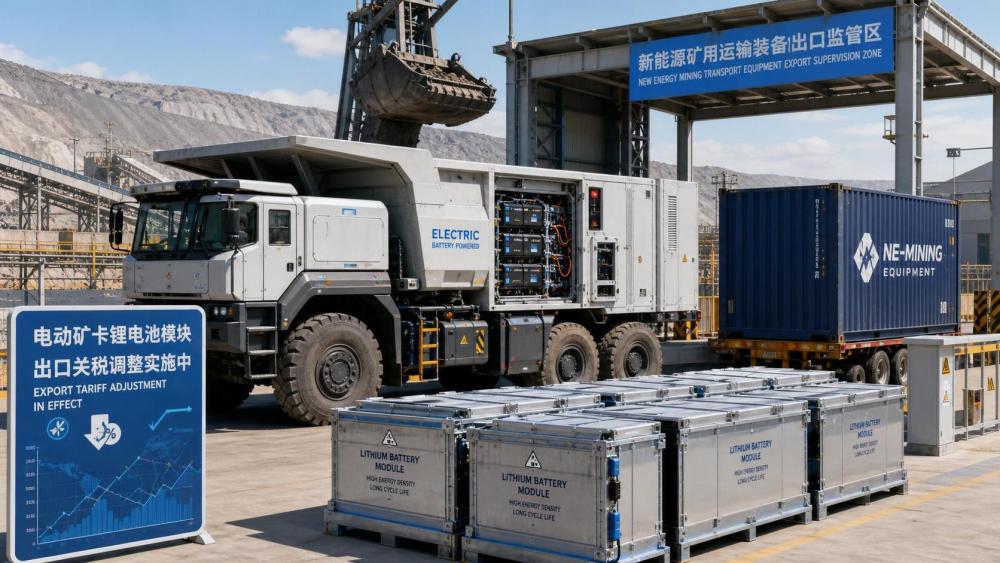
On June 17, 2026, the Office of the United States Trade Representative (USTR) announced a tariff adjustment that matters directly to the import economics of electric mining transport equipment. Effective July 1, the most-favored-nation rate on lithium battery modules under HTS Code 8507.60 will be reduced from 7.5% to 6.6% for core powertrain components of EV mining trucks originating in China. For importers, equipment buyers, and supply chain service providers, the significance is not only the lower duty rate itself, but also the expected 12% reduction in total customs clearance costs for complete units and an average clearance time shortened by 2.3 working days.
What Has Been Officially Confirmed
According to the information provided, USTR made the announcement on June 17, 2026, and the new rate will take effect on July 1. The adjustment applies to lithium battery modules classified under HTS Code 8507.60 and specifically covers core power system components used in EV mining trucks when those goods originate in China.
The confirmed rate change is a reduction in the most-favored-nation tariff from 7.5% to 6.6%. The same information states that the change is expected to lower the overall customs clearance cost of imported complete vehicles by about 12% and shorten average customs processing time by 2.3 working days.
The adjustment is described as a phased outcome of China-U.S. trade consultations, and its stated scope clearly includes pure electric mining transport equipment, where rigid demand is noted in the source information.
Where the Impact Is Likely to Be Felt First
Import planning becomes more time-sensitive
From an industry perspective, direct importers of EV mining truck systems or complete units are likely to feel the immediate effect in landed-cost calculations and delivery scheduling. A lower tariff rate, combined with shorter average clearance time, can influence how shipments are timed around the July 1 effective date and how procurement teams compare near-term import batches.
Equipment buyers may reassess purchasing rhythm
For procurement-side participants focused on pure electric mining transport equipment, the development may affect budgeting and order timing. Analysis shows that even when the tariff change applies to a specific component category, the expected reduction in complete-unit clearance cost makes it relevant to buyers evaluating total import expense rather than component cost alone.
Supply chain service providers need sharper execution
Customs brokers, freight operators, and related service providers may be affected through documentation handling, classification accuracy, and timing coordination. What deserves closer attention is whether shipment documents, product descriptions, and origin-related materials are fully aligned with the announced scope, since the practical benefit depends on compliant execution rather than policy wording alone.
Upstream and assembly-side coordination may tighten
For manufacturers and processing or assembly businesses linked to EV mining truck power systems, the change may influence quotation structures, delivery commitments, and customer communication. Observably, the policy matters not only at the border, but also in how suppliers and customers allocate cost savings expectations across contracts and delivery windows.
What Companies Should Watch Closely Now
Confirm whether products fall squarely within the stated scope
Companies should pay close attention to whether their products are correctly classified under HTS Code 8507.60 and whether they fit the stated coverage of core powertrain components for EV mining trucks originating in China. This is a practical issue because the announced rate change is scope-specific.
Separate policy language from operational execution
Analysis shows that a published tariff reduction and an actual reduction in clearance cost are related but not identical. Businesses should focus on the operational conditions required for implementation, including product documentation, customs filing consistency, and internal review of shipment materials before the July 1 effective date.
Revisit delivery schedules and customer communication
With an expected reduction in average customs clearance time of 2.3 working days, companies involved in procurement, delivery, and after-sales coordination may need to update timing assumptions. What deserves closer attention is how to communicate revised delivery expectations without treating the announced average as a guaranteed result for every shipment.
Track follow-up wording from official channels
Because the adjustment is described as a phased outcome of trade consultations, businesses should continue monitoring whether any additional clarifications, implementation notes, or scope interpretations emerge from official channels. This matters especially for companies with ongoing orders or repeated shipment cycles.
How This Signal Should Be Read
Observably, this development can be read as a concrete short-term cost and clearance adjustment for a clearly identified product area, but not yet as proof of a broader structural shift beyond the stated scope. The fact pattern is specific: a tariff reduction, a defined HTS code, a named application in EV mining truck power systems, and expected customs-related gains beginning July 1.
Analysis shows that the more durable significance lies in the combination of tariff relief and faster customs handling for equipment linked to rigid demand in pure electric mining transport. At the same time, it is more appropriate to understand this as a policy signal that still requires continued observation, especially regarding execution consistency and any later expansion, clarification, or limitation of scope.
Why the Industry Is Paying Attention
This update stands out because it connects trade policy, import cost, and delivery timing in one targeted adjustment. For market participants in EV mining trucks, the immediate relevance is practical rather than abstract: customs cost assumptions, import scheduling, and cross-border coordination may all need recalibration.
At this stage, it is more appropriate to understand the news as a defined and actionable near-term change with broader signaling value, rather than as a final indicator of long-term policy direction. The confirmed benefits are specific, while the wider implications still warrant careful follow-up.
Basis of This Article
This article is based on the user-provided news title, event date, and event summary concerning the U.S. tariff reduction for EV mining truck battery modules and the expected decline in customs clearance costs. No additional unverified data, company information, market size figures, or external policy details have been added.
For this type of industry update, commonly relevant source categories may include official government announcements, company disclosures, industry association releases, authoritative media coverage, and standard-related documentation. A specific official source link was not provided in the input, so further verification remains necessary. Follow-up attention should remain on official wording, scope interpretation, and implementation details after the July 1 effective date.
Related News

How to Evaluate European Drill-and-Blast Tunnelling Contractors for Complex Projects
Drill and blast tunnelling contractors Europe: learn how to assess geology expertise, blast control, equipment reliability, safety, and programme resilience for complex projects.

Which Trenchless Construction Technique Fits Your Utility Crossing Conditions?
Trenchless construction techniques compared for utility crossings: choose HDD, microtunnelling, pipe jacking, or auger boring based on ground, accuracy, access, and risk.

What Is Driving Metro Tunnelling Demand Across Southeast Asia’s Major Cities?
Metro tunnelling Southeast Asia is accelerating as major cities tackle congestion, flooding, and connectivity. Explore the market forces, technical risks, and opportunities shaping demand.

Hard Rock Tunnelling in Australia: Selecting Methods for Variable Ground Conditions
Hard rock tunnelling in Australia: compare TBM, drill-and-blast and hybrid methods to manage variable ground, reduce risk and protect project costs.

Hydropower Tunnel Excavation: Selecting Methods for Variable Rock Conditions
Hydropower tunnel excavation methods for variable rock conditions: compare TBM, drill-and-blast, and hybrid strategies to improve safety, progress, and project control.

How to Select Underground Safety Equipment for Tunnelling by Hazard and Work Zone
Underground Safety Equipment for tunnelling: match protection to hazards, work zones, compliance, and emergency needs with this practical selection guide.

EPB or Slurry Shield? Selecting Soft-Ground Tunnelling Equipment by Soil Conditions
Tunnel Excavation Equipment for soft ground: compare EPB and slurry shields by soil, groundwater, settlement risk, and project logistics to choose confidently.

How to Specify TBM Backup System Parts for Reliable Long-Distance Tunnelling
TBM backup system parts: learn how to specify reliable spares for long-distance tunnelling, reduce downtime, ensure compatibility, and speed underground recovery.

How to Size Open Pit Mining Trucks for Haul Distance, Grade, and Payload?
Open Pit Mining Trucks: learn how to match payload, haul distance, grade, road resistance, and loading capacity for safer, lower-cost mine operations.
Related News
- 00
0000-00
How to Evaluate European Drill-and-Blast Tunnelling Contractors for Complex Projects - 00
0000-00
Which Trenchless Construction Technique Fits Your Utility Crossing Conditions? - 00
0000-00
What Is Driving Metro Tunnelling Demand Across Southeast Asia’s Major Cities? - 00
0000-00
Hard Rock Tunnelling in Australia: Selecting Methods for Variable Ground Conditions - 00
0000-00
Hydropower Tunnel Excavation: Selecting Methods for Variable Rock Conditions
Weekly Insights
Stay ahead with our curated technology reports delivered every Monday.