
TBM Export Certification Fast Track Launched at 2026 GBA Expo





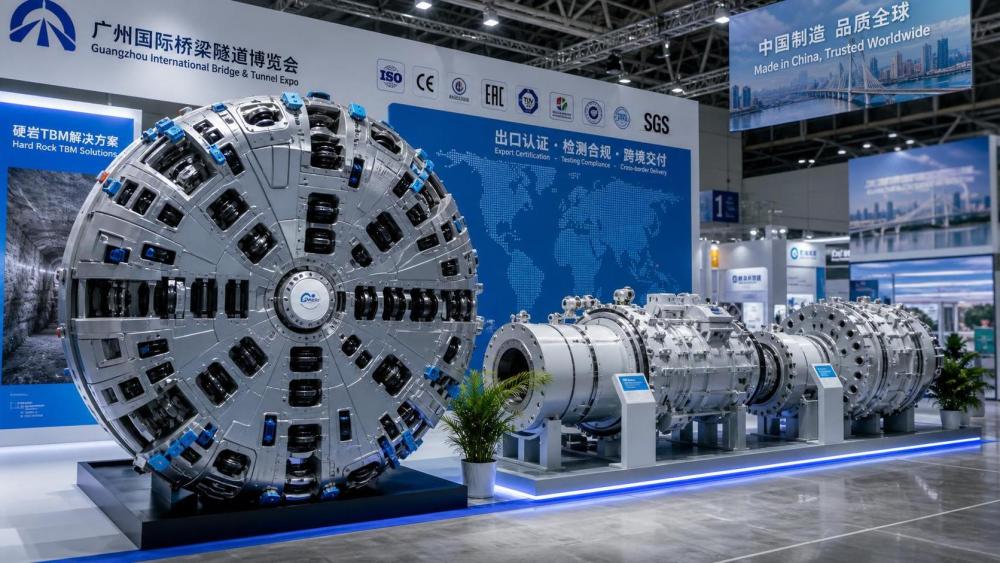
At the Greater Bay Area International Bridge and Tunnel Expo held in Guangzhou from June 24 to 26, 2026, a new fast-track certification channel for TBM exports was announced on the opening day. For manufacturers targeting overseas delivery of Hard Rock TBMs and Slurry/EPB Shields, the update is worth attention because it directly touches compliance timing, document processing, and coordination with export-market requirements rather than only product exhibition activity.
What Was Announced in Guangzhou
According to the event information provided, the Greater Bay Area International Bridge and Tunnel Expo took place in Guangzhou from June 24 to 26, 2026. On the first day of the exhibition, the China Construction Machinery Association, together with SGS and TÜV Rheinland, announced the launch of a “TBM export certification green channel.”
The arrangement is described as offering approved Chinese manufacturers parallel CE/ASME/GB dual-standard testing, certificate issuance within 72 hours, and direct filing access with embassies in China representing export destination countries. The scope stated in the event summary covers mainstream machine categories including Hard Rock TBMs and Slurry/EPB Shields.
Why Different Parts of the Value Chain May Watch This Closely
Export-facing TBM manufacturers
From an industry perspective, manufacturers are the most directly affected group because the announcement is tied to export certification workflow. The practical impact, if implemented as described, would center on how quickly companies can complete compliance checks, prepare outbound documentation, and align machine deliveries with overseas customer schedules.
Testing, inspection, and compliance service providers
For service providers involved in product testing, certification, and technical file preparation, the launch points to possible changes in how projects are sequenced and coordinated. What deserves closer attention is whether parallel handling of CE, ASME, and GB-related requirements changes document preparation standards, internal review timing, or communication responsibilities among participating parties.
Overseas buyers and project procurement teams
For procurement teams and end users evaluating Chinese-made TBMs, the development may matter because certification speed and embassy filing procedures can affect contract confidence and project mobilization planning. Observably, buyers will still need to distinguish between a faster procedural channel and the full set of project-specific technical, legal, and acceptance requirements attached to each order.
Supply chain and delivery coordinators
Supply chain service companies, logistics planners, and contract execution teams may also follow this closely. If certification lead times become more predictable for approved manufacturers, the main business implication would be on shipment scheduling, customs preparation, and delivery communication rather than on machine design itself.
What Companies Should Track Next
Eligibility and review conditions
The announcement applies to manufacturers that pass the relevant review. Companies should therefore pay close attention to how approval conditions are defined in later official wording, because access to the green channel appears to depend on prior qualification rather than universal participation.
Scope of standards and document readiness
Businesses involved in TBM exports should review how they currently prepare materials linked to CE, ASME, and GB requirements. Analysis shows that the immediate operational question is not only whether testing can run in parallel, but whether technical files, product records, and supporting documents are already organized well enough to benefit from a shorter certification window.
Embassy filing versus actual market entry
What deserves closer attention is the distinction between direct embassy filing access and final commercial execution in the destination market. Companies should avoid treating a faster filing path as identical to full market clearance, contract acceptance, or project approval in every export destination.
Customer communication and delivery commitments
Manufacturers and traders may also need to adjust how they communicate lead times to customers. If they reference the 72-hour certificate issuance arrangement in negotiations, they should be careful to separate certification timing from production readiness, transport planning, and project-side acceptance steps.
How This News Is Best Interpreted for Now
Analysis shows that this announcement is more meaningful as a process and compliance signal than as proof of immediate market expansion. The confirmed fact is that a green channel has been launched with stated services and coverage; what remains to be observed is how widely manufacturers can access it, how consistently it operates in practice, and how export markets respond to documents processed through this route.
It is more appropriate to understand this as a near-term operational development with possible longer-term implications. In the short run, it may affect certification coordination and export preparation. In the longer run, the industry will likely watch whether this becomes a stable mechanism that influences buyer confidence and overseas execution efficiency for Chinese TBM suppliers.
A Practical Reading of the Signal
At this stage, the launch of the TBM export certification green channel should be read as a targeted development in export compliance support for Chinese manufacturers rather than as a complete change in international market conditions. The clearest industry significance lies in certification workflow, documentation efficiency, and cross-border coordination. A neutral reading is that the move deserves attention now, while its full commercial effect still requires continued observation.
Basis of This Article and Ongoing Verification
This article is based on the user-provided news title, event date, and event summary regarding the 2026 Greater Bay Area International Bridge and Tunnel Expo and the launch of the TBM export certification green channel. For reporting of this kind, commonly relevant source types may include official announcements, company statements, industry association releases, authoritative media coverage, and documents issued by standards or certification bodies.
A specific official source link was not provided in the input, so further verification remains necessary. Continued observation should focus on any later official clarification regarding review criteria, operating rules, applicable documentation, and the practical execution of the certification and filing process.
Related News

How to Evaluate European Drill-and-Blast Tunnelling Contractors for Complex Projects
Drill and blast tunnelling contractors Europe: learn how to assess geology expertise, blast control, equipment reliability, safety, and programme resilience for complex projects.

Which Trenchless Construction Technique Fits Your Utility Crossing Conditions?
Trenchless construction techniques compared for utility crossings: choose HDD, microtunnelling, pipe jacking, or auger boring based on ground, accuracy, access, and risk.

What Is Driving Metro Tunnelling Demand Across Southeast Asia’s Major Cities?
Metro tunnelling Southeast Asia is accelerating as major cities tackle congestion, flooding, and connectivity. Explore the market forces, technical risks, and opportunities shaping demand.

Hard Rock Tunnelling in Australia: Selecting Methods for Variable Ground Conditions
Hard rock tunnelling in Australia: compare TBM, drill-and-blast and hybrid methods to manage variable ground, reduce risk and protect project costs.

Hydropower Tunnel Excavation: Selecting Methods for Variable Rock Conditions
Hydropower tunnel excavation methods for variable rock conditions: compare TBM, drill-and-blast, and hybrid strategies to improve safety, progress, and project control.

How to Select Underground Safety Equipment for Tunnelling by Hazard and Work Zone
Underground Safety Equipment for tunnelling: match protection to hazards, work zones, compliance, and emergency needs with this practical selection guide.

EPB or Slurry Shield? Selecting Soft-Ground Tunnelling Equipment by Soil Conditions
Tunnel Excavation Equipment for soft ground: compare EPB and slurry shields by soil, groundwater, settlement risk, and project logistics to choose confidently.

How to Specify TBM Backup System Parts for Reliable Long-Distance Tunnelling
TBM backup system parts: learn how to specify reliable spares for long-distance tunnelling, reduce downtime, ensure compatibility, and speed underground recovery.

How to Size Open Pit Mining Trucks for Haul Distance, Grade, and Payload?
Open Pit Mining Trucks: learn how to match payload, haul distance, grade, road resistance, and loading capacity for safer, lower-cost mine operations.
Related News
- 00
0000-00
How to Evaluate European Drill-and-Blast Tunnelling Contractors for Complex Projects - 00
0000-00
Which Trenchless Construction Technique Fits Your Utility Crossing Conditions? - 00
0000-00
What Is Driving Metro Tunnelling Demand Across Southeast Asia’s Major Cities? - 00
0000-00
Hard Rock Tunnelling in Australia: Selecting Methods for Variable Ground Conditions - 00
0000-00
Hydropower Tunnel Excavation: Selecting Methods for Variable Rock Conditions
Weekly Insights
Stay ahead with our curated technology reports delivered every Monday.