
West Harbour Tunnel Opens New TBM Compliance Signal





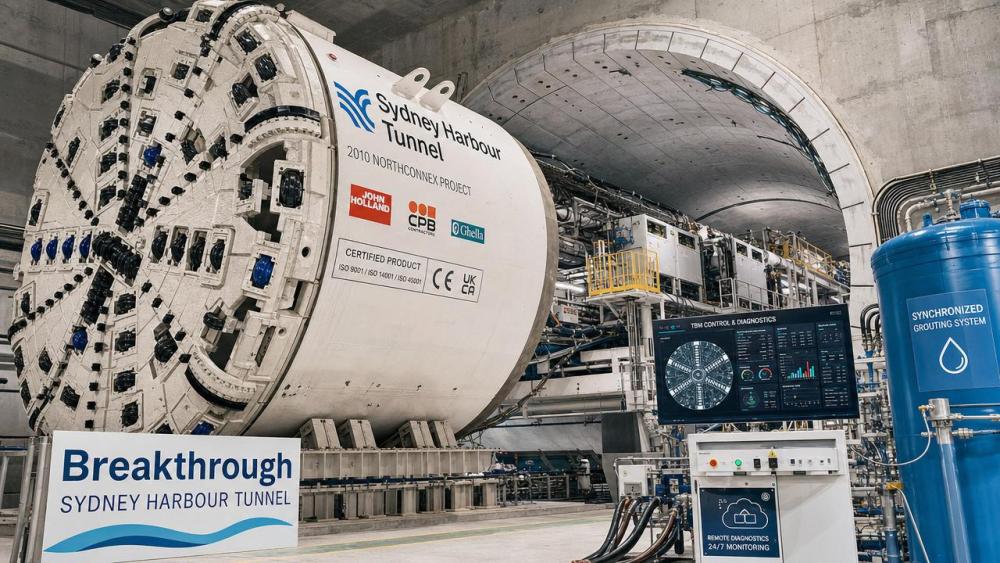
On June 10, 2026, the completion of full tunnelling on Sydney’s West Harbour Tunnel by the slurry shield TBM “Linghang” drew attention beyond project delivery itself. The more consequential signal for the market is that the machine became the first Chinese-made TBM to obtain full certification under AS/NZS 4341:2025, a standards-based threshold that can affect equipment qualification, procurement review, technical documentation, certification readiness, and cross-border delivery expectations for participants linked to high-end infrastructure works in Australia and New Zealand.
A confirmed shift in market access conditions
According to the provided information, “Linghang,” developed by CCCC Tianhe, completed the full excavation of the West Harbour Tunnel in Sydney on June 10, 2026. The machine is identified as the first Chinese-produced TBM to pass the full AS/NZS 4341:2025 certification in Australia.
The certification is described as covering 12 stringent indicators, including cutterhead seal pressure resistance, synchronous grouting accuracy, and remote fault diagnostics. Based on the provided event summary, this result marks the formal entry of Chinese slurry shields into the access threshold for high-end infrastructure projects in the Australia-New Zealand market.
Where the compliance effect may be felt first
Technical qualification is likely to become more central in bidding
From an industry perspective, equipment manufacturers and exporters may be affected first because certification under a named standard can move technical eligibility closer to the front of procurement and pre-award review. What deserves closer attention is whether future technical bid alignment, product dossiers, testing records, and compliance statements increasingly need to map directly to AS/NZS 4341:2025 requirements.
Procurement teams may face a narrower screening focus
For buyers, project procurement units, and contractors, the practical impact may appear in supplier screening and equipment comparison. Analysis shows that once a full-certification case is visible in the market, purchasing discussions may pay more attention to whether critical functions such as sealing performance, grouting precision, and remote diagnostics can be evidenced through certification documents, technical submissions, or acceptance materials.
Certification and testing service providers may see more detailed requests
Certification-related firms and testing service providers may also be affected because market participants often respond to a completed certification case by reviewing documentation depth, test scope, and evidence consistency. The likely pressure point is not only whether a machine can meet a requirement, but whether the supporting file set is complete enough for tender review, project approval, delivery acceptance, and later traceability.
After-sales and delivery support may receive closer scrutiny
For service providers involved in commissioning, fault response, and lifecycle support, remote fault diagnostics being included within the certified indicators is worth watching. Observably, this can shift attention toward how post-delivery support capability is described in contracts, handover files, and service commitments, even if the provided information does not confirm any new mandatory execution rule yet.
What companies should watch now
Check whether certification evidence is presentation-ready
Analysis shows that manufacturers and export teams should pay close attention to how certification-related materials are organized for external review. The event does not disclose detailed execution procedures, so it is more appropriate to focus on whether technical files, test records, and compliance narratives are ready for tender, customer review, and delivery-stage verification rather than assuming a uniform market practice is already in place.
Follow future wording in tenders and specifications
What deserves closer attention is whether upcoming procurement documents, specification clauses, or qualification checklists begin to reference full-standard alignment more explicitly. Companies active in this segment should monitor whether certification becomes a preferred condition, a comparative advantage, or a more direct entry requirement in actual project documents.
Review supply-chain readiness against certified functions
Because the provided summary highlights cutterhead seal pressure resistance, synchronous grouting accuracy, and remote fault diagnostics, firms should examine whether upstream components, integration quality, and supporting technical documentation are consistent with those kinds of assessed functions. This is not yet proof of a broader rule change across all projects, but it is a practical compliance checkpoint.
Prepare for tighter delivery and traceability expectations
Exporters, delivery teams, and after-sales units should also watch for possible changes in document handling, acceptance support, and quality traceability expectations. Observably, once a market begins to recognize full certification under a specific standard, buyers may place greater weight on document completeness and post-delivery response capability alongside the machine itself.
Why this looks more like an execution signal than a one-off milestone
Analysis shows that this development is better understood as an execution signal tied to standards-based market access rather than as a standalone construction achievement. The confirmed fact is the completion of tunnelling and the full AS/NZS 4341:2025 certification of a Chinese-made TBM. The broader industry meaning lies in the visible proof that compliance with a demanding standard can become part of the commercial pathway into high-end infrastructure work.
At the same time, it remains too early to treat this event alone as a settled rule change across all procurement and delivery scenarios. Observably, the market still needs to watch how certification language appears in future tenders, how review criteria are applied in practice, and how industry participants respond in specification drafting, supplier qualification, and project execution.
How the market may best read this development
A cautious reading is that the event confirms a concrete compliance benchmark has already been met in practice by a Chinese slurry shield TBM in the Australia-New Zealand high-end infrastructure context. For industry participants, the value of the news is less about headline celebration and more about what it indicates for qualification thresholds, documentation discipline, and supplier readiness.
It is more appropriate to understand this as a market-access signal with practical compliance implications, while continuing to observe how standards application, tender wording, and project-side review expectations develop after this case.
Basis of this article and items still requiring verification
This article is generated from the user-provided news title, event date, and event summary. For developments of this kind, commonly relevant source types may include official announcements, regulator releases, trade or customs authority information, industry association updates, standard-setting organization documents, and reporting by authoritative media. No specific official source link was provided in the input, so the precise official documentation still requires ongoing verification.
Further observation is still needed on detailed implementation language, certification interpretation in project practice, changes in tender documents, industry feedback, and how companies incorporate these requirements into qualification, delivery, and after-sales execution.
Related News

How to Evaluate European Drill-and-Blast Tunnelling Contractors for Complex Projects
Drill and blast tunnelling contractors Europe: learn how to assess geology expertise, blast control, equipment reliability, safety, and programme resilience for complex projects.

Which Trenchless Construction Technique Fits Your Utility Crossing Conditions?
Trenchless construction techniques compared for utility crossings: choose HDD, microtunnelling, pipe jacking, or auger boring based on ground, accuracy, access, and risk.

What Is Driving Metro Tunnelling Demand Across Southeast Asia’s Major Cities?
Metro tunnelling Southeast Asia is accelerating as major cities tackle congestion, flooding, and connectivity. Explore the market forces, technical risks, and opportunities shaping demand.

Hard Rock Tunnelling in Australia: Selecting Methods for Variable Ground Conditions
Hard rock tunnelling in Australia: compare TBM, drill-and-blast and hybrid methods to manage variable ground, reduce risk and protect project costs.

Hydropower Tunnel Excavation: Selecting Methods for Variable Rock Conditions
Hydropower tunnel excavation methods for variable rock conditions: compare TBM, drill-and-blast, and hybrid strategies to improve safety, progress, and project control.

How to Select Underground Safety Equipment for Tunnelling by Hazard and Work Zone
Underground Safety Equipment for tunnelling: match protection to hazards, work zones, compliance, and emergency needs with this practical selection guide.

EPB or Slurry Shield? Selecting Soft-Ground Tunnelling Equipment by Soil Conditions
Tunnel Excavation Equipment for soft ground: compare EPB and slurry shields by soil, groundwater, settlement risk, and project logistics to choose confidently.

How to Specify TBM Backup System Parts for Reliable Long-Distance Tunnelling
TBM backup system parts: learn how to specify reliable spares for long-distance tunnelling, reduce downtime, ensure compatibility, and speed underground recovery.

How to Size Open Pit Mining Trucks for Haul Distance, Grade, and Payload?
Open Pit Mining Trucks: learn how to match payload, haul distance, grade, road resistance, and loading capacity for safer, lower-cost mine operations.
Related News
- 00
0000-00
How to Evaluate European Drill-and-Blast Tunnelling Contractors for Complex Projects - 00
0000-00
Which Trenchless Construction Technique Fits Your Utility Crossing Conditions? - 00
0000-00
What Is Driving Metro Tunnelling Demand Across Southeast Asia’s Major Cities? - 00
0000-00
Hard Rock Tunnelling in Australia: Selecting Methods for Variable Ground Conditions - 00
0000-00
Hydropower Tunnel Excavation: Selecting Methods for Variable Rock Conditions
Weekly Insights
Stay ahead with our curated technology reports delivered every Monday.