
Smart Underground Mining Analytics: Using Equipment Data to Reduce Downtime





Smart Underground Mining Analytics: Using Equipment Data to Reduce Downtime
Unexpected equipment downtime can disrupt production schedules, inflate maintenance costs, and put underground mining projects at risk. Smart underground mining analytics helps turn equipment data into actionable insights, revealing early signs of component wear, recurring faults, and inefficient operating patterns. By connecting data from drilling jumbos, underground LHD loaders, and other critical assets, teams can prioritize maintenance, improve equipment availability, and make better-informed decisions. The challenge is turning those signals into decisions that can be acted on before the next interruption.
Start with the interruption, not the dashboard
An underground operation can collect thousands of equipment signals and still struggle to explain why a development heading missed its schedule. A fault code may identify a hydraulic pressure alarm, but it does not automatically show whether the machine stopped because of a failing component, a damaged hose, an operating condition, or a sensor problem.
The starting point is a specific interruption with consequences. A jumbo that repeatedly loses drilling time at a critical heading deserves a different investigation from a loader whose availability is high but whose haul cycles are consistently longer than planned. The first issue may point toward equipment reliability; the second could involve road conditions, traffic, charging arrangements, or dispatch practices.
Before selecting an analytics tool, agree on the decision it should support. Is the team trying to schedule a hydraulic inspection, identify the cause of recurring stops, or determine whether another loader is needed to protect the development plan? Each question requires different data, different expertise, and a different measure of success.
Connect equipment signals to the work underground
Useful analysis combines machine data with maintenance records and operational context. Engine or motor hours, temperatures, pressures, fault codes, and component states can indicate what the machine was experiencing. Work orders and technician notes help explain what was found. Shift reports, location, operating mode, and production plans help establish why the interruption mattered.
That context is important because underground equipment rarely works under stable conditions. Rock hardness, gradients, ventilation, water, road condition, and operator practices can all change the load on a machine. A pressure increase during a demanding drilling cycle is not necessarily a defect. The same increase during comparable cycles over several shifts, accompanied by rising temperature or repeated alarms, is a more useful reason to investigate.
A practical data flow starts at the machine, preserves timestamps when the network is unavailable, and links events to a common asset identifier. Once the data reaches a usable system, analysts can compare it with maintenance history and operating conditions. The output should be a decision with an owner, such as an inspection before the next planned service window, rather than another unexplained alert.
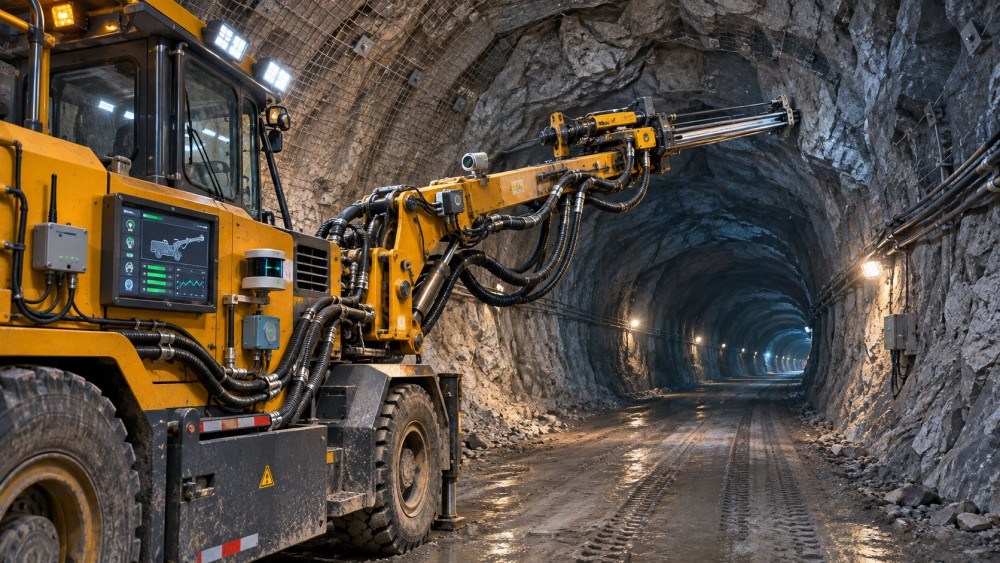
Drilling jumbos: separate machine faults from ground conditions
For a drilling jumbo, relevant signals may include percussion and feed pressures, hydraulic oil temperature, drill cycle duration, fault history, and utilization by operating mode. If available, hole depth and drilling parameters add context. Maintenance records can show whether similar alarms preceded a hose replacement, cooling-system repair, or other intervention.
The interpretation still needs a person who understands the heading. Longer drilling cycles may reflect changing ground rather than deteriorating equipment. Comparing the same machine across broadly similar tasks, then reviewing differences with operators and maintenance staff, is often more useful than comparing raw averages across an entire fleet.
Look for combinations rather than isolated readings. A recurring temperature alarm after extended drilling, for example, warrants a check of cooling-system condition and operating circumstances. It does not, by itself, prove that a component is failing or justify an automatic replacement.
Underground LHDs: distinguish reliability from cycle losses
An LHD may spend time loading, hauling, waiting, dumping, traveling empty, charging or refueling, and undergoing maintenance. Treating all non-hauling time as equipment downtime conceals the actual problem. A loader waiting for access to a drawpoint may be mechanically available even though the production cycle is delayed.
For battery-electric machines, battery state of charge, temperature, charging or swap events, and energy use can help explain whether the energy system fits the duty cycle. These readings should be interpreted alongside gradients, payload, travel distance, and machine availability. A change in energy consumption may reflect a longer or steeper route rather than battery degradation.
Remote operation and automation add another layer. A loss of communication, a positioning issue, or a machine fault can all interrupt a cycle, but they call for different responses. Event records should distinguish the vehicle, network, positioning, and control-system states wherever the installed equipment makes that possible.
Make unreliable underground data usable
Connectivity is rarely uniform throughout an underground site. Equipment may pass through coverage gaps, while older machines may have limited interfaces or rely on manual records. An analytics plan that assumes continuous streaming can therefore miss the very events it is intended to investigate.
Check whether the machine or local gateway can store records during an outage and upload them later. Confirm how much data can be retained, what happens if storage fills, and whether timestamps remain trustworthy after reconnection. A delayed upload should not be mistaken for the time of the original event.
Mixed fleets introduce another problem: two manufacturers may use different names, units, or definitions for apparently similar signals. A common equipment model and consistent event categories help, but the original values and source definitions should remain accessible. Otherwise, an apparently clean dashboard can hide a misleading comparison.
Maintenance history needs attention too. Free-text notes can contain valuable evidence, but inconsistent component names and vague descriptions make trends difficult to validate. Agree on a manageable set of failure and delay codes, while leaving room for technicians to record what they actually observed. Data quality improves when the people entering records can see how the information helps their work.
Choose an approach that matches the decision
Not every site needs a complex predictive model. The right starting point depends on the available history, the consequences of failure, and whether someone can act on the result.
- Rules and thresholds can flag conditions such as repeated alarms or temperatures outside an agreed operating range. They are comparatively easy to explain, but thresholds require review and should account for the machine and its duty.
- Trend analysis helps teams see gradual changes against a machine’s own history or comparable operating periods. It is useful for investigation, although a trend alone rarely identifies the root cause.
- Predictive models may help rank assets for inspection when sufficient relevant failure and operating data exists. Their outputs need validation against actual findings, especially when equipment, duty cycles, or ground conditions change.
A model that predicts a possible failure without indicating what to inspect, how urgently, and who owns the response may create more work than value. Conversely, a simple recurring-fault report can be highly useful if it leads to a planned repair and removes an interruption from the critical path.
Avoid treating analytics as a substitute for protective systems, manufacturer instructions, or established safety procedures. An alert may support a maintenance decision; it should not authorize operation beyond approved limits or override an interlock. Any automated action requires separate engineering and safety review.
Turn an alert into a maintenance decision
The value of an equipment alert depends on the response around it. Define who reviews the signal, what evidence is needed, and when an inspection should be scheduled. A maintenance planner may need to check spare-parts availability and access to the machine; the shift supervisor may need to assess whether the task affects the heading or haulage plan.
Close the loop after the work. Record whether a defect was found, what was repaired, and whether the original symptom returned. A missed warning and a false alarm are both useful feedback. Without that record, teams can count alerts but cannot tell whether the analysis helped prevent disruption.
This also guards against a common planning mistake: moving downtime rather than reducing its impact. A component change during a convenient service window may protect production, but it still consumes labor, parts, and equipment time. Compare the intervention with the failure risk and operational constraints rather than assuming that every early replacement is beneficial.
Measure results against the production plan
Equipment availability is useful, but its definition must be agreed before results are compared. Decide which hours form the denominator and how planned maintenance, standby time, operational delays, and unplanned repairs are classified. Keep those definitions consistent between the baseline and the review period.
For a development project, the more consequential question may be whether equipment interruptions delayed work on a critical heading. Track unplanned downtime by asset and cause, repeat faults after repair, time taken to diagnose and restore the machine, and the proportion of alerts that lead to a confirmed finding. Where records permit, compare planned and actual maintenance work as well.
Interpret changes carefully. A new haul route, different ground conditions, or a revised shift schedule can affect results independently of the analytics initiative. Keep a record of such changes and review the evidence with operations and maintenance before attributing an improvement to a particular tool.
Build a pilot around one consequential problem
A practical pilot begins with a small group of critical assets and a failure or delay pattern that the site can describe. Establish the baseline, identify the signals and work-order history available, and nominate the people responsible for reviewing findings. Agree in advance on what would justify continuing, changing, or stopping the trial.
Include the commercial and technical constraints early. Confirm access to equipment data, ownership and permitted use of records, integration with the maintenance system, support arrangements, and the cost of collecting and retaining data. For mixed fleets, check whether the same level of detail is available across machines before promising fleet-wide comparisons.
Global Underground Tunnelling & Mining Dynamics (UTMD) examines equipment reliability alongside electrification and automation across underground engineering. That wider perspective is useful when a mining project must judge whether an apparent equipment problem also involves energy supply, connectivity, operating practices, or the physical conditions of the excavation.
Before expanding a pilot, review a sample of alerts with the people who inspected the machines. If the team cannot explain what changed, what action followed, and how that action affected the work plan, collecting more signals is unlikely to solve the problem. Refine the question and the response process first; then add equipment or analytical complexity where the evidence supports it.
Related News
Mega Tunnel Contractors: How to Evaluate Experience and Project Risks
Evaluate mega tunnel contractors with confidence. Learn how to assess relevant experience, ground risks, construction plans, and bid assumptions before award.
Hudson Tunnel Project’s Second TBM Begins Excavating South Tunnel
Hudson Tunnel Project’s second TBM begins south tunnel excavation. Explore what this milestone could mean for contractors and suppliers.
How Bolting Jumbo Automation Works in Underground Rock Support
Explore how bolting jumbo automation coordinates drilling and rock support, and discover what to assess for safer, more consistent underground operations.
China’s Transport Ministry Issues Highway Tunnel Upgrade Standard
China’s highway tunnel upgrade standard takes effect December 1, 2026. Explore potential implications for contractors, project owners and equipment suppliers.
Three Export Control Notices Take Effect November 18, Adding Tunnel Boring Machines
China export controls add tunnel boring machines to the dual-use list. Explore potential licensing implications for equipment, components and project delivery.
Choosing a TBM Components Supplier: Lead Times, Quality and Compatibility
Choose a TBM components supplier with confidence. Compare lead times, quality evidence and compatibility to reduce procurement risk and keep your project moving.
How Autonomous LHD Collision Avoidance Works in Underground Mines
Discover how autonomous LHD collision avoidance combines sensing, positioning and braking to manage underground hazards and support safer mine operations.

Mining Equipment Market Could Reach $19.42 Billion by 2033, Report Says
Mining equipment market could reach $19.42 billion by 2033. Explore how electrification, automation and surface mining demand are shaping the industry's outlook.
Selecting Municipal Trenchless Contractors in Canada: Key Bid Criteria
Municipal trenchless construction contractors Canada buyers can trust: compare bid criteria, technical risks and costs to make a confident award decision.
Related News
- 00
0000-00
Mega Tunnel Contractors: How to Evaluate Experience and Project Risks - 00
0000-00
Hudson Tunnel Project’s Second TBM Begins Excavating South Tunnel - 00
0000-00
How Bolting Jumbo Automation Works in Underground Rock Support - 00
0000-00
China’s Transport Ministry Issues Highway Tunnel Upgrade Standard - 00
0000-00
Smart Underground Mining Analytics: Using Equipment Data to Reduce Downtime
Weekly Insights
Stay ahead with our curated technology reports delivered every Monday.