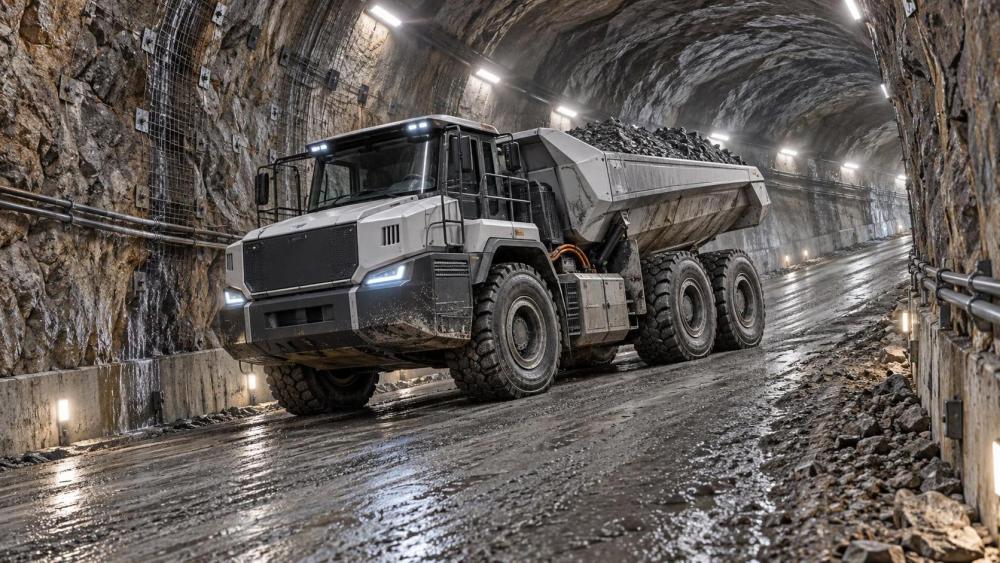
Yes—articulated dump trucks *can* operate safely on 15% underground gradients—but only when three interdependent conditions are simultaneously satisfied: mechanical capability aligned with ISO 21807’s dynamic stability thresholds, real-time traction management under confined-space environmental constraints, and operational governance that treats gradient safety as a closed-loop control problem—not a static specification.
ISO 21807 does not prescribe a universal “maximum allowable gradient” for articulated haulers. Instead, it defines a performance-based safety envelope rooted in longitudinal and lateral stability margins, braking energy dissipation capacity, and driver-assist system response latency—all measured under representative underground conditions: reduced visibility, limited sightlines, damp or dust-laden wheel–rock interfaces, and thermal buildup in enclosed haulage tunnels. A 15% gradient (8.53°) falls well within the geometric capability of modern electric articulated trucks—many exceed 25% gradeability in open-pit settings—but underground deployment introduces physics-level constraints that render open-pit metrics irrelevant unless recalibrated.
The critical divergence lies in traction availability. On surface roads, tyre–asphalt adhesion typically exceeds 0.8 coefficient of friction. In underground hard-rock tunnels—especially those with wet quartzite, fine muck accumulation, or diesel particulate residue—the effective coefficient can drop to 0.35–0.45. At 15%, gravitational force component parallel to the slope equals ~14.9% of vehicle weight. For a 45-tonne payload truck, that translates to ~67 kN of downhill force requiring continuous counteraction. Mechanical brakes alone cannot sustain this without rapid fade; regenerative braking must contribute ≥60% of total retarding effort—and its effectiveness collapses if battery state-of-charge exceeds 92% or ambient temperature exceeds 42°C, both common in deep mine haulage zones.
ISO 21807-compliant operation therefore depends less on whether the truck *can* climb or descend 15% and more on whether its control architecture maintains stability *throughout* the entire duty cycle—not just at initiation. This requires integration across three layers:
First, drivetrain torque vectoring must respond within ≤120 ms to wheel slip detection at individual axle ends. Conventional differential locks or basic ABS are insufficient: they react *after* instability begins. Next-generation systems use distributed motor control (one inboard motor per wheel end) combined with real-time inertial measurement unit (IMU) fusion to preemptively redistribute torque *before* lateral skid angles exceed 2.3°—the threshold beyond which recovery becomes probabilistic, not deterministic.
Second, braking energy routing must be validated under worst-case thermal loading—not lab-rated peak kW. ISO 21807 Annex D mandates thermal soak testing: the truck must perform five consecutive 15%-grade descents of ≥800 m length, with ≤90-second dwell time between runs, while maintaining brake disc surface temperature below 580°C and battery absorption rate above 85% of nominal regen capacity. Few OEMs publish full-cycle thermal validation data; most cite single-run performance under ideal cooling conditions.
Third, human–machine interface design must eliminate ambiguity in grade-related decision points. ISO 21807 Clause 7.4.2 prohibits reliance on driver interpretation of “steepness.” Instead, it requires automatic activation of speed-limiting logic at 12% gradient, coupled with haptic steering feedback and head-up display alerts at 14.5%. The system must also log every instance where grade-compensated traction control intervened—data that feeds fleet-level predictive maintenance but is rarely accessible to procurement teams reviewing spec sheets.
Field evidence from UTMD’s Strategic Intelligence Center confirms these requirements are not theoretical. In two lithium-rich deep mines currently operating at 1,200–1,600 m depth—where 15% gradients appear in ramp development and ore-pass access routes—only fleets deploying fully integrated electric haulers (with dual-motor axles, liquid-cooled battery buffers, and embedded SLAM-based tunnel mapping for grade prediction) achieved zero grade-related incidents over 18 months. In contrast, hybrid-diesel units with retrofitted regen systems recorded 3.2 grade-induced near-misses per 1,000 operating hours—primarily during transition from level to inclined sections, where transient traction loss exceeded control loop response time.
This reveals a decisive practical distinction: ISO 21807 compliance is not a product certification—it is an operational state maintained through continuous calibration of vehicle dynamics against site-specific geomechanical and thermal realities. A truck certified to ISO 21807 in a German test tunnel may fail compliance validation in a South African ultra-deep mine not due to nonconformance, but because the standard’s clause 5.2.1 explicitly defers to “site-defined ambient and surface condition parameters” as binding inputs to the safety assessment.
Procurement decisions therefore hinge on verifiable evidence—not brochures. Buyers must require OEMs to disclose: (1) full thermal soak test reports conducted on representative underground-grade profiles; (2) IMU-derived lateral stability margin logs from ≥500 real-world 15%+ gradient cycles; and (3) documented integration of onboard grade-sensing with fleet telematics to trigger pre-emptive speed reduction at known high-risk transitions.

There is no universal “yes” or “no” to safe 15% underground operation. There is only a conditional “yes”—contingent on demonstrable alignment between ISO 21807’s dynamic control requirements and the actual physical, thermal, and operational environment where the truck will run. That alignment cannot be assumed from payload rating, motor power, or even prior underground deployments. It must be validated—per shift, per ramp, per thermal cycle—because in underground haulage, gradient safety is not a feature. It is a continuously enforced boundary.