
Hydrogen Powered Mining Trucks: Refueling Time, Payload, and Mine Site Fit Explained





Hydrogen Powered Mining Trucks are moving from pilot headlines into serious fleet evaluation. Interest is rising because haulage decarbonization is no longer only about emissions targets. It is also about uptime, payload, ventilation savings, site energy strategy, and the practical limits of battery size in heavy-duty cycles.
For mine operators and infrastructure planners, the central question is straightforward. Can hydrogen deliver diesel-like operating continuity while supporting zero-emission goals in surface and underground-linked mining systems? The answer depends less on theory and more on refueling design, route profile, power demand, and the fit between truck architecture and mine layout.
That is why the topic matters across UTMD’s coverage universe. In the same way that TBMs, pipe jacking systems, drilling jumbos, mining dump trucks, and underground LHDs are being reshaped by electrification and automation, heavy haulage is now being judged by how well it integrates energy, digital control, and asset utilization under harsh operating conditions.
What Hydrogen Powered Mining Trucks actually change
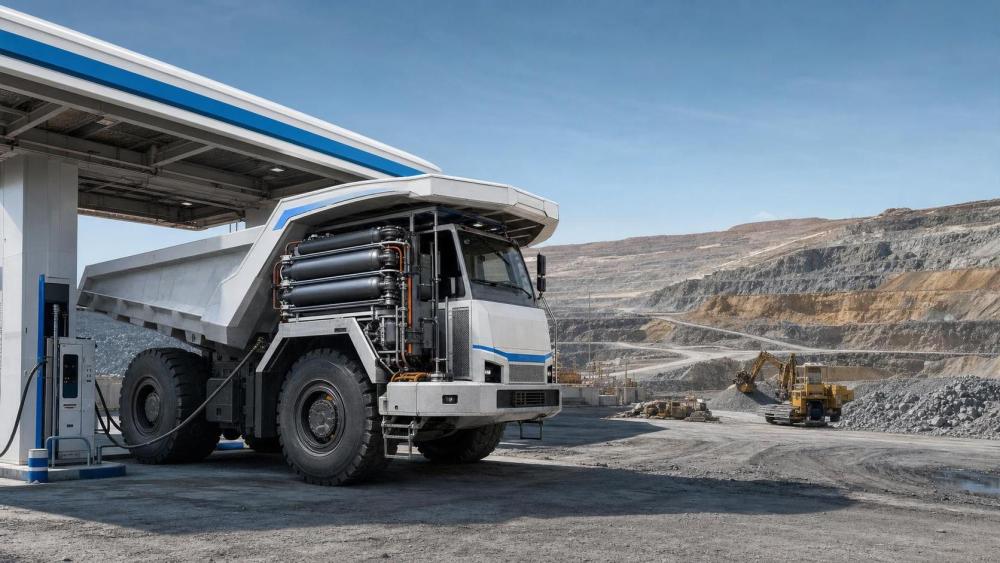
At a basic level, Hydrogen Powered Mining Trucks use hydrogen as an onboard energy carrier. In most current concepts, fuel cells generate electricity for traction motors, while batteries handle transient loads, regenerative braking, and peak power support.
This matters because mining trucks do not operate like highway vehicles. They carry extreme payloads, climb long ramps, brake heavily downhill, and often run in remote areas where grid capacity is limited or expensive to expand.
Compared with diesel, hydrogen pathways can eliminate tailpipe carbon emissions. Compared with large battery-only trucks, they can reduce onboard energy mass for some duty cycles and shorten energy replenishment time if fueling systems are well engineered.
Still, Hydrogen Powered Mining Trucks are not automatically the best answer. Their value appears when the energy chain, truck duty cycle, and mine development plan support the technology rather than fight it.
Why refueling time has become a board-level issue
Refueling time is often the first reason hydrogen enters the conversation. Large haul trucks represent expensive moving capacity. When idle time rises, production cost per ton usually rises with it.
Battery-electric trucks can perform strongly in mines with trolley assist, short routes, or planned charging windows. However, some operations face a tougher equation. High-energy cycles may require larger batteries, longer charging events, or more charging assets distributed around the site.
Hydrogen Powered Mining Trucks promise a different operating rhythm. If hydrogen storage, compression, and dispensing are designed at production scale, refueling can align more closely with conventional shift planning.
That does not mean refueling is simple. Fast fill for mining trucks depends on pressure management, thermal control, fueling queue design, safety setbacks, and redundancy. A short nominal fueling time on paper means little if the site creates bottlenecks around dispensers or hydrogen supply trailers.
In commercial terms, the real metric is not minutes per fill alone. It is whether total fleet availability improves after including waiting time, fueling labor, hydrogen delivery logistics, and maintenance interruptions.
Questions behind the refueling claim
- How many trucks can one station support during peak shift transitions?
- What is the buffer capacity if hydrogen production pauses?
- How far is the dispenser from active haul roads or loading zones?
- Can the fueling layout scale as the mine deepens or expands?
Payload retention is more than a specification line
Payload retention is another core argument for Hydrogen Powered Mining Trucks. In heavy haulage, every ton allocated to energy storage is a ton not available for ore or waste movement unless the gross vehicle weight envelope is adjusted.
This is where hydrogen often gains strategic attention. For long, energy-intensive routes, a hydrogen fuel cell system can offer a better balance between range and mass than a very large battery pack. That can help preserve payload and cycle productivity.
The advantage is not universal. Tank design, protective structures, battery hybridization, and thermal systems all add weight. Actual payload impact must be reviewed against route gradient, haul distance, ambient temperature, and the truck’s structural configuration.
UTMD’s coverage of smart underground mining transport systems highlights a broader point here. In heavy equipment transitions, architecture matters as much as energy source. A technically clean fuel choice can still underperform if machine packaging reduces reliability, maintainability, or loading efficiency.
What to compare when payload matters
Mine site fit decides whether the model works
The strongest case for Hydrogen Powered Mining Trucks appears when site conditions reward fast energy replenishment and high daily utilization. Large open-pit mines with long haul distances are the most visible candidates, but they are not the only ones.
Some underground-related operations may also benefit, especially where zero-exhaust priorities are rising and ventilation power is a major cost driver. Even then, the solution is not simply to replace diesel with hydrogen unit by unit.
Mine site fit depends on an energy ecosystem. That includes hydrogen production route, water access, renewable power integration, storage method, dispensing layout, and safety procedures across mobile and fixed assets.
In regions where grid expansion is slow, onsite hydrogen production may strengthen energy independence. In other locations, the electricity needed to make green hydrogen may make direct battery use more efficient. The site decision is therefore deeply local.
Typical fit scenarios
- Long-haul open-pit routes with limited charging windows
- Operations seeking diesel replacement without major payload sacrifice
- Sites pairing renewable generation with hydrogen production assets
- Mines building future autonomy platforms around electric drivetrains
The business case extends beyond fuel cost
Hydrogen Powered Mining Trucks should not be assessed only by comparing hydrogen price with diesel price. That approach misses the system economics that often determine success or failure.
A stronger evaluation includes utilization, maintenance profile, emissions compliance exposure, carbon strategy, power infrastructure capex, and the cost of lost production during energy replenishment. For deep industrial assets, these variables are tightly linked.
This is especially relevant in the UTMD context. Mines, tunneling projects, and underground logistics networks are converging around electrification, automation, and data-rich fleet management. Hydrogen can fit into that transition when it supports operational continuity rather than creating a parallel complexity burden.
ESG value also deserves a practical lens. Zero tailpipe emissions can improve permitting narratives, decarbonization reporting, and social license positioning. Yet investors increasingly look for credible pathways, not symbolic pilots. Supply security and measured performance matter more than announcements.
A useful decision frame
Where caution is still necessary
Hydrogen Powered Mining Trucks offer a compelling narrative, but several risks remain. Fuel cell durability under mining vibration, dust, and thermal cycling is still a live issue. So is the lifespan of high-pressure storage components in heavy-duty service.
Hydrogen quality control, leakage detection, emergency response planning, and technician training also need mature procedures. These are manageable issues, but they are not side notes. They directly influence insurance, uptime, and regulatory acceptance.
Another caution involves comparison discipline. Mines should avoid evaluating hydrogen against an outdated diesel baseline only. The more meaningful comparison is often among hydrogen, battery-electric, trolley-assist, hybrid architectures, and staged fleet decarbonization pathways.
In some cases, the best near-term solution may be mixed. Battery trucks can suit shorter cycles. Hydrogen units can target the highest-energy routes. That portfolio logic is often more realistic than searching for one universal answer.
How to move from interest to a defensible decision
A sound assessment starts with route-level data rather than fuel preference. Measure duty cycle, queue time, elevation change, ambient conditions, maintenance windows, and expected mine expansion. Then test how Hydrogen Powered Mining Trucks perform against those realities.
It is also worth modeling the full infrastructure sequence. Start with pilot throughput, then scale to commercial fleet demand. This exposes whether the hydrogen system remains efficient once more trucks, more shifts, and deeper pits are added.
UTMD’s intelligence perspective is useful here because heavy underground and mining equipment transitions rarely succeed through machine selection alone. They succeed when equipment, energy, digital control, and site engineering are stitched into one operating model.
For the next step, build a comparison framework around refueling time, payload retention, infrastructure complexity, and expansion fit. That approach makes Hydrogen Powered Mining Trucks easier to judge on evidence, not momentum.
Related News

How to Evaluate European Drill-and-Blast Tunnelling Contractors for Complex Projects
Drill and blast tunnelling contractors Europe: learn how to assess geology expertise, blast control, equipment reliability, safety, and programme resilience for complex projects.

Which Trenchless Construction Technique Fits Your Utility Crossing Conditions?
Trenchless construction techniques compared for utility crossings: choose HDD, microtunnelling, pipe jacking, or auger boring based on ground, accuracy, access, and risk.

What Is Driving Metro Tunnelling Demand Across Southeast Asia’s Major Cities?
Metro tunnelling Southeast Asia is accelerating as major cities tackle congestion, flooding, and connectivity. Explore the market forces, technical risks, and opportunities shaping demand.

Hard Rock Tunnelling in Australia: Selecting Methods for Variable Ground Conditions
Hard rock tunnelling in Australia: compare TBM, drill-and-blast and hybrid methods to manage variable ground, reduce risk and protect project costs.

Hydropower Tunnel Excavation: Selecting Methods for Variable Rock Conditions
Hydropower tunnel excavation methods for variable rock conditions: compare TBM, drill-and-blast, and hybrid strategies to improve safety, progress, and project control.

How to Select Underground Safety Equipment for Tunnelling by Hazard and Work Zone
Underground Safety Equipment for tunnelling: match protection to hazards, work zones, compliance, and emergency needs with this practical selection guide.

EPB or Slurry Shield? Selecting Soft-Ground Tunnelling Equipment by Soil Conditions
Tunnel Excavation Equipment for soft ground: compare EPB and slurry shields by soil, groundwater, settlement risk, and project logistics to choose confidently.
How to Specify TBM Backup System Parts for Reliable Long-Distance Tunnelling
TBM backup system parts: learn how to specify reliable spares for long-distance tunnelling, reduce downtime, ensure compatibility, and speed underground recovery.
How to Size Open Pit Mining Trucks for Haul Distance, Grade, and Payload?
Open Pit Mining Trucks: learn how to match payload, haul distance, grade, road resistance, and loading capacity for safer, lower-cost mine operations.
Related News
- 00
0000-00
How to Evaluate European Drill-and-Blast Tunnelling Contractors for Complex Projects - 00
0000-00
Which Trenchless Construction Technique Fits Your Utility Crossing Conditions? - 00
0000-00
What Is Driving Metro Tunnelling Demand Across Southeast Asia’s Major Cities? - 00
0000-00
Hard Rock Tunnelling in Australia: Selecting Methods for Variable Ground Conditions - 00
0000-00
Hydropower Tunnel Excavation: Selecting Methods for Variable Rock Conditions
Weekly Insights
Stay ahead with our curated technology reports delivered every Monday.