
Singapore LTA Tightens Slurry Pipe Jacking Entry Rules





On July 14, 2026, Singapore’s Land Transport Authority (LTA) updated its access requirements for Slurry Pipe Jacking equipment through the release of Underground Utilities Installation Code Rev.3. The immediate change is not only a compliance issue for equipment suppliers, but also a practical delivery issue for exporters, project contractors, procurement teams, and service providers involved in municipal works tied to Southeast Asia, especially where import timing and technical documentation directly affect project schedules.
What the new requirement formally changes
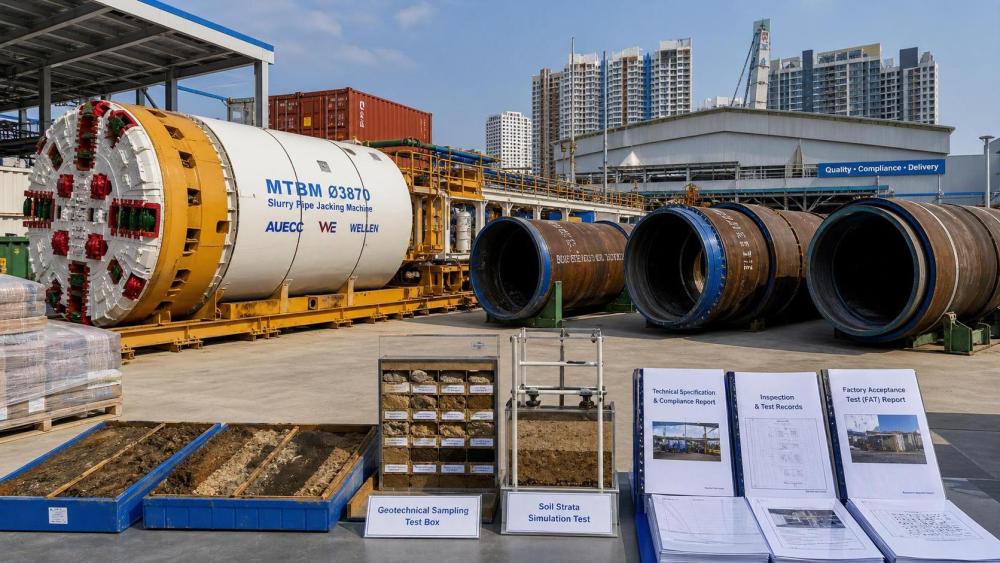
According to the confirmed information provided, LTA issued Underground Utilities Installation Code Rev.3 on July 14, 2026. Under the updated rule, all Slurry Pipe Jacking equipment must complete local geological simulation testing before import.
The testing requirement includes verification under two ground conditions: coastal soft soil and granite residual soil. In addition, importers must submit a thrust-settlement coupling model report issued by a third-party institution.
The rule took effect immediately upon release. The information provided also indicates that the change is affecting the delivery rhythm of Chinese equipment exports for municipal projects in Southeast Asia.
Where pressure is likely to appear across the business chain
Export-facing equipment suppliers may face a front-loaded compliance burden
From an industry perspective, the first area of impact is likely to be the pre-shipment stage. Suppliers serving overseas municipal projects may need to align equipment readiness with local simulation testing and third-party reporting requirements before import can proceed. The business effect is likely to appear in documentation preparation, test coordination, and shipment timing.
Project procurement and contracting teams may need to reassess delivery sequencing
For procurement teams and project contractors, the issue is not only whether equipment can be supplied, but whether supply can match the required construction schedule. Analysis shows that when a rule takes effect immediately, any gap between contractual delivery expectations and actual compliance readiness can become a practical project management issue. What deserves closer attention is whether procurement plans and acceptance timelines are still realistic under the updated access condition.
Third-party technical service providers may become more central to transaction execution
The required thrust-settlement coupling model report introduces a clearer role for external technical verification. Observably, service providers involved in testing, modeling, and documentation may now sit closer to the commercial path of equipment entry, because their output is tied directly to whether import conditions can be satisfied in time.
Supply chain coordinators may need to watch cross-border handoff risk more closely
Where delivery depends on synchronized manufacturing, transport, import clearance, and site scheduling, a new mandatory local test step can add coordination pressure. From an industry perspective, this is especially relevant for businesses managing customer commitments across borders, because even a technically qualified machine may still face timing risk if the required validation sequence is not built into the shipment plan.
What companies should watch now
Focus on how the immediate implementation is interpreted in practice
Analysis shows that the phrase “effective immediately” matters operationally. Companies should pay close attention to how active quotations, pending shipments, and near-term project deliveries are treated under the new requirement, because the practical impact may depend on how the rule is applied to equipment already in the export pipeline.
Check whether technical files are adequate for the new review path
The new requirement is not limited to equipment supply itself; it also introduces a documentation threshold through third-party modeling reports. What deserves closer attention is whether existing technical files, test records, and product-related submission materials are sufficient to support the required review without causing additional back-and-forth during project execution.
Revisit delivery commitments tied to Southeast Asia municipal work
For companies serving municipal projects in the region, current contract schedules and customer communication may need renewed attention. Observably, the rule change has already been described as affecting the delivery rhythm of Chinese equipment exports, so businesses should be alert to where timing assumptions were built on earlier access conditions.
Separate policy text from business execution risk
From an industry perspective, a published rule and its on-the-ground execution are related but not identical. Companies should watch not only the formal requirement itself, but also the operational details around testing arrangements, third-party report acceptance, and communication with project-side stakeholders, because these factors will shape the real commercial impact.
Why this looks like more than a routine document update
Analysis shows that this development can be read as a stronger emphasis on locally validated technical suitability rather than a simple paperwork adjustment. The requirement to complete local geological simulation testing under two specified ground conditions, together with a third-party thrust-settlement coupling model report, suggests a higher threshold for demonstrating equipment fit before import.
At the same time, it is more appropriate to understand this as an active industry signal rather than a fully settled long-term outcome. The immediate effect on delivery timing is already visible in the information provided, but the broader commercial consequences will still depend on how consistently the requirement is implemented in real project workflows.
How this update is best understood for now
At this stage, the Singapore LTA update is best understood as a concrete compliance change with near-term delivery implications, especially for exporters and project participants linked to municipal infrastructure work. It should not be reduced to a routine standards revision, but it also should not be overstated beyond the confirmed facts.
A balanced reading is that this is both a short-term operational change and a longer-term signal worth monitoring. The immediate issue is execution pressure around testing, reporting, and import timing. The broader question, which still requires observation, is whether this approach becomes a more persistent market access expectation for related equipment flows in the region.
Basis of this article and what still needs verification
This article is based on the user-provided news title, event date, and event summary concerning Singapore LTA’s updated access requirements for Slurry Pipe Jacking equipment. In coverage of this type, relevant source categories would usually include official notices, standard or code documents, company disclosures, industry association updates, and reporting by authoritative trade media.
No specific official source link was provided in the input, so the exact source document access path still requires ongoing verification. Follow-up attention should remain on any further official wording, implementation clarifications, and practical developments affecting testing arrangements, third-party reporting, and export delivery schedules.
Related News

How to Evaluate European Drill-and-Blast Tunnelling Contractors for Complex Projects
Drill and blast tunnelling contractors Europe: learn how to assess geology expertise, blast control, equipment reliability, safety, and programme resilience for complex projects.

Which Trenchless Construction Technique Fits Your Utility Crossing Conditions?
Trenchless construction techniques compared for utility crossings: choose HDD, microtunnelling, pipe jacking, or auger boring based on ground, accuracy, access, and risk.

What Is Driving Metro Tunnelling Demand Across Southeast Asia’s Major Cities?
Metro tunnelling Southeast Asia is accelerating as major cities tackle congestion, flooding, and connectivity. Explore the market forces, technical risks, and opportunities shaping demand.

Hard Rock Tunnelling in Australia: Selecting Methods for Variable Ground Conditions
Hard rock tunnelling in Australia: compare TBM, drill-and-blast and hybrid methods to manage variable ground, reduce risk and protect project costs.

Hydropower Tunnel Excavation: Selecting Methods for Variable Rock Conditions
Hydropower tunnel excavation methods for variable rock conditions: compare TBM, drill-and-blast, and hybrid strategies to improve safety, progress, and project control.

How to Select Underground Safety Equipment for Tunnelling by Hazard and Work Zone
Underground Safety Equipment for tunnelling: match protection to hazards, work zones, compliance, and emergency needs with this practical selection guide.

EPB or Slurry Shield? Selecting Soft-Ground Tunnelling Equipment by Soil Conditions
Tunnel Excavation Equipment for soft ground: compare EPB and slurry shields by soil, groundwater, settlement risk, and project logistics to choose confidently.

How to Specify TBM Backup System Parts for Reliable Long-Distance Tunnelling
TBM backup system parts: learn how to specify reliable spares for long-distance tunnelling, reduce downtime, ensure compatibility, and speed underground recovery.

How to Size Open Pit Mining Trucks for Haul Distance, Grade, and Payload?
Open Pit Mining Trucks: learn how to match payload, haul distance, grade, road resistance, and loading capacity for safer, lower-cost mine operations.
Related News
- 00
0000-00
How to Evaluate European Drill-and-Blast Tunnelling Contractors for Complex Projects - 00
0000-00
Which Trenchless Construction Technique Fits Your Utility Crossing Conditions? - 00
0000-00
What Is Driving Metro Tunnelling Demand Across Southeast Asia’s Major Cities? - 00
0000-00
Hard Rock Tunnelling in Australia: Selecting Methods for Variable Ground Conditions - 00
0000-00
Hydropower Tunnel Excavation: Selecting Methods for Variable Rock Conditions
Weekly Insights
Stay ahead with our curated technology reports delivered every Monday.