
Jintang Undersea Tunnel Breakthrough Sets New High-Speed Rail Benchmark





On June 10, 2026, the twin bores of the Jintang undersea tunnel on the Yongzhou Railway were connected, marking a notable milestone for high-speed rail tunneling in challenging marine conditions. For contractors, equipment suppliers, rail infrastructure owners, and engineering service providers, the development is worth attention not only because of the tunnel’s 16.18-kilometer length, but also because it demonstrates verified performance in high water pressure, mixed soft-hard ground, and strong tidal waters under tightly controlled settlement conditions.
What Was Confirmed at the Tunnel Crossing
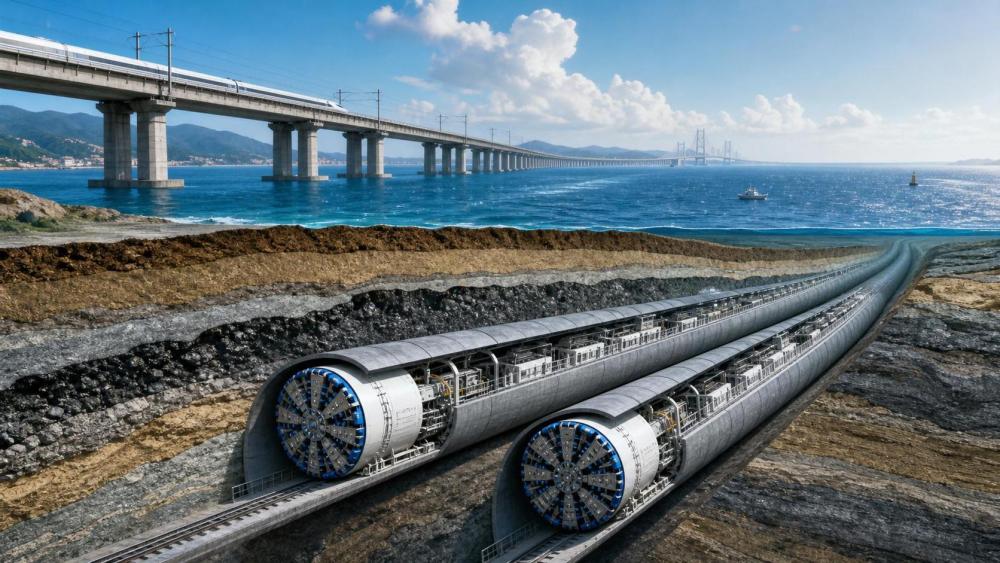
The project was delivered by China Railway Construction, and the Jintang undersea tunnel achieved full twin-line breakthrough on June 10, 2026. The tunnel has a total length of 16.18 kilometers. According to the provided information, construction passed through high water pressure zones and composite ground conditions with uneven soft and hard strata.
The work used the self-developed “Yongzhou” compound shield machine, described as a Slurry/EPB shield. The reported peak daily advance reached 28 meters, while settlement control precision was held to ±2 mm. The project is also identified as the world’s first undersea high-speed rail tunnel in a strong tidal area to complete millimeter-level docking, and the outcome is presented as validation of the reliability and repeatability of China’s shield tunneling system in extreme operating conditions.
Why Different Parts of the Rail Construction Chain Are Paying Attention
For tunnel engineering contractors, the signal is about executable performance
From an industry perspective, this development matters to civil works contractors because it turns difficult marine tunneling conditions into a documented delivery result rather than a purely theoretical capability. The immediate business relevance lies in construction planning, shield selection, risk control, and coordination during breakthrough and docking stages. What deserves closer attention is whether clients and prime contractors begin to place greater weight on proven capability in mixed geology, high-pressure environments, and precision settlement management.
For shield equipment and systems suppliers, reliability becomes a commercial differentiator
Analysis shows that equipment manufacturers and subsystem providers are likely to focus on what this says about machine adaptability under complex seabed conditions. The reported use of a compound Slurry/EPB shield and the precision outcome may influence how buyers assess equipment suitability for projects where geology changes rapidly and operating windows are narrow. In practical terms, attention may shift toward technical documentation, operating stability, and evidence of repeatable performance under extreme conditions.
For project owners and infrastructure buyers, precision control moves closer to procurement criteria
For owners, procurement teams, and project management units, the breakthrough highlights the importance of measurable execution indicators. Settlement control at ±2 mm and millimeter-level docking in strong tidal waters are not just engineering descriptions; they may affect how tender evaluation, technical review, and contractor communication are approached in comparable projects. Observably, the business impact is less about immediate volume change and more about how future capability requirements may be framed.
For engineering and supply-chain service firms, coordination risk deserves renewed attention
Service providers involved in design support, logistics coordination, technical consulting, and project delivery should note that the achievement was linked to multiple difficult conditions occurring at the same time. That means coordination risk, equipment readiness, and delivery sequencing remain central in this type of project. What deserves closer attention is how service firms present their support for extreme-condition execution, not only their general infrastructure credentials.
What Companies Should Watch Next
Track how the achievement is described in subsequent official communication
Companies should distinguish between the confirmed breakthrough itself and any later expansion of its policy or commercial meaning. The verified facts are clear, but whether they translate into broader procurement standards, qualification emphasis, or market references still requires follow-up observation.
Prepare technical proof points around complex geology and marine conditions
For firms seeking opportunities in tunneling, equipment supply, or technical services, the practical issue is whether they can demonstrate capability in conditions similar to those cited here: high water pressure, uneven soft-hard composite ground, and strong tidal environments. The attention point is not generic marketing language, but project-ready records, technical parameters, and delivery evidence that clients can evaluate.
Review supplier documentation and fulfillment assumptions
Analysis shows that suppliers and subcontractors may need to reassess how they present qualification files, equipment records, operating parameters, and delivery commitments for projects with strict precision requirements. In this context, documentation quality and communication discipline can matter as much as capacity claims.
Keep client communication grounded in verified facts
Because the current input confirms a technical milestone rather than broader market outcomes, companies should avoid overstating downstream implications when speaking with customers or partners. A more workable approach is to frame this event as evidence of proven execution under extreme conditions while acknowledging that wider commercial effects remain subject to further observation.
How This Milestone Is Best Interpreted at This Stage
Analysis shows that this is best understood as a strong technical and delivery signal rather than a complete market conclusion. The confirmed result indicates that undersea high-speed rail tunneling in strong tidal waters can achieve highly precise docking while maintaining tight settlement control, which is important for engineering credibility. At the same time, the information provided does not by itself establish how quickly procurement models, bidding thresholds, or project pipelines will change.
Observably, the most important takeaway for the industry is the combination of reliability and repeatability under extreme conditions. That makes this milestone relevant beyond a single project. Still, it remains more appropriate to treat the news as a validated capability marker and a development that warrants continued tracking, rather than as proof of immediate structural change across the entire market.
A Technical Result With Broader Watch Value
The twin-line breakthrough of the Jintang undersea tunnel matters because it links a record-length undersea high-speed rail tunnel with confirmed performance in difficult marine geology and precision control. For the industry, the real value lies in what has now been demonstrated: a completed engineering result under conditions that are typically seen as demanding.
At present, it is more appropriate to understand this event as a long-term technical signal with practical near-term relevance for procurement, equipment evaluation, contractor positioning, and project communication. The facts already make it significant, but the wider commercial meaning still depends on how future projects, buyers, and official references evolve from here.
Basis of This Article and Ongoing Verification
This article is based on the user-provided news title, event date, and event summary related to the June 10, 2026 twin-line breakthrough of the Jintang undersea tunnel on the Yongzhou Railway. The analysis above is limited to those provided facts and does not rely on additional unverified project data, market figures, or external claims.
For this type of industry update, commonly relevant source categories would include official project announcements, company statements, industry association information, authoritative media coverage, and standards-related documentation. A specific official source link was not provided in the input, so continued verification is still necessary. Follow-up attention should focus on any subsequent official technical disclosures, procurement language, qualification references, and project-level interpretations that may emerge later.
Related News

How to Evaluate European Drill-and-Blast Tunnelling Contractors for Complex Projects
Drill and blast tunnelling contractors Europe: learn how to assess geology expertise, blast control, equipment reliability, safety, and programme resilience for complex projects.

Which Trenchless Construction Technique Fits Your Utility Crossing Conditions?
Trenchless construction techniques compared for utility crossings: choose HDD, microtunnelling, pipe jacking, or auger boring based on ground, accuracy, access, and risk.

What Is Driving Metro Tunnelling Demand Across Southeast Asia’s Major Cities?
Metro tunnelling Southeast Asia is accelerating as major cities tackle congestion, flooding, and connectivity. Explore the market forces, technical risks, and opportunities shaping demand.

Hard Rock Tunnelling in Australia: Selecting Methods for Variable Ground Conditions
Hard rock tunnelling in Australia: compare TBM, drill-and-blast and hybrid methods to manage variable ground, reduce risk and protect project costs.

Hydropower Tunnel Excavation: Selecting Methods for Variable Rock Conditions
Hydropower tunnel excavation methods for variable rock conditions: compare TBM, drill-and-blast, and hybrid strategies to improve safety, progress, and project control.

How to Select Underground Safety Equipment for Tunnelling by Hazard and Work Zone
Underground Safety Equipment for tunnelling: match protection to hazards, work zones, compliance, and emergency needs with this practical selection guide.

EPB or Slurry Shield? Selecting Soft-Ground Tunnelling Equipment by Soil Conditions
Tunnel Excavation Equipment for soft ground: compare EPB and slurry shields by soil, groundwater, settlement risk, and project logistics to choose confidently.

How to Specify TBM Backup System Parts for Reliable Long-Distance Tunnelling
TBM backup system parts: learn how to specify reliable spares for long-distance tunnelling, reduce downtime, ensure compatibility, and speed underground recovery.
How to Size Open Pit Mining Trucks for Haul Distance, Grade, and Payload?
Open Pit Mining Trucks: learn how to match payload, haul distance, grade, road resistance, and loading capacity for safer, lower-cost mine operations.
Related News
- 00
0000-00
How to Evaluate European Drill-and-Blast Tunnelling Contractors for Complex Projects - 00
0000-00
Which Trenchless Construction Technique Fits Your Utility Crossing Conditions? - 00
0000-00
What Is Driving Metro Tunnelling Demand Across Southeast Asia’s Major Cities? - 00
0000-00
Hard Rock Tunnelling in Australia: Selecting Methods for Variable Ground Conditions - 00
0000-00
Hydropower Tunnel Excavation: Selecting Methods for Variable Rock Conditions
Weekly Insights
Stay ahead with our curated technology reports delivered every Monday.