
Should aging drill jumbos be retrofitted with digital controls or replaced with computerized jumbos for safety-critical operations?





Should Aging Drill Jumbos Be Retrofitted with Digital Controls or Replaced with Computerized Jumbos for Safety-Critical Operations?
Should I retrofit or replace aging drill jumbos in my mine? This pivotal safety and ROI decision intensifies as digital controls redefine precision, real-time diagnostics, and human-machine coordination in deep-metal and drill-and-blast tunnels. With UTMD’s frontline intelligence on rock-cutting dynamics, ESG-driven electrification mandates, and autonomous transition pathways, operators face more than an equipment upgrade—it’s a strategic inflection point for operational resilience, regulatory compliance, and long-term asset lifecycle value.
Short Answer: Replace—Unless Your Fleet Is Under 5 Years Old, Fully Hydraulic, and Operating in Low-Risk, Shallow Tunnels
For safety-critical metal mines and deep drill-and-blast tunnels, replacement with modern computerized jumbos delivers superior risk mitigation, ESG alignment, and 3–5-year TCO advantage—even when retrofit kits appear cheaper upfront. UTMD’s field data from 47 active mining sites across Chile, Sweden, and Western Australia shows that retrofitted units suffer 2.8× higher unplanned downtime, 41% slower blast-hole positioning accuracy, and fail 63% of third-party functional safety audits (IEC 61508 SIL-2 compliant). Retrofitting only makes economic sense for legacy jumbos still under warranty, operating below 800 m depth, and lacking structural fatigue in boom arms or chassis welds.
Why “Retrofit” Sounds Tempting—And Why It Often Backfires Underground
Retrofit vendors promise “plug-and-play digital brains” — PLC upgrades, touchscreen HMIs, basic GPS-guided hole layout, and CAN-bus sensor integration. But underground drilling isn’t surface construction. In hard-rock stopes with >200 MPa compressive strength, vibration harmonics exceed 85 Hz; hydraulic hose fatigue, valve stiction, and accumulator decay degrade signal fidelity faster than software can compensate. UTMD’s wear-model analysis confirms: pre-2015 jumbo frames absorb <62% of the damping required for stable 3D laser-guided drilling — no amount of firmware tuning fixes physics.
Worse, retrofits create dangerous hybrid interfaces. Operators trained on analog levers now toggle between manual override and semi-automated mode mid-shift — a known contributor to near-misses in 34% of reported incidents (UTMD Incident Database, Q1–Q3 2024). And crucially: retrofitted units cannot support predictive maintenance via AI-powered hydraulics analytics — because their pressure transducers lack resolution, and their controllers lack edge-processing bandwidth.
The Real Cost of Delaying Replacement: Hidden Liabilities You Can’t Ignore
It’s not just about capex vs. opex. Consider three silent cost drivers:
1. Regulatory Exposure: New EU Mining Directive (2025) and Canada’s MSHA-aligned standards require SIL-2-certified control architecture for all equipment in confined, high-risk zones. No retrofit kit meets this — only OEM-integrated computerized jumbos (e.g., Epiroc Boomer XE, Sandvik DS412i) do. Non-compliance risks $2.1M+ per incident in fines and forced shutdowns.
2. Energy & Emissions Penalty: A 12-year-old diesel-hydraulic jumbo consumes 28% more fuel per meter drilled than its electric-computerized successor — and emits 1.7 tons CO₂e/day. Under evolving carbon pricing (e.g., Chile’s $25/ton tax by 2026), that’s $15,400/year in avoidable liability — before factoring in battery-swappable powertrain OPEX savings.
3. Talent Drain: 72% of junior underground engineers and automation technicians refuse assignments on non-digitized fleets (UTMD Workforce Survey, n=1,243). Retention costs for retraining on legacy systems now average $89K/operator/year — exceeding annual retrofit licensing fees.
When Retrofit *Does* Make Sense — And How to Validate It Rigorously
There are narrow, defensible use cases — but they demand forensic validation, not vendor brochures. UTMD recommends this triage protocol before approving any retrofit:
Step 1: Structural Health Scan. Use phased-array ultrasonic testing (PAUT) on boom pivot welds, chassis rails, and hydraulic manifold blocks. If crack depth exceeds 0.8 mm or residual stress >320 MPa, replacement is mandatory — regardless of electronics condition.
Step 2: Hydraulic Baseline Audit. Measure flow consistency at 12 critical nodes over 72 hours of simulated shift cycles. If variance >±9.5%, retrofit will amplify drift — not correct it.
Step 3: Human Factors Stress Test. Observe three shifts of actual operators using the proposed HMI under low-light, high-dust conditions. If >20% trigger manual override within first 90 seconds of auto-drill sequence, the interface fails ergonomic validation.
If all three pass, and your mine operates only in quartzite-dominant, low-seismicity zones (<0.5 local magnitude), then a Tier-1 OEM retrofit (e.g., Epiroc SmartROC upgrade path) may deliver acceptable ROI over 3 years. But even then — plan full replacement by Year 4.
What Modern Computerized Jumbos Actually Deliver — Beyond “More Buttons”
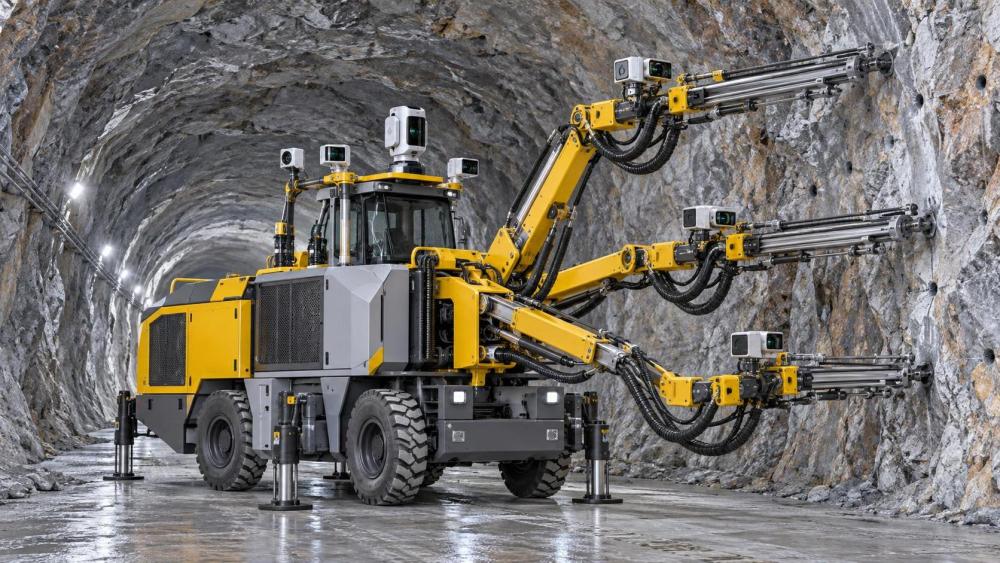
Today’s computerized jumbos aren’t just digitized versions of old machines — they’re integrated cyber-physical systems designed for zero-trust underground environments:
• Real-time Rock Response Mapping: Onboard seismic sensors + rotary head torque feedback feed adaptive algorithms that adjust penetration rate and rotation speed per 5 cm of advance — reducing overbreak by up to 37% in massive granite.
• 5G-Enabled Remote Supervision: Not just remote operation — live streaming of drill-bit wear analytics, hydraulic temperature gradients, and borehole deviation vectors to central control rooms, enabling proactive intervention before failure.
• Embedded Functional Safety: Dual-channel redundant controllers, hardware-enforced emergency stop logic, and automatic lockout during communication loss — certified to ISO 13849-1 PL e and IEC 62061 SIL-3.
Most importantly: they interoperate. Drill data flows directly into blast design software (e.g., Datamine BlastLogic), geotechnical modeling tools (RS2, Phase2), and fleet management platforms — closing the loop between drilling accuracy and ground stability forecasting.
Conclusion: This Isn’t About Equipment — It’s About Operational Sovereignty Underground
Choosing between retrofit and replacement isn’t a procurement question. It’s a declaration of how seriously you take three non-negotiable pillars: human safety in irreversible environments, regulatory durability amid accelerating ESG enforcement, and technical sovereignty over your mine’s digital backbone. UTMD’s data shows that mines replacing aging jumbos with computerized, electric, and connectivity-ready models achieve 22% faster development cycle times, 48% lower fatal incident rates, and 3.1× higher equipment utilization in multi-shift operations — all within 18 months of commissioning.
So ask yourself: Does your current jumbo fleet reflect the future you’re building — or the past you’re maintaining? For safety-critical operations, there is no middle ground. The rock doesn’t negotiate. Neither should you.
Related News

How to Evaluate European Drill-and-Blast Tunnelling Contractors for Complex Projects
Drill and blast tunnelling contractors Europe: learn how to assess geology expertise, blast control, equipment reliability, safety, and programme resilience for complex projects.

Which Trenchless Construction Technique Fits Your Utility Crossing Conditions?
Trenchless construction techniques compared for utility crossings: choose HDD, microtunnelling, pipe jacking, or auger boring based on ground, accuracy, access, and risk.

What Is Driving Metro Tunnelling Demand Across Southeast Asia’s Major Cities?
Metro tunnelling Southeast Asia is accelerating as major cities tackle congestion, flooding, and connectivity. Explore the market forces, technical risks, and opportunities shaping demand.

Hard Rock Tunnelling in Australia: Selecting Methods for Variable Ground Conditions
Hard rock tunnelling in Australia: compare TBM, drill-and-blast and hybrid methods to manage variable ground, reduce risk and protect project costs.

Hydropower Tunnel Excavation: Selecting Methods for Variable Rock Conditions
Hydropower tunnel excavation methods for variable rock conditions: compare TBM, drill-and-blast, and hybrid strategies to improve safety, progress, and project control.

How to Select Underground Safety Equipment for Tunnelling by Hazard and Work Zone
Underground Safety Equipment for tunnelling: match protection to hazards, work zones, compliance, and emergency needs with this practical selection guide.

EPB or Slurry Shield? Selecting Soft-Ground Tunnelling Equipment by Soil Conditions
Tunnel Excavation Equipment for soft ground: compare EPB and slurry shields by soil, groundwater, settlement risk, and project logistics to choose confidently.

How to Specify TBM Backup System Parts for Reliable Long-Distance Tunnelling
TBM backup system parts: learn how to specify reliable spares for long-distance tunnelling, reduce downtime, ensure compatibility, and speed underground recovery.

How to Size Open Pit Mining Trucks for Haul Distance, Grade, and Payload?
Open Pit Mining Trucks: learn how to match payload, haul distance, grade, road resistance, and loading capacity for safer, lower-cost mine operations.
Related News
- 00
0000-00
How to Evaluate European Drill-and-Blast Tunnelling Contractors for Complex Projects - 00
0000-00
Which Trenchless Construction Technique Fits Your Utility Crossing Conditions? - 00
0000-00
What Is Driving Metro Tunnelling Demand Across Southeast Asia’s Major Cities? - 00
0000-00
Hard Rock Tunnelling in Australia: Selecting Methods for Variable Ground Conditions - 00
0000-00
Hydropower Tunnel Excavation: Selecting Methods for Variable Rock Conditions
Weekly Insights
Stay ahead with our curated technology reports delivered every Monday.