
How to Select Underground Safety Equipment for Tunnelling by Hazard and Work Zone





At a tunnel heading, the safety picture can change before the next round of excavation is complete. Freshly exposed rock may release gas, a ventilation duct may be damaged by moving plant, water can enter through a fissure, and a pedestrian can suddenly share a narrow route with a locomotive, LHD, or service vehicle. For quality-control and safety managers, selecting Underground Safety Equipment for tunnelling is therefore not a matter of ordering a universal PPE package. It is a disciplined process of matching protection to the hazard, the work zone, the operating method, and the credible emergency scenario.
A tunnel driven by a full-face TBM has different risk patterns from a drill-and-blast heading. A short urban pipe-jacking drive raises different concerns from a deep mine decline served by battery-electric LHDs. The selection decision should reflect those realities: what can fail, who may be exposed, how quickly conditions can deteriorate, and whether the chosen equipment will still work when dust, water, vibration, noise, and human stress are at their worst.
Begin with the work zone, not the equipment catalogue
The most useful procurement documents start with a zone map. Instead of listing “gas detector,” “helmet,” or “radio” as stand-alone items, define each area of the underground operation and identify the people, plant, energy sources, and environmental hazards within it.
A practical zoning model may include the portal and access route, shaft or adit, haulage tunnel, ventilation and utility corridor, active heading, cross-passages, refuge locations, TBM backup area, workshops, and material storage bays. Each zone needs its own risk controls. The active face may demand continuous atmospheric monitoring and strict exclusion rules; the workshop may place greater emphasis on electrical isolation, hot-work controls, and fire suppression; the haulage route may be governed by visibility, separation, and traffic communication.
This approach prevents a common purchasing mistake: selecting equipment because it is familiar rather than because it controls the risk where it actually occurs. A high-specification gas monitor does not compensate for poor air distribution at the face. Reflective clothing alone does not make a blind bend safe when heavy underground transport is moving through it.
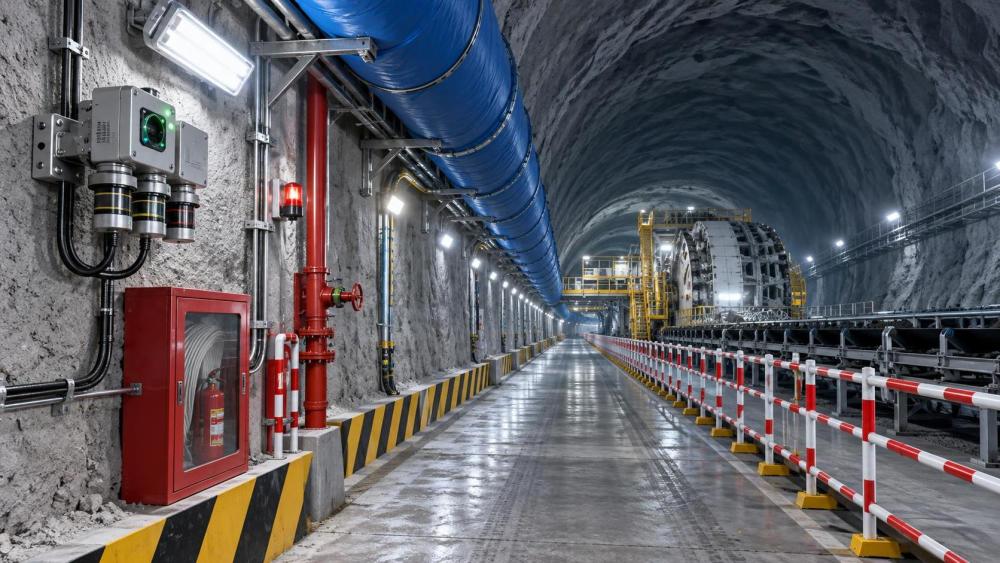
Hazard-to-equipment selection: the questions that matter
Risk assessments often identify broad hazards, but safety equipment selection becomes clearer when each hazard is translated into operational questions. The answers should be recorded in a traceable matrix so that procurement, site supervision, maintenance, and QC teams are working from the same assumptions.
Atmospheric hazards: oxygen, toxic gases, flammables, and diesel contaminants
At headings, blind drives, sumps, and poorly ventilated pockets, atmospheric safety is a system rather than a single instrument. Select fixed gas monitoring where continuous surveillance is needed, supplemented by portable multi-gas detectors for workers entering changing conditions. The detector configuration must match the anticipated gases, which may include oxygen deficiency, carbon monoxide, hydrogen sulphide, methane, nitrogen oxides, or other project-specific contaminants.
QC personnel should verify more than the presence of a detector. Check sensor range, alarm setpoints, response time, bump-test requirements, calibration traceability, charging arrangements, event logging, and suitability for wet or dusty use. Where flammable atmospheres are credible, ensure that the device classification is appropriate for the designated hazardous area. Equipment approvals should never be assumed to transfer automatically between jurisdictions or site classifications.
Ventilation equipment deserves the same scrutiny. Fans, ducts, regulators, airflow sensors, and alarm interfaces should be selected around the tunnel length, diesel fleet, blasting cycle, heat load, and expected leakage. In mechanized tunnels, a damaged duct, a poorly positioned discharge, or a blocked return path can undermine otherwise compliant gas detection. A monitor tells the team that a problem exists; ventilation capacity and control logic determine whether the problem can be corrected safely.
Mobile plant and pedestrian interaction
Haulage routes are often where routine activity becomes a serious exposure. In confined tunnels, operators contend with dust, poor sightlines, noise, gradients, water, and restricted turning radii. The risk increases when drill jumbos, service vehicles, rail systems, concrete mixers, LHDs, or battery-electric machines share the same corridor.
Choose traffic-control equipment as a coordinated package: high-visibility personal wear, clearly defined pedestrian refuges, physical barriers where feasible, illuminated signage, convex mirrors at bends, speed-control measures, vehicle proximity detection, reversing cameras, and radio protocols. On busy operations, tag-based personnel tracking or collision-avoidance systems may add another layer, but they do not remove the need for disciplined route design.
For quality assurance, test the system under real site conditions. A camera that is clear in a workshop may be obscured by slurry spray underground. A proximity alarm may be masked by machinery noise. A warning beacon has little value if its light output disappears against a bright TBM work area. Acceptance testing should include the environmental conditions in which the equipment will actually operate.
Rockfall, falling objects, and face instability
Ground conditions change along the alignment, sometimes abruptly. At drill-and-blast faces, unstable wedges, loose scaling, and unsupported ground require controls that extend well beyond hard hats. At TBM interfaces, risks may arise during cutter changes, segment handling, work in shielded areas, or inspection near moving components.
Relevant Underground Safety Equipment for tunnelling can include certified head protection with compatible eye and hearing protection, face shields for specific tasks, fall-arrest systems where elevated work is unavoidable, exclusion-zone barriers, remote scaling tools, rockfall monitoring where designed into the project controls, and dependable task lighting. Selection should account for compatibility. A helmet lamp, hearing protection, face shield, and respiratory equipment must fit together without compromising the protective function of any component.
Safety managers should also ask whether the equipment supports the method statement. If workers need to remove gloves to operate a control panel, or lift eye protection repeatedly because it fogs in humid conditions, the actual protection level is lower than the specification suggests.
Fire, smoke, and loss of escape conditions
Underground fire planning must consider more than extinguishers. Smoke can travel quickly through a tunnel, obscure signage, interrupt communications, and make a familiar route unrecognizable. Fire risks can be associated with fuel systems, conveyor belts, electrical cabinets, hot work, lithium-ion battery charging or swapping areas, hydraulic fluids, and stored materials.
Select extinguishing media according to the fuels and electrical risks present, then support it with smoke detection, fire-rated cable and hose choices where required, emergency lighting, directional escape signage, fire blankets for suitable tasks, and protected refuge or safe-haven arrangements where the emergency plan calls for them. Self-rescuers or emergency breathing apparatus must be chosen for the expected contaminants, duration, storage conditions, wearer training, and inspection regime.
Do not treat refuge equipment as a box to be checked at handover. Verify access routes, occupancy assumptions, communications, air supply arrangements, maintenance status, and the ability of people wearing muddy PPE or carrying injuries to enter. An emergency solution that cannot be reached during a vehicle incident or smoke event is not a reliable solution.
Electrical, hydraulic, and stored-energy protection in mechanized tunnels
Modern underground projects depend on interconnected electrical, hydraulic, pneumatic, and automated systems. TBM backup gantries, pumps, conveyors, drilling jumbos, charging stations, and smart transport systems all introduce stored-energy hazards. The selection process should include lockout/tagout devices matched to the isolation points actually installed, voltage-rated test instruments, arc-flash protection where assessments require it, insulated tools, emergency stop interfaces, cable protection, and suitable lighting for electrical work.
Battery-electric equipment brings a different set of controls. In addition to the operational gains of eliminating diesel exhaust at the point of use, sites need equipment and procedures for battery handling, charging or swapping, thermal-event response, electrical isolation, and restricted access to energy-storage areas. Safety managers should request clear information from equipment suppliers on emergency shutdown behavior, battery fault indications, fire response limitations, and compatibility with the tunnel’s ventilation and emergency plan.
For any energy-control device, field verification is essential. Labels must survive moisture and abrasion. Lockout points must be accessible. Isolation diagrams must reflect as-built installations, not an earlier drawing revision. A strong QC program samples these details before they become latent hazards.
Compliance is a starting gate, not the final decision
Certificates, declarations of conformity, and test reports are necessary, but they should be reviewed in context. A compliant item can still be unsuitable if its ingress protection is too low, its operating temperature range is unrealistic, its charging method cannot be managed underground, or spare parts cannot be obtained during a critical phase of the drive.
Create a technical evaluation file for significant safety equipment. It should include applicable legal and project requirements, manufacturer documentation, serial-number traceability where relevant, inspection and calibration intervals, training requirements, maintenance instructions, shelf-life controls, and acceptance-test records. For life-critical devices, define who has authority to reject an item and how quarantined equipment is controlled.
Where equipment is expected to connect with control rooms, ventilation systems, fleet-management platforms, or underground communication networks, include interoperability in the review. An alarm that remains isolated on a local screen may not support rapid evacuation decisions. Conversely, excessive unfiltered alarms can lead to alarm fatigue. The goal is meaningful information reaching the people who need to act on it.
Build the selection around usability and failure modes
Workers rarely reject safety equipment because they dislike safety. They reject it when it is heavy, difficult to clean, uncomfortable in heat, incompatible with their task, or unreliable after a few shifts underground. Procurement teams should involve operators, maintainers, and supervisors in controlled trials before committing to large quantities.
Ask practical questions: Can the portable detector be operated with gloved hands? Does the radio work near the face and behind the TBM backup? Is the respirator seal compatible with the site’s facial-hair policy? Can the lamp be recharged without creating cable clutter? Are spare batteries, sensor cartridges, filters, and replacement visors available on the project’s supply schedule?
Evaluate failure modes as carefully as normal operation. What happens if a monitor loses power? If the tracking network drops out? If a ventilation sensor is covered in dust? If an emergency radio channel is congested? Redundancy may be appropriate for certain critical functions, but it should be designed purposefully rather than added as a vague precaution.
A procurement checklist for safety and quality teams
Before approving an order, confirm that every major item has a defined hazard, zone, user group, inspection method, and owner. Verify that the specification states environmental limits, required approvals, compatibility requirements, maintenance provisions, and acceptance criteria. For critical equipment, require a demonstration or site trial, not only a brochure review.
After delivery, inspect quantities, labels, calibration status, physical condition, documentation, and accessories. Then move beyond receiving inspection: commission the equipment within the tunnel environment, train users in realistic scenarios, record defects, and feed those findings back into the next purchasing decision.
The strongest underground safety programs are not built from the longest equipment lists. They are built from careful alignment between hazards, work zones, people, machines, and emergency response. For teams following the evolution of TBMs, trenchless systems, drilling equipment, and automated underground transport, the practical lesson remains constant: protection must be engineered into the operation, verified in the field, and reviewed whenever the ground or the work method changes. That is the standard of selection that keeps Underground Safety Equipment for tunnelling meaningful long after it arrives on site.
Related News
How to Evaluate European Drill-and-Blast Tunnelling Contractors for Complex Projects
Drill and blast tunnelling contractors Europe: learn how to assess geology expertise, blast control, equipment reliability, safety, and programme resilience for complex projects.
Which Trenchless Construction Technique Fits Your Utility Crossing Conditions?
Trenchless construction techniques compared for utility crossings: choose HDD, microtunnelling, pipe jacking, or auger boring based on ground, accuracy, access, and risk.
What Is Driving Metro Tunnelling Demand Across Southeast Asia’s Major Cities?
Metro tunnelling Southeast Asia is accelerating as major cities tackle congestion, flooding, and connectivity. Explore the market forces, technical risks, and opportunities shaping demand.
Hard Rock Tunnelling in Australia: Selecting Methods for Variable Ground Conditions
Hard rock tunnelling in Australia: compare TBM, drill-and-blast and hybrid methods to manage variable ground, reduce risk and protect project costs.
Hydropower Tunnel Excavation: Selecting Methods for Variable Rock Conditions
Hydropower tunnel excavation methods for variable rock conditions: compare TBM, drill-and-blast, and hybrid strategies to improve safety, progress, and project control.
EPB or Slurry Shield? Selecting Soft-Ground Tunnelling Equipment by Soil Conditions
Tunnel Excavation Equipment for soft ground: compare EPB and slurry shields by soil, groundwater, settlement risk, and project logistics to choose confidently.
How to Specify TBM Backup System Parts for Reliable Long-Distance Tunnelling
TBM backup system parts: learn how to specify reliable spares for long-distance tunnelling, reduce downtime, ensure compatibility, and speed underground recovery.
How to Size Open Pit Mining Trucks for Haul Distance, Grade, and Payload?
Open Pit Mining Trucks: learn how to match payload, haul distance, grade, road resistance, and loading capacity for safer, lower-cost mine operations.
Evaluating Structural Durability and Maintenance Frequency in Heavy-Duty Concrete Mixer Trailers Under Frequent Dump Cycles
Discover how dump special trailers withstand 12–18 daily dump cycles — structural durability, maintenance optimization & real-world fleet insights revealed.
Related News
- 00
0000-00
How to Evaluate European Drill-and-Blast Tunnelling Contractors for Complex Projects - 00
0000-00
Which Trenchless Construction Technique Fits Your Utility Crossing Conditions? - 00
0000-00
What Is Driving Metro Tunnelling Demand Across Southeast Asia’s Major Cities? - 00
0000-00
Hard Rock Tunnelling in Australia: Selecting Methods for Variable Ground Conditions - 00
0000-00
Hydropower Tunnel Excavation: Selecting Methods for Variable Rock Conditions
Weekly Insights
Stay ahead with our curated technology reports delivered every Monday.