
Underground Communication Systems: Choosing Coverage for Mines and Tunnels





Choose underground communication systems by starting with the services that must remain available at each location: emergency voice, equipment control, personnel tracking, operational data, or a combination. A radio signal that supports a voice call along a main haulage drift does not establish that a moving loader can maintain a control session around a corner, or that a tunnel boring machine can transmit video from behind a congested work zone.
Leaky feeder, Wi-Fi, and private cellular provide different forms of wireless access; fiber usually carries traffic between underground nodes and the surface. The strongest design often combines them, with coverage boundaries, failure behavior, and maintenance access defined before equipment is selected.
Define coverage around movement and excavation
An underground coverage plan needs a three-dimensional route, not just a marked-up level plan. Shafts, declines, crosscuts, refuge areas, loading bays, conveyor drives, and temporary headings create different propagation and access conditions. Rock blocks direct radio paths, while bends, junctions, metal services, vehicles, and machinery alter reflections and shadowing. A reading taken in an empty heading can change when a machine occupies the passage.
The excavation face is a moving network boundary. In a tunnel, a cable or fiber route must advance with the machine while accommodating segment installation, trailing gear, and other services. In a mine, production headings can branch, close, or reopen. Map the expected advance sequence and identify who extends the network, how the work is authorized, and how long a new section can operate before coverage is installed.
Separate continuous-coverage routes from locations where intermittent data transfer is acceptable. A loader traveling between a stope and a tipping point needs an assessment along the entire route, including turning points and queues. A fixed pump that reports operating data periodically has a different requirement. Refuge areas and emergency access routes need explicit treatment even if they carry little routine traffic.
Compare the available communication layers
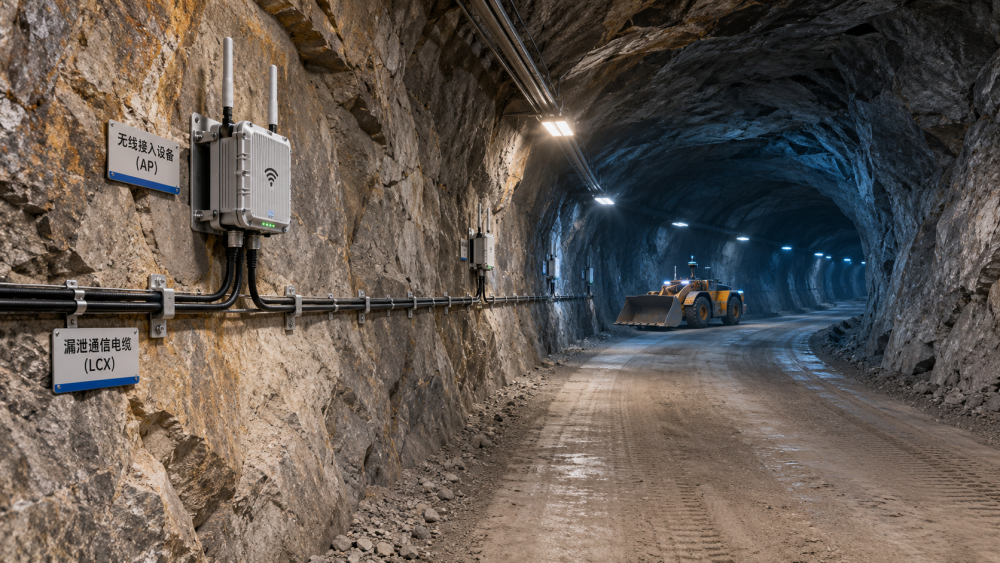
Leaky feeder for route-based radio coverage
A leaky feeder cable radiates and receives radio signals along its length. Amplifiers compensate for signal loss, and splitters or couplers extend the distribution into branches. This makes the architecture well suited to long headings and travelways where handheld or vehicle radio coverage follows known routes.
Its value depends on the complete system, including radio channels, power supplies, amplifier spacing, and any interface to surface communications. Cable continuity alone does not prove usable voice quality: a damaged connector, failed amplifier, poor branch design, or local interference can produce a weak section while other sections remain operational. Data and tracking capabilities are implementation-specific; verify supported devices, capacity, update behavior, and whether they share resources with voice.
Fiber as the transport backbone
Fiber carries traffic over long underground routes without the electromagnetic interference that can affect metallic communications cables. It can connect switches, radio nodes, Wi-Fi access points, cellular equipment, and control systems. Choose cable construction and protection for the installation environment, including abrasion, water, equipment movement, and access for repairs.
Two fibers in the same cable or along the same exposed route do not provide independent paths against a single physical strike. A ring topology can improve continuity only when routes, switching behavior, power, and recovery have been designed and tested accordingly. At a tunnel face, plan spare length, splice locations, and the transition between fixed infrastructure and moving equipment.
Wi-Fi for local data and mobile routes
Wi-Fi access points can support tablets, cameras, sensors, and equipment interfaces where capacity is needed around defined work areas. Placement must account for passage geometry, obstructions, mounting protection, and access to power and backhaul. Adding an access point at the far end of a heading does not fix a bottleneck farther upstream.
For moving equipment, examine the actual client as well as the network. Roaming decisions can depend on client software and configuration; adjacent access points that both show adequate signal do not guarantee a timely transition. Video traffic, retransmissions, and contention can raise delay before a device visibly disconnects. Test loaded conditions with the intended application and antennas in their installed positions.
Private cellular for managed mobility
Private cellular can provide managed access for compatible devices across a planned underground radio network. It is a candidate where mobile equipment, voice, and data need coordinated coverage over a larger operating area. Its deployment still requires underground radio units or distributed radio infrastructure, backhaul, power, and a core network whose location and availability affect service.
Confirm that usable spectrum and the necessary operating authorizations are available at the site. Then assess device and modem compatibility, antenna placement, handover between cells, and the consequences of losing connectivity to the core or surface. A device supporting a cellular generation in general does not establish that it supports the site’s frequency bands and required features.
Specify performance by service, not by signal bars
A coverage map based on signal strength is useful for finding gaps, but it cannot establish application performance on its own. Signal quality, interference, available capacity, packet loss, and the return path all affect the result. Define each service with measurable requirements at the device or application interface, including conditions during movement and network recovery.
- Voice: intelligibility, call setup, group communication, priority behavior, and access during a degraded network state.
- Remote equipment operation: end-to-end latency, variation in latency, packet loss, video continuity, and the equipment’s response when the link degrades or fails.
- Telemetry: message size, reporting interval, acceptable delay, buffering, and recovery after a connection returns.
- Personnel location: required update interval and location accuracy, including junctions, refuge areas, and places where tags are shielded.
Latency figures need defined endpoints and traffic conditions. A radio link measurement excludes processing in cameras, encoders, switches, servers, and operator displays; all contribute to the delay experienced by an operator. Likewise, an average can hide brief interruptions during roaming. Record delay distribution and loss during travel, handover, congestion, and recovery, then compare the results with the equipment control system’s limits.
Tracking deserves a separate acceptance test. Radio coverage can carry a tag message without locating the tag precisely enough to distinguish adjacent headings. Accuracy depends on the locating method, anchor placement, environment, and update rate. Test the reported position against known locations, including areas with similar-looking routes or heavy machinery.
Design for failure and safe recovery
List credible single failures and their effects on each service: a cut cable, failed amplifier, damaged access point, lost switch, power interruption, or loss of the surface connection. A shared power supply or cable tray can turn apparently separate voice and data systems into a common failure. Where independent paths are required, trace their physical routes and power sources rather than relying on a network diagram alone.
Emergency communications require an agreed operating concept. Establish which devices work underground, which areas they must reach, what happens when a link to the surface fails, and how backup power is maintained. A normal production network should not be assumed to meet emergency obligations without a documented assessment against the requirements applicable to the site.
For remotely controlled machinery, define a controlled response to loss of communication with the equipment supplier and site operating team. Network redundancy can reduce interruptions, but it does not replace machine-level protective functions or a tested procedure for restoring operation.
Interoperability and installation constraints
Inventory the equipment that must connect before selecting a radio architecture. Handhelds, vehicle modems, access points, radio gateways, switches, and application servers can have different interface and power requirements. Confirm whether voice groups, alarms, dispatch functions, and tracking data must cross between systems; a physical connection between networks does not automatically provide those functions.
Underground hardware also needs an installation suited to the environment. Water ingress, dust, vibration, corrosion, impact, and washdown can affect enclosures and connectors. Cable routes compete with ventilation ducting, electrical services, rails, and moving plant. In hazardous areas, equipment selection and installation must satisfy the applicable site and jurisdictional requirements for that environment.
Maintenance access changes the practical coverage choice. An access point mounted where a crew cannot safely reach it, or a splice buried behind permanent services, can extend an outage. Record node locations, labels, spare parts, power isolation points, and the tools needed to identify and repair a fault. Include the labor and production access needed to extend coverage as the face advances.
Validate the design under operating conditions
Begin with a route survey and propagation model, then use a representative installation to test the assumptions that matter most: a bend, a junction, a long straight heading, a congested machine location, and the transition to the advancing face. Measurements should include both directions of travel and the equipment orientations expected in service. A stationary test with a handheld at chest height cannot represent a vehicle antenna shielded by steelwork.
Apply representative traffic while measuring voice quality, application delay, throughput, packet loss, and handover interruptions. Test with machinery and infrastructure in their normal positions where safe to do so. Record the device, antenna, software configuration, route, load, and measurement endpoints so that results can be reproduced after a layout change.
Finally, introduce controlled failures: disconnect a backhaul segment, remove a node’s power, and restore the connection under an agreed test procedure. Observe which services remain available, how alarms reach operators, whether sessions recover, and whether any manual intervention is needed. Use those results to define acceptance boundaries and the conditions that trigger a new survey as excavations and equipment routes change.
Share your questions or requirements, and our team will get in touch.
We respect your privacy. Your information is strictly confidential.
Related News
 Pipe Jacking Machine Cost: Key Price Factors and What to BudgetPipe Jacking Machine cost depends on diameter, ground conditions and equipment scope. Explore key price factors and build a reliable project budget.
 Bauma China 2026 Closes as Visitor Numbers Rise 21%Bauma China 2026 reports a 21% rise in visitors. Explore what interest in mining trucks, underground machinery and automation could mean for buyers.
 Underground Communication Systems: Choosing Coverage for Mines and TunnelsCompare Underground Communication Systems for mines and tunnels. Explore coverage options, reliability, and testing to choose the right solution.
 Global Mine Permitting Delays Ease, but the United States Still LagsMine permitting delays are easing globally, but the United States still lags. Explore what this means for project timelines and mining equipment demand.
 Underground Excavation Safety: How to Control Ground and Air HazardsUnderground excavation safety starts with stable ground and breathable air. Discover practical controls, monitoring tips and stop-work triggers.
 Mega Tunnel Contractors: How to Evaluate Experience and Project RisksEvaluate mega tunnel contractors with confidence. Learn how to assess relevant experience, ground risks, construction plans, and bid assumptions before award.
 Smart Underground Mining Analytics: Using Equipment Data to Reduce DowntimeSmart underground mining analytics turns equipment data into actionable insights. Discover how to reduce downtime and improve maintenance decisions.
 Choosing a TBM Components Supplier: Lead Times, Quality and CompatibilityChoose a TBM components supplier with confidence. Compare lead times, quality evidence and compatibility to reduce procurement risk and keep your project moving.
Related News
- 00
0000-00
Dinghai Shield Machine Passes 5,000 Metres in Jintang Undersea Tunnel - 00
0000-00
Pipe Jacking Machine Cost: Key Price Factors and What to Budget - 00
0000-00
Bauma China 2026 Closes as Visitor Numbers Rise 21% - 00
0000-00
Chinese-Made 16-Meter Shield Machine Completes Yangtze River Crossing - 00
0000-00
Hydrogen Mining Truck Price: What Drives the Purchase Cost?
Weekly Insights
Stay ahead with our curated technology reports delivered every Monday.