
Australia Tightens EV Mine Truck Import Rules





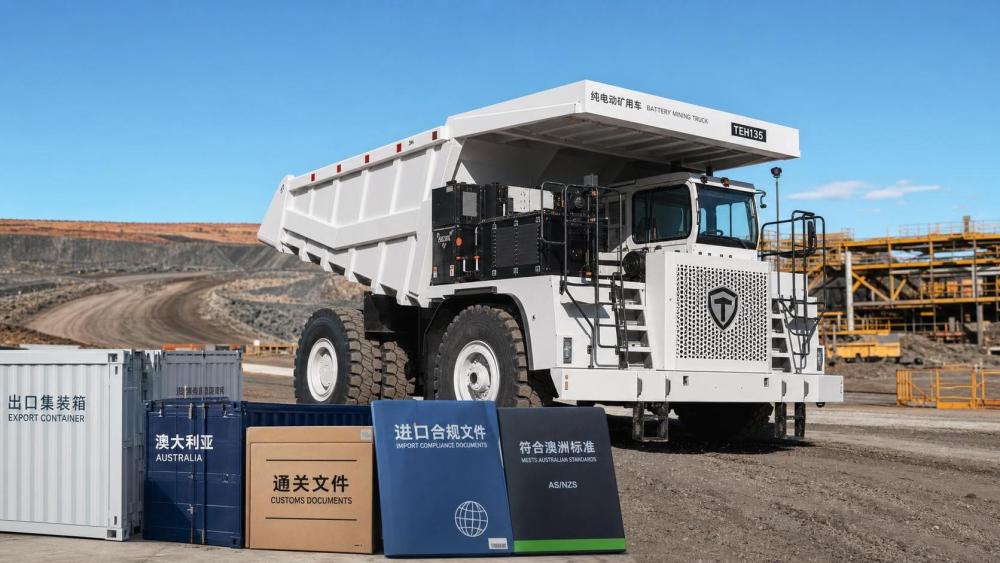
On July 26, 2026, Australia’s transport authorities issued a new import compliance notice for electric off-highway vehicles, setting a September 1 enforcement date for dual type approval on imported battery-electric mining haul trucks. For manufacturers exporting to Australia, mining equipment buyers, compliance teams, and logistics partners, the update matters because it links market access directly to both battery safety and cybersecurity certification, with non-compliant units unable to clear customs or enter mine operations.
What the Notice Now Requires
According to the information provided, the Australian Department of Transport released the Electric Off-Highway Vehicles Import Compliance Notice No. 2026-8 on July 26, 2026. The notice states that from September 1, 2026, all fully electric rigid and articulated mining haul trucks imported into Australia, including Rigid Haul Trucks and Articulated Dump Trucks, must obtain both UN R100-03 certification for battery safety and UN R155 certification for cybersecurity management systems.
The requirement applies to imported vehicles in the covered categories. Based on the provided summary, equipment that does not have the required certifications will not be able to clear customs or be put into mining operation in Australia.
Where the Immediate Pressure Will Appear
Export manufacturers face a direct market-entry checkpoint
From an industry perspective, manufacturers shipping battery-electric mining trucks to Australia are the first group affected because certification is now tied to import eligibility. The practical impact is likely to concentrate on product approval status, export documentation, shipment timing, and delivery readiness for Australia-bound units.
Mining buyers and project procurement teams may need tighter verification
Procurement functions on the buying side may also be affected because the new rule changes what must be confirmed before equipment can be accepted for import and site deployment. What deserves closer attention is whether certification status is verified early enough in the purchasing cycle rather than only at the customs or delivery stage.
Supply chain and customs service providers will be pulled into compliance review
For logistics, customs, and trade service providers, the issue is less about vehicle design and more about document completeness and import execution. Analysis shows that any gap between declared compliance and actual certification status could disrupt customs handling or delivery schedules, especially where shipments are already planned around the September 1 effective date.
Chinese exporters are specifically exposed on the Australia route
The provided information explicitly notes an impact on the export path of Chinese manufacturers. Observably, this makes Australia-bound sales, contract execution, and client communication a priority area for companies that rely on that route for electric mining truck deliveries.
What Companies Should Be Checking Now
Confirm the certification boundary for affected models
Companies should first clarify which Australia-bound products fall within the covered categories of fully electric rigid and articulated mining haul trucks. In practice, the key issue is not broad electrification strategy, but whether specific models scheduled for export on or after September 1 require the dual certification named in the notice.
Review document readiness against the import timeline
What deserves closer attention is the interaction between certification status and shipment timing. Businesses involved in export, customs preparation, and delivery coordination should check whether supporting documents for UN R100-03 and UN R155 can be aligned with customs clearance and site-entry requirements under the new timeline.
Separate policy text from operational execution
Analysis shows that compliance notices often create two layers of work: understanding the formal requirement and translating it into operational checkpoints. For this update, companies should pay close attention to how the rule is reflected in order acceptance, handover documentation, customs preparation, and customer communications, rather than treating the notice as only a regulatory headline.
Prepare client and supplier communication early
For sales teams, sourcing teams, and after-sales coordinators, a practical focus is expectation management. Exporters and service partners may need to communicate clearly with customers and suppliers about certification status, delivery conditions, and any risk to deployment timing for units intended for the Australian market.
Why This Reads as More Than a Routine Customs Update
As an editorial observation, this development is better understood as a concrete compliance threshold rather than a general policy signal. The reason is straightforward: the provided information links certification directly to customs clearance and operational entry, which gives the notice immediate commercial relevance for affected vehicles.
At the same time, it is still more appropriate to understand the broader market impact as something that requires continued observation. The confirmed facts establish the rule, the effective date, the covered vehicle types, and the consequence for non-compliant imports. Broader conclusions about how deeply this will reshape supplier strategies, procurement choices, or certification planning would need further verified information.
How the Market Should Read This Update
In practical terms, this is a near-term regulatory change with immediate implications for Australia-bound electric mining truck trade, especially for exporters that have not yet aligned battery safety and cybersecurity approval with delivery schedules. From an industry perspective, the most balanced reading is that the rule has already created a clear compliance condition, while its wider competitive and supply-chain effects should still be tracked carefully rather than assumed.
Basis of This Article and What Still Needs Verification
This article is based on the user-provided news title, event date, and event summary. For developments of this kind, commonly relevant source types may include official government notices, company statements, industry association updates, authoritative media reporting, and standard-related documents.
The specific official source link was not provided in the input, so continued verification remains necessary. The main follow-up points to watch are whether any further official clarification is issued on implementation details, document expectations, or enforcement practice around the September 1, 2026 start date.
Related News

How to Evaluate European Drill-and-Blast Tunnelling Contractors for Complex Projects
Drill and blast tunnelling contractors Europe: learn how to assess geology expertise, blast control, equipment reliability, safety, and programme resilience for complex projects.

Which Trenchless Construction Technique Fits Your Utility Crossing Conditions?
Trenchless construction techniques compared for utility crossings: choose HDD, microtunnelling, pipe jacking, or auger boring based on ground, accuracy, access, and risk.

What Is Driving Metro Tunnelling Demand Across Southeast Asia’s Major Cities?
Metro tunnelling Southeast Asia is accelerating as major cities tackle congestion, flooding, and connectivity. Explore the market forces, technical risks, and opportunities shaping demand.

Hard Rock Tunnelling in Australia: Selecting Methods for Variable Ground Conditions
Hard rock tunnelling in Australia: compare TBM, drill-and-blast and hybrid methods to manage variable ground, reduce risk and protect project costs.

Hydropower Tunnel Excavation: Selecting Methods for Variable Rock Conditions
Hydropower tunnel excavation methods for variable rock conditions: compare TBM, drill-and-blast, and hybrid strategies to improve safety, progress, and project control.

How to Select Underground Safety Equipment for Tunnelling by Hazard and Work Zone
Underground Safety Equipment for tunnelling: match protection to hazards, work zones, compliance, and emergency needs with this practical selection guide.

EPB or Slurry Shield? Selecting Soft-Ground Tunnelling Equipment by Soil Conditions
Tunnel Excavation Equipment for soft ground: compare EPB and slurry shields by soil, groundwater, settlement risk, and project logistics to choose confidently.
How to Specify TBM Backup System Parts for Reliable Long-Distance Tunnelling
TBM backup system parts: learn how to specify reliable spares for long-distance tunnelling, reduce downtime, ensure compatibility, and speed underground recovery.

How to Size Open Pit Mining Trucks for Haul Distance, Grade, and Payload?
Open Pit Mining Trucks: learn how to match payload, haul distance, grade, road resistance, and loading capacity for safer, lower-cost mine operations.
Related News
- 00
0000-00
How to Evaluate European Drill-and-Blast Tunnelling Contractors for Complex Projects - 00
0000-00
Which Trenchless Construction Technique Fits Your Utility Crossing Conditions? - 00
0000-00
What Is Driving Metro Tunnelling Demand Across Southeast Asia’s Major Cities? - 00
0000-00
Hard Rock Tunnelling in Australia: Selecting Methods for Variable Ground Conditions - 00
0000-00
Hydropower Tunnel Excavation: Selecting Methods for Variable Rock Conditions
Weekly Insights
Stay ahead with our curated technology reports delivered every Monday.