
Battery-Electric Underground Mining Trucks: Range and Charging Selection





Nominal battery capacity or a quoted range cannot establish whether an underground mining truck will meet a production target. The decisive question is whether the truck can complete the required loaded and empty haul cycles, retain a usable energy reserve, and recover enough energy during available charging windows without creating queues or exceeding the mine’s electrical capacity.
A truck with a smaller battery and reliable charging at a natural stopping point can outperform one with a larger battery that must leave the production route for a long recharge. The reverse is true when charging opportunities are unpredictable, haul distances change frequently, or a shared charger cannot serve the fleet during the same shift.
Turn the haul profile into an energy requirement
Range should be assessed against a defined route and duty cycle, not against distance alone. A kilometre travelled uphill with a full payload is not equivalent to a kilometre travelled empty on a level roadway. Build the operating profile from the loading point to the dump point and back, including elevation changes, speed restrictions, intersections, waiting time and any diversion to charge.
For each representative cycle, establish the loaded and empty distances, payload, vertical rise or descent, expected travel time and stationary periods. Rolling resistance also matters: road surface condition, standing water, tyre condition and maintenance practices affect the energy required to move the truck. A route that is short on a mine plan can still be energy-intensive if it includes a steep loaded climb or frequent stops.
Elevation is particularly important because the energy needed to raise the loaded vehicle depends on its total mass and vertical lift, not simply the gradient shown on a ramp drawing. Two routes with the same vertical rise have the same ideal gravitational energy requirement for a given mass, but their actual battery demand can differ because of distance, speed, rolling resistance and drivetrain losses.
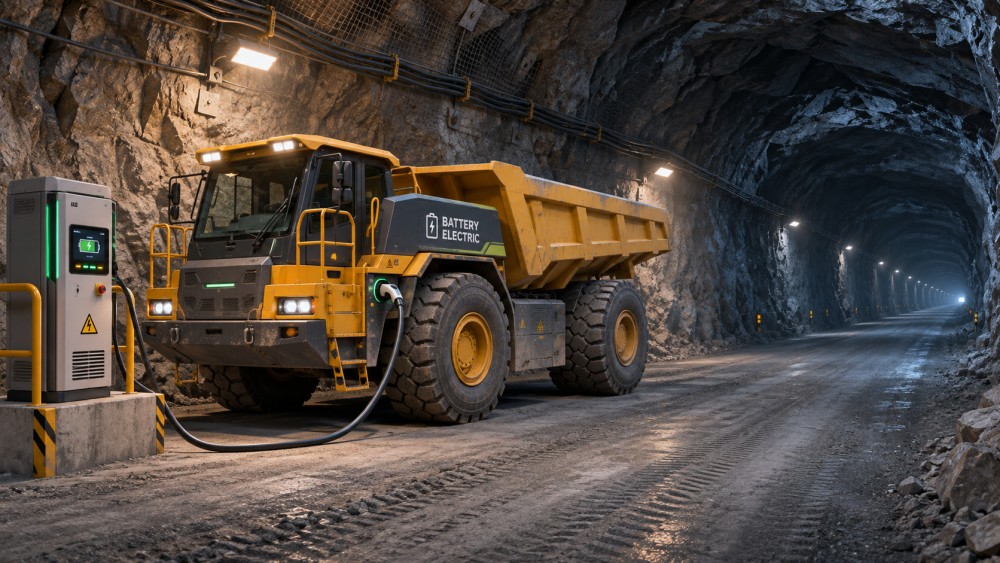
Auxiliary loads should be included separately where possible. Battery thermal management, cab conditioning, lighting, control systems and other onboard equipment consume energy even when the truck is waiting. A production model based only on traction can therefore understate consumption on routes with long loading queues or extended idle periods.
The useful output is energy per completed cycle under stated conditions, plus cycle time. Multiplying average cycle energy by the number of cycles is a starting point, but selection should also test a demanding shift: heavier payloads within the rated limit, degraded road conditions, longer queues and fewer charging opportunities. These factors do not necessarily peak together, so scenarios should be operationally credible rather than an arbitrary sum of every worst case.
Translate installed battery capacity into usable shift energy
Installed battery capacity is not the same as energy available for haulage. The battery management system may restrict the operating state-of-charge window, while temperature, power demand and battery ageing can reduce accessible capacity or limit performance. Establish whether the supplier’s figures refer to nominal pack capacity, usable energy when new, or guaranteed usable energy at a specified point in service life.
A practical energy balance is:
Available shift energy = usable energy at shift start + usable energy gained during the shift − required energy reserve.
Compare that figure with the energy needed for the planned cycles and auxiliaries. Keep the accounting boundary consistent: energy measured at the charger input is not the same as energy stored in the battery, and energy delivered by the battery is not the same as mechanical energy at the wheels. Charging losses must be accounted for when converting grid electricity into battery energy.
The reserve should reflect the operating plan rather than a generic percentage. It may need to cover a delayed charge, a route diversion, recovery to a safe location or an interruption in power supply. The battery should also retain sufficient power capability near the lower end of its permitted charge window: an energy balance alone does not prove that the truck can maintain the required speed on a ramp.
Ageing deserves a separate check. A configuration that works only with a new pack and ideal charging conditions leaves little room for degradation. Request the capacity-retention assumptions, duty-cycle conditions, temperature limits and warranty terms behind any end-of-life performance claim. Capacity loss and power limitations are related but distinct; both can affect the production cycle.
Count regenerative braking only where the battery can accept it
Regenerative braking can return part of the vehicle’s kinetic or gravitational energy to the battery during deceleration and downhill travel. Its value depends on the direction of the loaded haul, the elevation profile and the battery’s ability to accept charge at the time of descent. A loaded downhill leg can offer more recovery potential than an empty downhill leg, but neither recovers all the energy involved.
Motor and drivetrain losses, traction limits, battery temperature, state of charge and maximum charging power constrain recovery. If a truck starts a long descent with a nearly full battery, regeneration may be reduced because there is insufficient charge acceptance or storage headroom. Friction braking or another approved braking arrangement must still manage the remaining braking duty.
This creates a charging trade-off: filling the battery immediately before a descent may provide unnecessary energy while reducing room for regeneration. Conversely, leaving headroom is not useful if the following climb and reserve requirement demand a higher starting charge. Model the sequence of route segments and charging events, rather than subtracting a fixed regeneration percentage from total shift consumption.
Choose charging around the production cycle
Charging can be scheduled during breaks, shift changes or other planned stops, or it can be arranged as shorter opportunity charges during the operating cycle. The right choice depends on how much energy must be replaced, how predictable the stops are, and whether connecting the truck changes the cycle time.
A charger’s rated power is not necessarily the average power delivered throughout a session. The truck and charger may limit power as the battery fills, heats or cools, or approaches a permitted operating boundary. Connection, positioning and departure also take time. The relevant measure is therefore usable energy gained during the full interruption, not just peak charger output.
Consider an illustrative truck that uses 36 kWh per cycle, including allocated auxiliary consumption. Four cycles require 144 kWh. If the battery has 200 kWh of usable energy at the start and the operating plan reserves 40 kWh, the truck has 160 kWh available before charging. Four cycles fit within that budget; a fifth would require at least 20 kWh of additional usable energy. If a planned stop delivers only 15 kWh into the battery, it does not support that fifth cycle under the stated assumptions. This example describes an energy balance, not a measured truck performance claim.
Charging duration must also fit the timetable. A charger capable of supplying the required energy in isolation may not do so when multiple trucks arrive together. Conversely, a lower-power unit can be sufficient if the truck has a long, dependable stop and the connection does not interrupt production. Ask for charging curves under the relevant battery temperatures and starting states of charge, rather than relying on a single peak-power figure.
Charger location is a haulage decision
A charger near a loading or dumping point can make productive use of existing waiting time, but only if trucks can connect safely without blocking traffic or delaying the loading system. A charger away from the route may be easier to install and maintain, yet the detour consumes energy and adds travel time. Evaluate both the charging time and the full time lost to reach, occupy and leave the station.
Location also determines how much operational flexibility the fleet retains. A single central charger may serve several routes but creates a common dependency. Distributed charging can reduce detours and provide alternatives, while requiring more electrical infrastructure and maintenance points. The appropriate arrangement depends on route stability, available space and the consequences of losing a station.
Check the physical interface as carefully as the electrical rating: connector access, cable handling, clearance around the truck, protection from vehicle impact, water and dust exposure, and safe access for inspection. Charger placement must be compatible with the mine’s traffic management and emergency arrangements. Applicable electrical, fire protection and underground safety requirements depend on jurisdiction and site conditions and should be established during design.
Test fleet throughput, not just one truck
A single-truck calculation can show that charging is feasible while concealing a fleet bottleneck. If several trucks finish their energy window at similar times, a shared charger can become a queue. The production loss is not limited to the energy shortfall: each waiting truck is unavailable for haulage, and congestion can disrupt other equipment.
Model arrival times, connection duration, charging power and departure times across a complete shift. Include charger availability, planned maintenance, delayed trucks and the effect of one truck taking longer to charge. Average daily energy demand is useful for sizing the electrical supply, but it does not reveal whether the available chargers can serve trucks during short, overlapping windows.
At the electrical level, distinguish the charger’s output to the vehicle from the upstream supply needed to support it. Transformer capacity, cable length, voltage drop, protection coordination and other simultaneous mine loads can constrain the power available at the charging point. If a site uses load management, the resulting charging-power reductions must be included in the fleet model.
Battery swapping is an alternative where the truck platform and site are designed for it. It can separate battery replenishment from truck turnaround, but shifts the constraint to the availability, charging and handling of spare packs. The comparison must include swap time, spare battery capacity, charging equipment, handling infrastructure and the procedure for an unavailable or faulty pack. A quick exchange does not eliminate the need to replenish the batteries between uses.
Set acceptance conditions that match the mine
Supplier comparisons are most useful when every proposal is evaluated against the same route, payload, production schedule and reserve requirement. Request the assumptions behind cycle energy and time, including road resistance, gradients, auxiliary loads, regeneration limits and battery operating window. A range claim without those conditions is difficult to translate into production capacity.
Before final selection, establish how performance will be verified. A representative operating trial or agreed simulation should define the route, payload, battery condition, temperature range, measurement boundaries and number of cycles. Measure battery energy change and charger energy separately, record charging and queue times, and identify deviations from the assumed duty cycle. One favourable run should not be treated as proof of shift-wide performance.
The strongest configuration is the one that meets the required tonnes per shift with a credible reserve and a workable charging schedule, including when equipment or infrastructure is unavailable. Where two options have similar calculated energy margins, the more consequential difference may be whether the mine can consistently deliver the planned charging opportunity.
Related News
Hudson Tunnel Project’s Second TBM Begins Excavating South Tunnel
Hudson Tunnel Project’s second TBM begins south tunnel excavation. Explore what this milestone could mean for contractors and suppliers.
How Bolting Jumbo Automation Works in Underground Rock Support
Explore how bolting jumbo automation coordinates drilling and rock support, and discover what to assess for safer, more consistent underground operations.
China’s Transport Ministry Issues Highway Tunnel Upgrade Standard
China’s highway tunnel upgrade standard takes effect December 1, 2026. Explore potential implications for contractors, project owners and equipment suppliers.
Smart Underground Mining Analytics: Using Equipment Data to Reduce Downtime
Smart underground mining analytics turns equipment data into actionable insights. Discover how to reduce downtime and improve maintenance decisions.
Three Export Control Notices Take Effect November 18, Adding Tunnel Boring Machines
China export controls add tunnel boring machines to the dual-use list. Explore potential licensing implications for equipment, components and project delivery.
Choosing a TBM Components Supplier: Lead Times, Quality and Compatibility
Choose a TBM components supplier with confidence. Compare lead times, quality evidence and compatibility to reduce procurement risk and keep your project moving.
How Autonomous LHD Collision Avoidance Works in Underground Mines
Discover how autonomous LHD collision avoidance combines sensing, positioning and braking to manage underground hazards and support safer mine operations.

Mining Equipment Market Could Reach $19.42 Billion by 2033, Report Says
Mining equipment market could reach $19.42 billion by 2033. Explore how electrification, automation and surface mining demand are shaping the industry's outlook.

Selecting Municipal Trenchless Contractors in Canada: Key Bid Criteria
Municipal trenchless construction contractors Canada buyers can trust: compare bid criteria, technical risks and costs to make a confident award decision.
Related News
- 00
0000-00
Hudson Tunnel Project’s Second TBM Begins Excavating South Tunnel - 00
0000-00
How Bolting Jumbo Automation Works in Underground Rock Support - 00
0000-00
China’s Transport Ministry Issues Highway Tunnel Upgrade Standard - 00
0000-00
Smart Underground Mining Analytics: Using Equipment Data to Reduce Downtime - 00
0000-00
Three Export Control Notices Take Effect November 18, Adding Tunnel Boring Machines
Weekly Insights
Stay ahead with our curated technology reports delivered every Monday.