
Evaluating Autonomous Haulage Systems for U.S. Open-Pit Mine Conditions





At the end of a long production shift, an autonomous haulage proposal can look deceptively simple: add autonomous trucks, reduce exposure at the wheel, and make haulage more consistent. The difficulty usually appears when the mine map is opened beside the fleet plan. A wide, dry main ramp may look ready for automation, while the same operation has narrow passing zones, changing dump locations, seasonal freeze-thaw damage, mixed traffic, and loaders that still depend on experienced operators reading conditions in real time.
That gap between a fleet brochure and an operating mine is where evaluation work becomes difficult. A poor-fit deployment can create bottlenecks at loading or dumping, force restrictive traffic rules, complicate maintenance, and leave dispatch personnel managing two different operating models. A well-matched deployment, by contrast, begins with a clear question: which parts of the current haulage system are stable enough to automate without moving risk, delay, or cost somewhere else?
Start with the haul cycle, not the truck specification
When evaluating autonomous haulage systems USA mine operations, it is tempting to compare nominal payload, top speed, onboard sensors, and advertised automation functions first. Those details matter, but they do not reveal whether the operating environment is controllable. The haul cycle does.
Break the current cycle into loading, travel to dump, queueing, dumping, return travel, refueling or charging, inspections, and exceptions. Each segment should be reviewed separately because autonomy rarely encounters the same level of uncertainty everywhere. A repetitive travel segment on a well-maintained dedicated road may be suitable even when the loading face remains highly variable. In some mines, the better first decision is not full-pit autonomy but an autonomous corridor connecting a stable loading zone to a fixed crusher or stockpile.
Look beyond average cycle time. Averages can hide the situations that disrupt an autonomous fleet: a grader working on the ramp, a water truck crossing an intersection, loose material near a berm, a temporary bypass around road repair, or a loaded truck approaching a dump edge during poor visibility. Record the frequency, duration, and operational consequence of those events. If exceptions are common, the mine needs a practical rule for resolving them before autonomous production starts.
Map variability where it actually occurs
A useful route map combines geometry with operating behavior. Include road widths, grade changes, curve radii, intersections, pull-off areas, berm condition, drainage, signage, speed-control areas, and communications coverage. Then mark where congestion forms, where operators commonly slow down, and where road alignment changes as the pit advances.
Open-pit conditions in the United States can vary sharply by region and season. Dust may reduce visibility and affect sensor cleaning requirements. Heavy rain can alter rolling resistance and road edge definition. Snow, ice, fog, heat, and wind can change stopping behavior, traction, and communications reliability. The relevant question is not whether the automation system can operate in one difficult condition during a demonstration. It is whether the mine has defined operating limits, inspection routines, and fallback procedures for the conditions that repeatedly occur at that site.
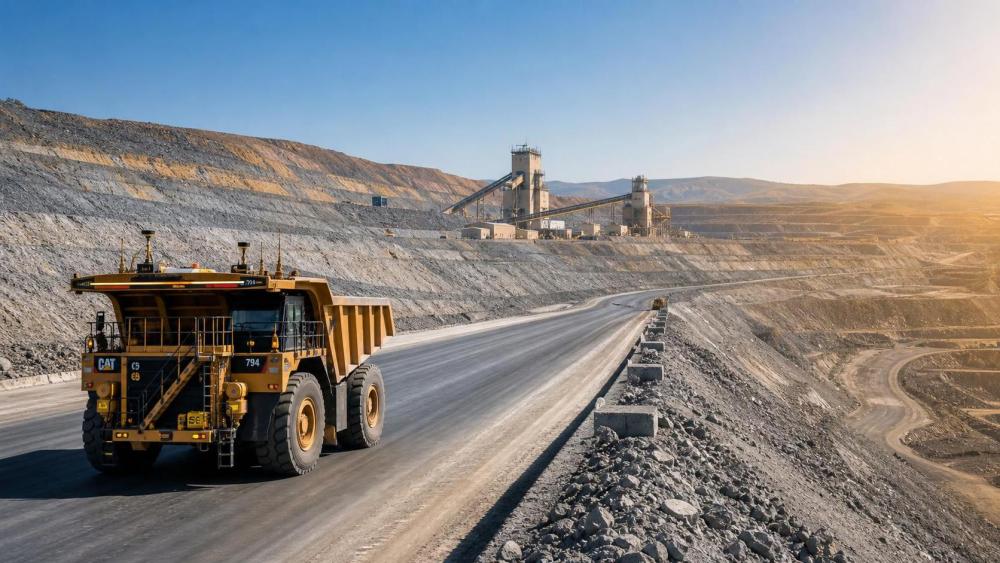
The road is part of the automation system
Autonomous trucks rely on a physical environment that remains interpretable. This does not mean every road must be perfect. It means that changes must be managed in a way the system can recognize and the operation can communicate. Haul roads with inconsistent widths, ambiguous boundaries, uncontrolled access points, or frequent unplanned modifications create operational uncertainty even if the trucks themselves are technically capable.
Evaluate road readiness in operational terms:
- Can loaded and empty trucks pass safely at all planned points, including areas affected by windrows, drainage, or temporary material buildup?
- Are intersections designed so that right-of-way rules can be enforced without relying on informal radio coordination?
- Can road crews enter a work zone through a controlled process, and can trucks be slowed, rerouted, or held before reaching it?
- Do dump points provide enough room for approach, tipping, exit, and recovery from an abnormal stop?
- Will pit progression require route updates often enough that map maintenance becomes a daily production constraint?
This review often changes the scope of the project. If a mine’s core routes are stable but peripheral routes change constantly, it may be more sensible to automate only the core routes at first. That is not a compromise in safety or capability. It is a way to test the operating model where the physical controls are strongest.
Mixed traffic is usually the harder question
Few operating mines can isolate every vehicle. Loaders, dozers, graders, light vehicles, service trucks, drill rigs, fuel equipment, and contractor vehicles may all interact with the haul network. The issue is not simply whether mixed traffic is allowed. The issue is whether every vehicle class has a defined behavior around autonomous equipment.
Many manual operations depend on habits that experienced drivers understand without saying: a light vehicle pulls aside near a blind curve, a grader expects trucks to wait while the blade is down, or a loader operator signals that a loading area is temporarily unavailable. Those habits need to become explicit rules, supported by road design, communications, access control, and training. If the autonomous truck must repeatedly interpret informal behavior, availability may suffer and personnel may be placed in uncertain situations.
Ask suppliers and internal operations teams to demonstrate the handling of realistic interactions rather than idealized scenarios. Consider a maintenance pickup that stops near a route boundary, a dozer reshaping a dump, a water truck entering an intersection, or a manually operated truck losing radio contact. The evaluation should identify who receives the alert, who has authority to intervene, how the area is made safe, and how production resumes. “The system will detect it” is not a complete operating procedure.
Define the human handoff before it is needed
Remote intervention is often treated as a final safety net, but it should be assessed as a routine operational function. Determine which exceptions can be resolved remotely, which require a field response, and which require the truck to stop in a predefined safe location. Review response time under normal staffing, during shift changes, and during simultaneous events.
Control-room design matters here. Operators need useful alarm prioritization, route status visibility, vehicle health information, and a clear record of active restrictions. Too many low-value alerts can create alarm fatigue; too little context can delay the correct decision. The best evaluation sessions include dispatchers, road-maintenance supervisors, loading personnel, safety representatives, and maintenance planners, because each group sees a different failure point in the cycle.
Interoperability can decide the project before autonomy does
An autonomous fleet does not operate alone. It needs to exchange information with production dispatch, fleet management, maintenance planning, high-precision positioning infrastructure, communications networks, fueling or charging systems, and often mine-planning data. If those connections are poorly understood, the project can become a collection of manual workarounds.
Before choosing a solution, document the systems already used to assign trucks, track payloads, manage delays, capture equipment condition, and report production. Then separate essential interfaces from desirable ones. Essential interfaces are those without which the operation cannot safely or accurately run the autonomous fleet: route authority, geofence updates, truck status, production destination, emergency-state information, and maintenance lockout status. Desirable interfaces may include deeper analytics or automated reporting that can be added later.
Vendor architecture should also be examined carefully. Some operations may prefer a tightly integrated fleet and autonomy stack because responsibility lines are clearer. Others may need compatibility with existing equipment or dispatch tools. Neither approach is automatically better. The practical choice depends on the current fleet, planned replacement timing, internal support capability, and the mine’s willingness to standardize its operating environment.
Do not reduce economics to labor assumptions
Labor structure is part of the economic case, but it should not dominate it. Autonomous haulage changes work rather than simply removing it. The operation may need route-management personnel, control-room coverage, communications support, autonomous-system maintenance skills, updated training, and a stronger process for managing road changes. These requirements should be included in the operating model from the start.
A more reliable economic review follows the physical cycle. Estimate the likely effects of speed controls, queueing rules, planned holds, route restrictions, refueling or charging, maintenance access, and weather-related limits. Compare them with the manual baseline using the same definitions for available hours, productive hours, delays, payload measurement, and road condition. A baseline built from unusually good months or from inconsistent delay codes will create misleading expectations.
Energy deserves a separate evaluation. Diesel trucks, trolley-assisted arrangements, and battery-electric haulage concepts each change the infrastructure question. For electric equipment, assess charging location, peak power demand, cable or charging access, downtime during energy replenishment, thermal performance, and emergency response procedures. On long descents, regenerative braking may improve energy recovery, but it does not remove the need to evaluate braking performance, traffic flow, and grade control under real road conditions.
A staged validation is more useful than a broad promise
Rather than asking whether the mine is “ready for autonomy,” define what must be proven in sequence. Start with a bounded route and a limited set of vehicle interactions. Establish acceptance criteria around safe stops, route adherence, dispatch response, communications loss, maintenance release, controlled work-zone entry, and shift handover. The criteria should be observable and agreed before production pressure encourages shortcuts.
Run the validation across normal and abnormal conditions. Include road maintenance, changing light, low-visibility conditions that are relevant to the site, temporary route closures, loader relocation, and a controlled loss of a supporting service where safe to test. The point is not to create a dramatic failure exercise. It is to verify that people, procedures, and equipment respond predictably when the plan changes.
After each phase, review more than truck utilization. Examine why trucks stopped, whether delays were preventable, how often human intervention was required, whether route updates were timely, and whether work groups found the access rules practical. A system that performs well only when the mine is unusually quiet is not yet ready for expansion.
Choosing the scope that fits the mine
For many autonomous haulage systems USA evaluations, the decisive choice is scope rather than supplier. A large, stable, high-volume route with controlled access may justify an early autonomous fleet. A mine with rapidly changing benches, multiple contractor interfaces, or highly variable dumping practices may need road and process improvements first. In other cases, autonomy may be suitable for selected trucks or a specific haul segment while manual equipment continues in flexible zones.
The strongest decision document states the limits clearly. It identifies routes that are eligible, conditions that require restricted operation, vehicle types allowed in the autonomous area, authorities for changing maps and geofences, minimum communications performance, recovery procedures, and the data used to judge expansion. It also names unresolved dependencies rather than hiding them in a general implementation plan.
Autonomous haulage is not a substitute for disciplined mine operations. It makes disciplined road management, traffic control, dispatch logic, maintenance coordination, and change control more visible. That can be uncomfortable during evaluation, but it is valuable. If the operating model can handle routine variation without relying on informal workarounds, the mine is in a much better position to decide whether autonomy belongs on its haul roads—and where it should begin.
Related News
How to Evaluate European Drill-and-Blast Tunnelling Contractors for Complex Projects
Drill and blast tunnelling contractors Europe: learn how to assess geology expertise, blast control, equipment reliability, safety, and programme resilience for complex projects.
Which Trenchless Construction Technique Fits Your Utility Crossing Conditions?
Trenchless construction techniques compared for utility crossings: choose HDD, microtunnelling, pipe jacking, or auger boring based on ground, accuracy, access, and risk.
What Is Driving Metro Tunnelling Demand Across Southeast Asia’s Major Cities?
Metro tunnelling Southeast Asia is accelerating as major cities tackle congestion, flooding, and connectivity. Explore the market forces, technical risks, and opportunities shaping demand.
Hard Rock Tunnelling in Australia: Selecting Methods for Variable Ground Conditions
Hard rock tunnelling in Australia: compare TBM, drill-and-blast and hybrid methods to manage variable ground, reduce risk and protect project costs.
Hydropower Tunnel Excavation: Selecting Methods for Variable Rock Conditions
Hydropower tunnel excavation methods for variable rock conditions: compare TBM, drill-and-blast, and hybrid strategies to improve safety, progress, and project control.
How to Select Underground Safety Equipment for Tunnelling by Hazard and Work Zone
Underground Safety Equipment for tunnelling: match protection to hazards, work zones, compliance, and emergency needs with this practical selection guide.
EPB or Slurry Shield? Selecting Soft-Ground Tunnelling Equipment by Soil Conditions
Tunnel Excavation Equipment for soft ground: compare EPB and slurry shields by soil, groundwater, settlement risk, and project logistics to choose confidently.
How to Specify TBM Backup System Parts for Reliable Long-Distance Tunnelling
TBM backup system parts: learn how to specify reliable spares for long-distance tunnelling, reduce downtime, ensure compatibility, and speed underground recovery.
How to Size Open Pit Mining Trucks for Haul Distance, Grade, and Payload?
Open Pit Mining Trucks: learn how to match payload, haul distance, grade, road resistance, and loading capacity for safer, lower-cost mine operations.
Related News
- 00
0000-00
How to Evaluate European Drill-and-Blast Tunnelling Contractors for Complex Projects - 00
0000-00
Which Trenchless Construction Technique Fits Your Utility Crossing Conditions? - 00
0000-00
What Is Driving Metro Tunnelling Demand Across Southeast Asia’s Major Cities? - 00
0000-00
Hard Rock Tunnelling in Australia: Selecting Methods for Variable Ground Conditions - 00
0000-00
Hydropower Tunnel Excavation: Selecting Methods for Variable Rock Conditions
Weekly Insights
Stay ahead with our curated technology reports delivered every Monday.