
What are the operational differences between EPB and slurry shield TBMs in high-water-pressure, mixed-face ground conditions?





Pressure, Paste, and Panic: Why Face Stability Isn’t Just a Setting on the Control Panel
High-water-pressure, mixed-face ground—think glacial till over fractured limestone, or weathered granite interbedded with sand lenses beneath a coastal aquifer—is where EPB and slurry shield TBMs stop behaving like textbook machines and start revealing their true operational DNA. It’s not about which one is “better.” It’s about which one buys you time when the face suddenly bleeds water, the clay turns sticky, and the gravel layer shifts under load. UTMD’s field intelligence from recent projects in Oslo’s fjord-adjacent tunnels, Jakarta’s volcanic alluvium, and Santiago’s Andean piedmont shows one consistent pattern: misalignment between ground behavior and shield type choice rarely triggers immediate failure—but it *guarantees* slower advance rates, higher cutter wear, and repeated pressure recalibrations that erode schedule certainty.
It Starts at the Face—Not the Pump Station
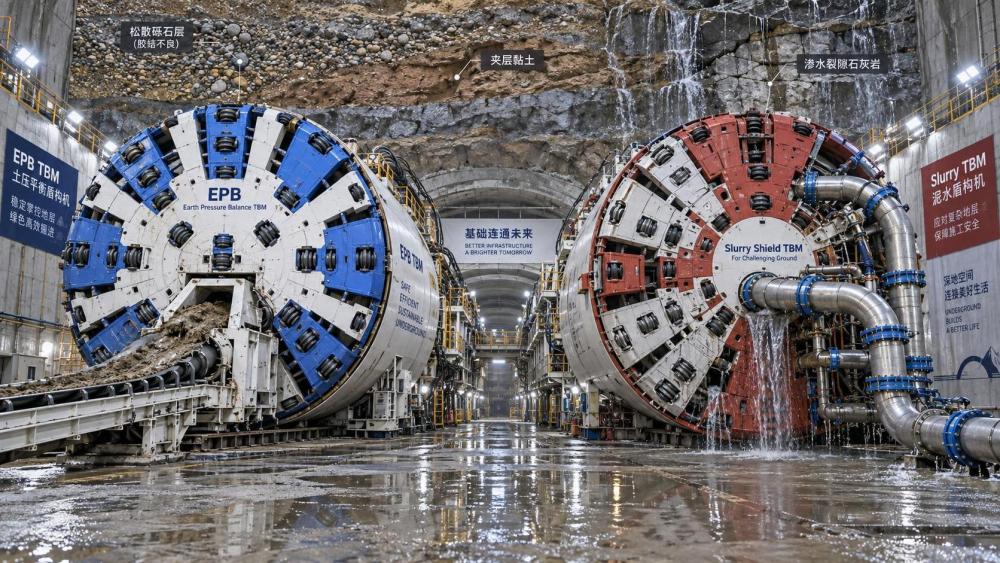
An EPB relies on plasticized spoil to form a temporary, self-supporting plug behind the cutterhead. In high-water mixed ground, that plug must resist both hydrostatic head *and* differential pressure across varying lithologies. If the clay content drops below ~25%—a threshold observed repeatedly in Singapore’s Kallang Basin excavations—the spoil loses cohesion. You get blowouts at the screw conveyor outlet, not just at the face. Slurry shields don’t ask for cohesion. They rely on external bentonite suspension to balance pressure, independent of spoil properties. But that suspension has its own limits: fine silt can clog the separation plant; coarse gravel can settle in the ring gap; and rapid transitions between clay and sand demand real-time rheology adjustments—not just pump speed tweaks.
The Water Doesn’t Care About Your Sealing Strategy
In >6 bar water pressure, leakage isn’t theoretical—it’s measurable in liters per minute at the shield tail and visible as seepage along segment joints. EPBs seal primarily via grease injection into the tailskin and grout behind segments. That works—until the grout washes out through a gravel lens or the grease fails to bond with wet, sandy muck. Slurry shields use pressurized bentonite in the annulus as both support medium *and* sealant. But if bentonite viscosity drops below 35–40 seconds (Marsh funnel), sealing degrades fast. UTMD’s monitoring data from a 2023 tunnel in southern Chile showed that every 5-second drop in viscosity correlated with a 12–18% increase in tail leakage—and required either chemical reconditioning or full slurry replacement, halting advance for up to 4 hours.
Spit, Suck, or Stall: How Spoil Handling Defines Daily Progress
EPBs move spoil via a screw conveyor—mechanically positive displacement, but highly sensitive to moisture and particle size distribution. When mixed ground delivers alternating bands of stiff clay and saturated gravel, the screw alternately chokes and surges. Operators end up cycling between torque limits and conveyor torque limits, losing rhythm. Slurry shields pump spoil as a homogeneous suspension. No choking. No surging. But they demand stable flow continuity: a sudden influx of coarse material can overload the cyclone separators, forcing bypass mode—and dumping unprocessed slurry into the settling pond. That’s not just an environmental headache; it’s a regulatory pause point, especially under tightening ESG reporting frameworks now tracking sediment discharge volumes per meter advanced.
Real-Time Adaptability Is Measured in Minutes—Not Hours
Face condition shifts in mixed ground aren’t gradual—they’re step changes. A 2-meter advance might cross from claystone into a fault gouge zone without warning. EPB response hinges on operator judgment: adjust foam dosage? Increase screw speed? Reduce penetration rate? Each action has cascading effects on face pressure stability. Slurry shields respond faster *in theory*: change slurry density, adjust inlet pressure, tweak flow rate. But in practice, the feedback loop includes slurry preparation time, separation efficiency lag, and the physical inertia of kilometers of pipeline. On one project in Bangkok’s soft clay–sand interface, slurry system response lag averaged 7.3 minutes versus 2.1 minutes for EPB foam adjustment—critical when face loss begins at 0.5 mm/min.
Where Maintenance Becomes a Schedule Risk
EPBs expose critical components—screw conveyor seals, main bearing grease lines, foam nozzles—to direct contact with abrasive, wet spoil. In mixed ground, those components see accelerated wear, especially when gravel content exceeds 15%. Slurry shields isolate the cutterhead and main bearing from spoil, but shift wear to pumps, valves, and cyclones—components less accessible underground and more dependent on above-ground maintenance bays. UTMD’s reliability database shows EPBs average 1.8 unplanned interventions per km in mixed ground; slurry shields average 1.4—but those 1.4 interventions take 37% longer to resolve due to slurry circuit complexity and dependency on surface infrastructure.
So What Actually Decides the Choice?
Not geotechnical reports alone. Not contractor preference. Not even cost per meter. It’s the *operational tolerance for uncertainty*. If your team has deep experience managing foam chemistry in variable clay content—and your project allows for frequent, short-term excavation pauses—EPB remains viable. If your ground profile shows abrupt, unpredictable lithological boundaries *and* your schedule has zero buffer for slurry plant downtime—slurry shield gives tighter pressure control, but demands robust above-ground logistics and real-time rheology labs onsite. There’s no universal answer. Only calibrated judgment—ground-truthed, not spreadsheet-derived.
One Last Thing Contractors Forget
Both systems assume stable power supply, consistent bentonite quality, and reliable foam concentrate delivery. In remote mountain or island sites—where UTMD has tracked increasing TBM deployments—logistics volatility often outweighs technical differences. A slurry shield stuck waiting for bentonite shipment is functionally identical to an EPB stalled by foam shortage. The machine doesn’t care about the spec sheet. It cares about what arrives at the portal gate tomorrow morning.
Related News

How to Evaluate European Drill-and-Blast Tunnelling Contractors for Complex Projects
Drill and blast tunnelling contractors Europe: learn how to assess geology expertise, blast control, equipment reliability, safety, and programme resilience for complex projects.

Which Trenchless Construction Technique Fits Your Utility Crossing Conditions?
Trenchless construction techniques compared for utility crossings: choose HDD, microtunnelling, pipe jacking, or auger boring based on ground, accuracy, access, and risk.

What Is Driving Metro Tunnelling Demand Across Southeast Asia’s Major Cities?
Metro tunnelling Southeast Asia is accelerating as major cities tackle congestion, flooding, and connectivity. Explore the market forces, technical risks, and opportunities shaping demand.

Hard Rock Tunnelling in Australia: Selecting Methods for Variable Ground Conditions
Hard rock tunnelling in Australia: compare TBM, drill-and-blast and hybrid methods to manage variable ground, reduce risk and protect project costs.

Hydropower Tunnel Excavation: Selecting Methods for Variable Rock Conditions
Hydropower tunnel excavation methods for variable rock conditions: compare TBM, drill-and-blast, and hybrid strategies to improve safety, progress, and project control.

How to Select Underground Safety Equipment for Tunnelling by Hazard and Work Zone
Underground Safety Equipment for tunnelling: match protection to hazards, work zones, compliance, and emergency needs with this practical selection guide.

EPB or Slurry Shield? Selecting Soft-Ground Tunnelling Equipment by Soil Conditions
Tunnel Excavation Equipment for soft ground: compare EPB and slurry shields by soil, groundwater, settlement risk, and project logistics to choose confidently.
How to Specify TBM Backup System Parts for Reliable Long-Distance Tunnelling
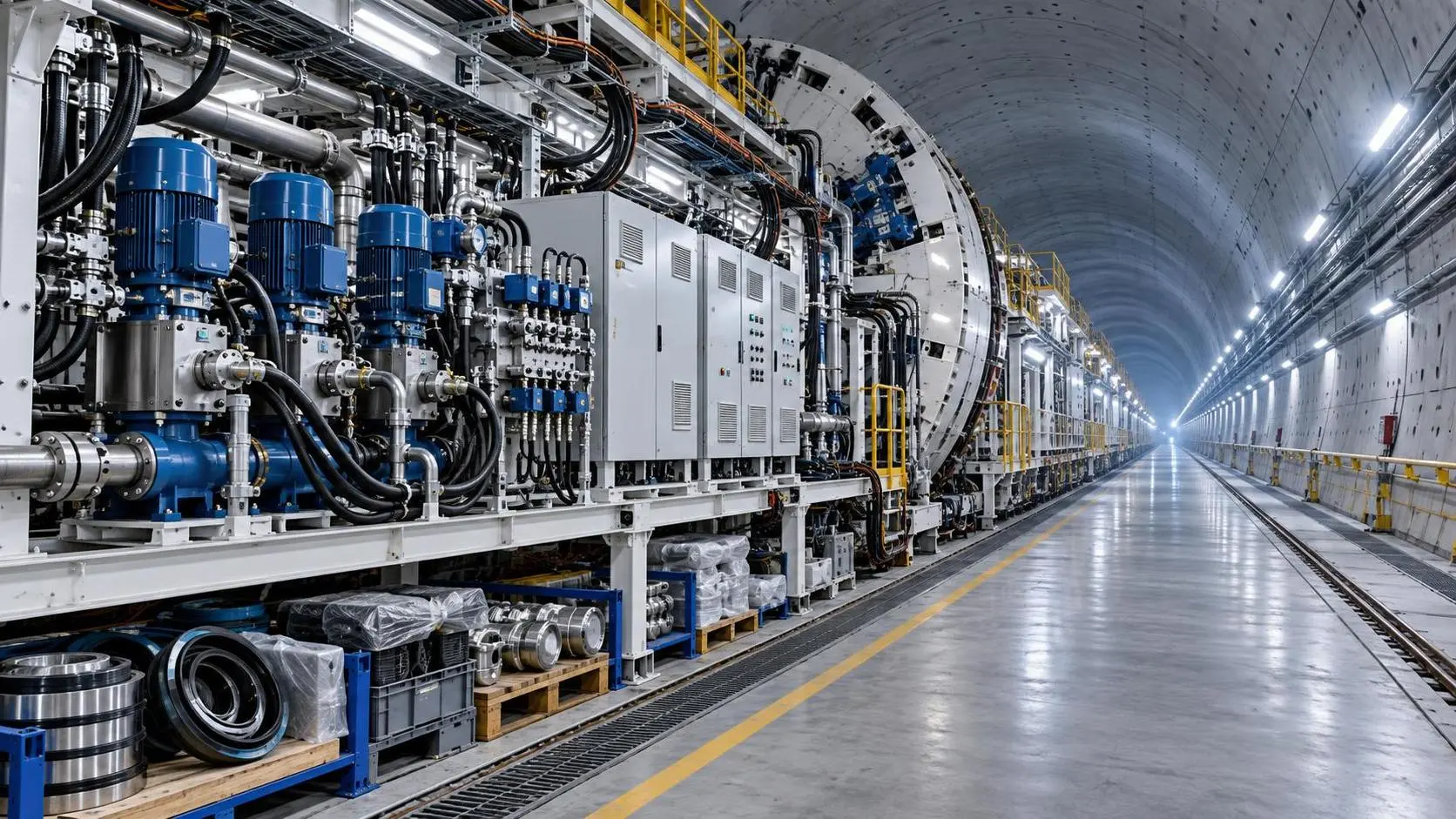
TBM backup system parts: learn how to specify reliable spares for long-distance tunnelling, reduce downtime, ensure compatibility, and speed underground recovery.
How to Size Open Pit Mining Trucks for Haul Distance, Grade, and Payload?
Open Pit Mining Trucks: learn how to match payload, haul distance, grade, road resistance, and loading capacity for safer, lower-cost mine operations.
Related News
- 00
0000-00
How to Evaluate European Drill-and-Blast Tunnelling Contractors for Complex Projects - 00
0000-00
Which Trenchless Construction Technique Fits Your Utility Crossing Conditions? - 00
0000-00
What Is Driving Metro Tunnelling Demand Across Southeast Asia’s Major Cities? - 00
0000-00
Hard Rock Tunnelling in Australia: Selecting Methods for Variable Ground Conditions - 00
0000-00
Hydropower Tunnel Excavation: Selecting Methods for Variable Rock Conditions
Weekly Insights
Stay ahead with our curated technology reports delivered every Monday.