
Autonomous Underground Loaders in Sweden: Assessing Mine Connectivity and Safety





Autonomous underground loaders in Sweden are ready for deployment only when the complete operating system demonstrates acceptable behavior across its intended routes, traffic conditions, and failure scenarios. Wireless coverage alone cannot establish readiness. The decisive questions are which functions require a live connection, how the loader responds when that connection deteriorates, and whether its protective functions remain effective during the transition.
A defensible selection therefore begins with the proposed operating envelope: loading points, haul routes, gradients, intersections, personnel access, and recovery arrangements. Connectivity and safety evidence must relate to that envelope. A successful demonstration inside an isolated loading area does not establish suitability for a longer route shared with service vehicles.
Establish where control and safety decisions happen
The term “autonomous” covers substantially different architectures. A loader might navigate a validated route using onboard perception while receiving assignments through the mine network. Another arrangement might rely on continuous remote driving for parts of the cycle. Assisted loading, autonomous tramming, and remote recovery can coexist on the same machine, with different communication requirements for each mode.
This distinction changes the connectivity assessment. Onboard navigation can tolerate an interruption in dispatch communication if the approved behavior permits completion of a defined movement. Remote driving requires timely command delivery and usable video throughout the maneuver. A network capable of carrying production data can still be unsuitable for controlling a loaded machine near a restricted clearance.
The technical submission should identify where navigation, obstacle detection, braking decisions, access authorization, and emergency commands are executed. It should also explain the transition between modes. A lost remote session must not leave uncertainty about whether the machine remains autonomous, stops, or awaits another command source.
Safety-related communication requires its own justification. A commercially robust wireless connection does not automatically provide a validated safety function. Where a protective action depends on transmitting information, the assessment must address delayed, missing, repeated, corrupted, and misdirected messages, together with the response to each condition.
Read the network survey against the haul cycle
Underground radio performance changes with tunnel geometry and machine position. Bends, crosscuts, steel infrastructure, and large vehicles alter propagation. A signal measured along an empty drift does not represent the same drift with a loaded LHD turning through an intersection and another vehicle between its antenna and the access point.
For Swedish underground projects, surface conditions also belong in the system boundary where portals, outdoor network cabinets, or surface backhaul support underground operation. Winter exposure matters for equipment installed in those locations. Underground, assessment should follow the actual temperature, water, dust, and vibration conditions along the route rather than assume a single environment throughout the mine.
Coverage surveys should therefore be paired with moving-machine measurements. Antenna placement, travel direction, articulation, and bucket position should reflect service conditions. Records need to connect radio events with vehicle position and operating mode so that a recurring interruption at a bend can be distinguished from congestion affecting the whole network.
Private cellular and industrial Wi-Fi architectures should be compared through these outcomes. Neither technology label establishes underground suitability. Backbone topology, power distribution, antenna engineering, traffic prioritization, maintenance access, and configuration control all influence the delivered service.
Latency measurements also need a defined boundary. A radio round-trip measurement excludes some combination of camera capture, video encoding, application processing, display delay, and actuator response. For remote driving, the relevant chain extends from the physical scene to the displayed image and from the control input to machine response.
Make communication loss a defined operating condition
A communication-loss response should be specified for each operating mode and route segment. “Stops safely” is insufficient without the detection interval, braking behavior, stopping position, and conditions for restarting. A stationary loader can still create a hazard if it blocks an escape route, obstructs an intersection, or stops on a gradient without reliable holding capability.
For a function that requires communication to remain valid, the distance traveled before standstill includes movement during failure detection and control processing, followed by braking distance. Load, speed, gradient, tire condition, and floor contamination affect the result. The permitted separation from a hazard must account for this complete distance and relevant uncertainty.
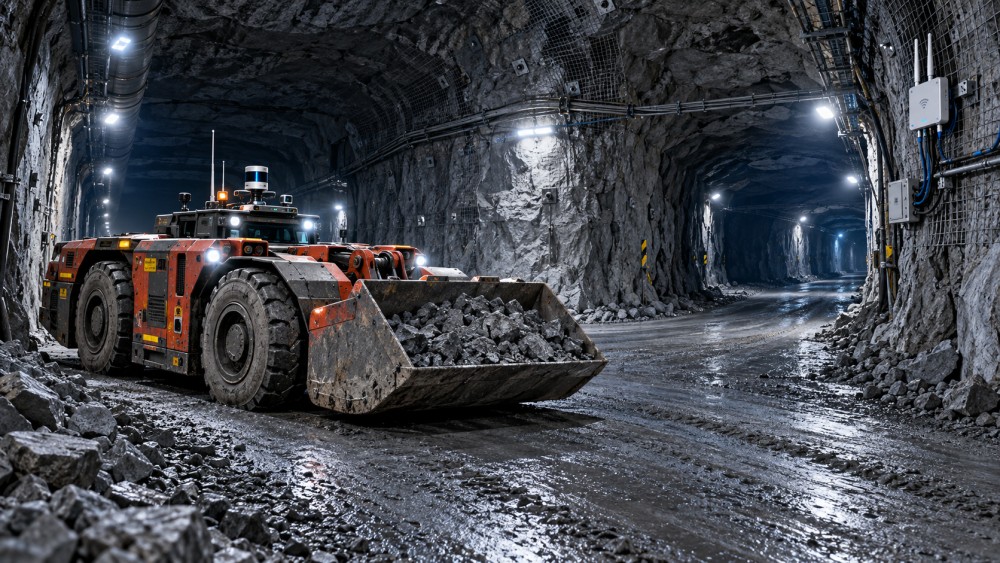
Continued autonomous movement after losing dispatch connectivity is acceptable only within a specifically validated envelope. That requires sufficient onboard perception and control, valid movement authorization, and a clear termination condition. Continuing toward a previously assigned destination becomes problematic if access permissions or traffic information can change while the loader is disconnected.
Recovery deserves equal attention. Reconnection should not automatically release a protective stop merely because packets are flowing again. Machine state, route occupancy, access status, and command authority must be reconciled. A stale command queued before the outage must not initiate unexpected movement after service returns.
Keep localization confidence separate from radio coverage
Strong wireless coverage says little about position accuracy. Underground localization may combine lidar, inertial sensing, wheel odometry, reference infrastructure, and map matching. Each contribution has limitations: wheel slip distorts odometry, repetitive tunnel geometry creates ambiguous matches, and dust or water on a sensor window degrades perception.
A single average localization error conceals the conditions that matter most. Position and heading uncertainty must be evaluated at tight corners, loading approaches, intersections, and dump points. A small heading error becomes significant when the bucket or rear frame approaches a wall, particularly during articulated steering.
Excavation changes introduce a separate problem. New crosscuts, altered stockpiles, temporary barriers, and ground-support work can invalidate assumptions embedded in a map. The system needs a defined method for detecting discrepancies, restricting affected routes, and validating map updates before autonomous operation resumes.
Fault diagnosis should preserve this distinction. A loader stopping repeatedly in the same location might be experiencing radio handover loss, localization ambiguity, obstacle detections, or a route-authority conflict. Time-aligned network, perception, control, and safety logs are necessary to identify the cause. Adding access points will not resolve a localization failure.
Mixed traffic sets a harder acceptance boundary
Physical separation simplifies an autonomous operating area, but the boundary must remain effective during maintenance, inspection, and production changes. An access gate, vehicle entry point, or pedestrian crossing is part of the control architecture. Its state must correspond reliably with movement permissions inside the protected area.
Shared routes require a more demanding analysis. Blind intersections, reversing service vehicles, parked equipment, and personnel emerging from crosscuts create encounters that a coverage map cannot describe. Detecting an object is only one requirement; the loader also needs sufficient distance and braking capability to respond before contact.
Wearable tags and vehicle identification systems add information, but their limitations must be explicit. A missing, discharged, damaged, or incorrectly assigned tag must not silently remove a person or vehicle from the protective concept. Any claim that tag detection provides protection needs evidence covering detection boundaries, communication faults, and the resulting machine response.
Remote intervention introduces another boundary. Camera views must support the maneuver being authorized, including articulation clearance and areas obscured by the bucket. When image quality falls below the validated limit, reduced speed or stopping should follow the defined control logic. Familiarity with the route cannot compensate for an unavailable view.
Use a staged trial with explicit rejection criteria
An acceptance trial should reproduce the proposed deployment closely enough to expose its constraints. Production-equivalent loads, representative network demand, realistic route geometry, and the intended software configuration matter more than a polished demonstration cycle. Fault injection belongs in controlled conditions with exclusion measures appropriate to the test.
The trial should cover three distinct questions:
- Does normal operation meet the required cycle behavior? Record loaded and empty travel, intersection waiting, remote interventions, and stops attributable to connectivity or localization.
- During planned handovers and controlled communication outages, establish whether detection, stopping, state reporting, and restart follow the documented design. Repeat relevant scenarios at route locations with different gradients and clearances.
- Can a stranded machine be recovered within the mine’s operating arrangements? This includes safe access, isolation, transfer of control, and restoration of route availability when remote recovery is unavailable.
Acceptance limits should be agreed before testing and tied to the hazard assessment and production requirements. Universal latency or localization thresholds are inappropriate because permissible values depend on speed, geometry, protective distances, and control architecture. Any reduced-speed restriction introduced to pass a test becomes part of the accepted operating envelope and the productivity calculation.
Availability figures also need consistent definitions. Autonomous operating time, successful cycle completion, network availability, and total production availability measure different things. A loader that repeatedly stops safely can satisfy a protective requirement while failing the intended production duty. Excluding those interruptions from the reported cycle time would obscure that distinction.
Carry the acceptance boundary into daily operation
The selection decision should leave a traceable record linking each route and operating mode to its network requirements, protective functions, tested limitations, and recovery procedure. Unresolved gaps belong in explicit deployment restrictions. An unvalidated intersection should remain outside autonomous service until the required evidence exists.
Mine development will alter the accepted conditions. Moving an access point, opening a crosscut, changing traffic rules, updating vehicle software, or replacing a sensor can affect the original justification. Change control should identify which modifications require a targeted retest and preserve the configuration associated with each result.
Expansion to another level or haul route should follow evidence from that location. Reliable operation on the first route establishes a useful baseline; the next route still needs its own connectivity, localization, stopping, and access conditions demonstrated before autonomous movement is released.
Related News
How TBM Excavation Works in Rock and Soft Ground: A Practical Guide
TBM Excavation in rock and soft ground explained: compare machine types, ground support, spoil removal, and the factors that guide smarter project planning.
Choosing a Zero-Emission Underground Equipment Supplier: What to Check
Choosing a zero emission underground equipment supplier? Compare duty-cycle performance, charging, safety, total costs and support before you commit.
Construction Starts on Germany's Pfaffensteig Rail Tunnel, With Two TBMs Planned
Pfaffensteig rail tunnel construction is underway in Germany. Discover how two planned TBMs will support the 11-kilometre project near Stuttgart.
How Real-Time Underground Mapping Systems Work in Tunneling
Discover how real-time underground mapping systems guide tunneling teams, integrate sensor data, and support confident decisions with verified accuracy.
First Mechanized Tunnel Crossing Beneath the Panama Canal Completed
Panama Canal tunnel crossing: Explore the reported Metro Line 3 milestone and what it could mean for future underwater tunneling projects.
Underground Utility Construction Equipment: Choosing by Ground Conditions
Choose underground utility construction equipment with confidence. Compare trenching, HDD, microtunnelling and TBMs by ground conditions, risk and cost.
China Sets Tunnel Boring Machine Export Controls as India Pushes Local Production
China tunnel boring machine export controls could reshape procurement as India pushes local production. Explore potential supply and project impacts.
Choosing a Trenchless Pipeline Installation Contractor: Key Qualifications
Choose a trenchless pipeline installation contractor with confidence. Learn how to assess experience, equipment, safety, costs, and project risks before you hire.
China's 70% TBM Share and Export Controls Challenge India's Local Production
China's TBM export controls could challenge India's local production and infrastructure sourcing. Explore the potential risks and procurement options.
Related News
- 00
0000-00
How TBM Excavation Works in Rock and Soft Ground: A Practical Guide - 00
0000-00
Choosing a Zero-Emission Underground Equipment Supplier: What to Check - 00
0000-00
Construction Starts on Germany's Pfaffensteig Rail Tunnel, With Two TBMs Planned - 00
0000-00
How Real-Time Underground Mapping Systems Work in Tunneling - 00
0000-00
First Mechanized Tunnel Crossing Beneath the Panama Canal Completed
Weekly Insights
Stay ahead with our curated technology reports delivered every Monday.