
When autonomous haulage systems justify their implementation cost





Autonomous haulage systems justify their implementation cost when they solve a persistent operating constraint across a sufficiently stable, sufficiently utilized fleet—not when they merely replace truck operators. The strongest financial cases arise where haulage is a large, controllable share of mine cost; trucks run for long, repeatable shifts; delays from shift changes, fatigue, traffic interactions, or uneven operating practice materially reduce available production time; and the mine can sustain throughput after the autonomous system is commissioned.
The weak case is equally clear. A small fleet with short remaining mine life, frequently changing haul routes, unresolved loading and crushing bottlenecks, or poor communications and road discipline can turn a high-value technology program into an expensive layer of complexity. The capital decision should therefore begin with the economics of the complete haulage system: equipment, infrastructure, production constraints, implementation disruption, and residual asset value.
Labor savings are real, but rarely sufficient on their own
The visible element of autonomous haulage is the removal of drivers from the cab. This makes labor savings easy to model: fewer operator positions, lower recruitment pressure, fewer accommodation and transport requirements at remote sites, and less exposure to overtime or absenteeism. Yet this calculation is incomplete.
A conventional truck is not productive because an operator is assigned to it. It is productive when it completes safe, consistent cycles at the planned payload, with minimal queueing, refuelling delay, tyre-related interruption, and unplanned maintenance. Autonomous operations can improve this system discipline by maintaining target speeds, following defined routes, managing separation between vehicles, and operating through shift transitions. The financial value is created by the additional tonnes moved per unit of fleet capital, fuel, energy, and maintenance cost.
This distinction matters because labor costs vary sharply by location, employment model, roster, and local availability of skilled operators. A mine with comparatively low direct labor cost may still have a compelling autonomous haulage case if truck utilization is constrained by human-dependent delays. Conversely, a high-labor-cost operation may fail to recover the investment if its fleet is too small or its production system has constraints elsewhere.
For approval purposes, direct labor reduction should be treated as one cash-flow line, not the investment thesis. The central question is whether autonomy increases the number of productive truck hours and productive tonnes over the asset life without creating offsetting costs that consume the gain.
The economic threshold is determined by fleet hours, not fleet size alone
Fleet count is a useful starting point, but it can mislead. Ten trucks operating continuously over a long mine life may provide a better platform for autonomy than a larger fleet that is intermittently deployed, approaching a major pushback, or scheduled for replacement before the autonomous system reaches steady operation.
The relevant denominator is annual productive haulage hours over the period during which the autonomous system will operate. A system has fixed costs that do not scale down gracefully: site surveys, network design, control facilities, fleet-management integration, safety validation, operating procedures, training, implementation support, and governance. A limited number of truck-hours must absorb those costs, making the return highly sensitive to utilization.
Mine life is equally important. An autonomous haulage deployment may require staged commissioning, route preparation, systems integration, and a period of operational tuning before benefits reach their intended level. If the remaining economic life of the pit, haul circuit, or truck fleet is short, the project can show attractive annual operating savings while still producing an unacceptable discounted return.
Financial models should distinguish between the life of the mine, the life of a specific haul route, and the useful life of the trucks. A long-life mine is not automatically a long-life autonomous operating environment. Haul roads may move as benches deepen, waste stripping sequences change, crushers relocate, or satellite pits open and close. Those changes do not necessarily rule out autonomy, but their engineering, commissioning, and operational costs need to be included rather than assumed away.
Production continuity often carries more value than faster truck movement
Autonomous haulage systems for mining industry operations are sometimes evaluated through nominal truck speed or cycle-time comparisons. That is too narrow. In a functioning mine, the value of a minute is determined by the point at which lost time constrains the whole production chain.
If the primary crusher regularly has spare capacity, additional hauling may have limited economic value. If the crusher, mill feed plan, or waste movement schedule is constrained by inconsistent truck availability, improved continuity can protect production targets, reduce the need for costly recovery shifts, and lower the risk that short-term delays become longer-term schedule slippage.
Autonomy tends to be most valuable where it makes operating performance less variable. Consistent navigation, controlled intersection behaviour, predictable spotting, and continuous dispatch visibility can reduce the operational spread around a planned cycle. The benefit is not simply a better average. It is a narrower range of outcomes, which helps dispatch, loading, crushing, maintenance, and mine planning operate against a more dependable schedule.
That benefit should not be credited automatically. A proper model identifies the current source of lost hours and tests whether autonomy addresses it. If the main cause of lost production is shovel availability, fragmentation, water management, crusher downtime, or insufficient road maintenance, an autonomous truck fleet will not correct the underlying constraint. It may even make the constraint more visible by removing the informal flexibility operators previously used to work around poor road conditions or changing instructions.
Road geometry and operating discipline are capital variables
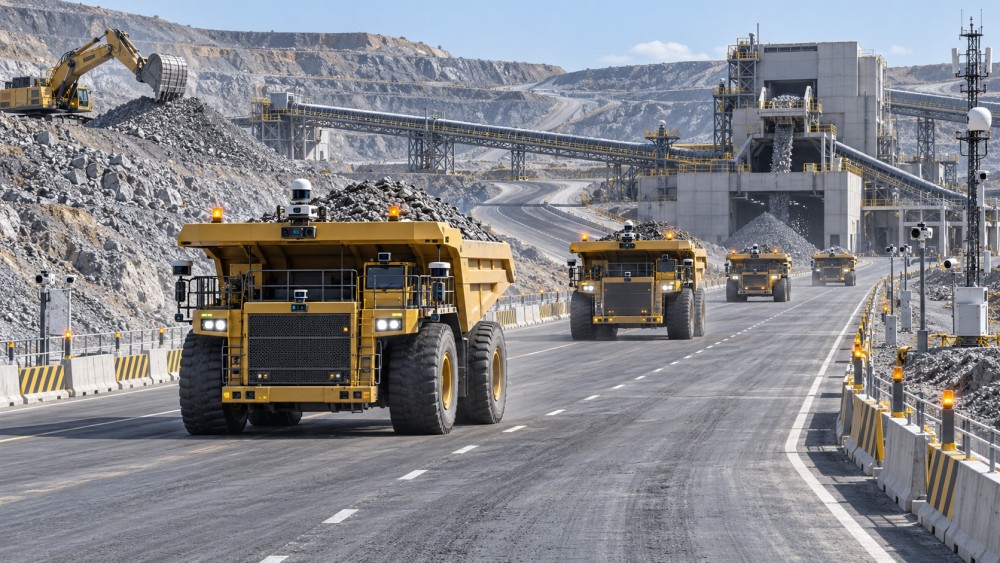
Autonomy is frequently described as a truck technology, but its financial performance depends heavily on the mine environment. Haul roads, intersections, dumping areas, loading zones, exclusion controls, communications coverage, and light-vehicle interaction rules all influence implementation cost and achievable utilization.
Sites with repetitive routes, defined loading and dumping points, manageable grades, disciplined traffic segregation, and stable road maintenance practices are generally easier to convert into autonomous operating areas. The point is not that every route must remain unchanged. Mine plans evolve. The question is whether route changes can be planned, mapped, verified, and released into production without causing recurring disruption or expensive rework.
Mixed traffic deserves particular scrutiny. Autonomous trucks must coexist with graders, dozers, water carts, service vehicles, shovels, drills, and occasional visitors. The operational design needs clear rules for access, communication, authority, and abnormal situations. The budget must cover the equipment and procedures required to maintain those rules. Treating mixed traffic as a minor operational detail can understate both the implementation cost and the ongoing management burden.
Road quality has a direct financial link as well. Poor drainage, loose berms, inconsistent running surfaces, and variable widths affect tyre wear, speed control, suspension loads, fuel consumption, and truck availability whether a fleet is staffed or autonomous. Automation may deliver more consistent operation, but it does not eliminate the cost of an inadequate haul road. In some cases, road upgrades are a prerequisite capital item rather than an optional improvement.
Build the business case around incremental cash flow
The appropriate comparison is not the purchase price of an autonomous package against a driver wage bill. It is the incremental lifecycle cash flow of an autonomous operating model compared with a credible conventional baseline.
Capital expenditure commonly includes autonomous-capable truck hardware or retrofit packages, onboard sensors and computing, positioning and communications infrastructure, control-room facilities, integration with dispatch and fleet-management systems, road and intersection modifications, commissioning resources, and spares or support arrangements. Depending on the contracting structure, software licenses, subscriptions, data services, and remote support may be operating expenditure rather than capital expenditure, but they remain part of total cost of ownership.
Implementation also has an economic cost. Haul routes may be temporarily unavailable during conversion. Equipment may operate below planned capacity during testing and commissioning. Supervisory workloads increase as procedures are revised and exceptions are resolved. These effects should be modeled as transition-period cash-flow impacts, not absorbed into a generic contingency line.
On the benefit side, separate the sources of value:
- reduced operator-related cost, including recruitment, training, accommodation, transport, and roster coverage where applicable;
- additional productive operating hours from reduced shift-change disruption and more consistent availability;
- higher or more reliable tonnes moved, but only where downstream capacity can convert those tonnes into value;
- fuel or electricity savings resulting from controlled speed, braking, idling, routing, and payload management;
- maintenance effects from more consistent operation, balanced against added autonomy-system maintenance and specialist support;
- lower expected cost of safety exposure, recognized carefully and without assuming that all incidents can be monetized;
- avoided capital, if improved utilization allows a planned truck purchase to be deferred or removed.
Avoided truck capital can be one of the most important benefits, but it requires a robust counterfactual. If the conventional mine plan genuinely requires another truck to meet its schedule and autonomy allows the same result with the existing fleet, the avoided purchase is tangible. If fleet requirements are uncertain because loading, road, or crusher performance has not been stabilized, the benefit should be discounted or excluded.
Use NPV, but do not hide uncertainty inside a single forecast
Net present value is generally more informative than a simple payback calculation because autonomous haulage involves upfront capital, phased benefits, recurring software and support costs, and assets with different useful lives. Internal rate of return, discounted payback, and cash-flow coverage remain useful supporting measures, particularly where capital allocation rules require them, but they should not replace an explicit NPV view.
The model should show a base case and a limited set of decision-relevant sensitivities rather than a large collection of decorative scenarios. The variables that most often change the conclusion are productive utilization improvement, annual operating hours, commissioning duration, energy cost, labor cost, fleet replacement timing, remaining autonomous operating life, and required infrastructure expenditure.
One useful discipline is to identify the break-even operational improvement required for approval. For example, the model can calculate the additional available truck-hours, reduction in unit haulage cost, or avoided fleet capital needed to achieve the required return. This turns an abstract financial threshold into an operational commitment that can be tracked after implementation.
Benefits should be phased. It is rarely sound to credit full utilization gains from the first month of commissioning. A realistic ramp-up recognizes that the mine must establish stable operating zones, train personnel, refine dispatch logic, manage exceptions, and integrate maintenance routines. A business case that remains viable after a conservative ramp-up is far more defensible than one dependent on immediate full performance.
Maintenance economics require a two-sided assessment
Autonomous operation can reduce variation in driving behaviour and provide richer machine and event data, which may improve maintenance planning. However, autonomy also introduces sensors, communications equipment, computing hardware, software updates, calibration needs, and specialist diagnostic requirements. The financial issue is not whether maintenance cost will fall or rise in aggregate; it is which cost categories change, who bears them contractually, and whether they create new availability risks.
Maintenance assumptions should therefore separate base-truck maintenance from autonomous-system maintenance. They should also distinguish scheduled servicing from production-limiting faults. A low annual software-support expense may be less important than the operational consequence of a communications or systems fault that restricts a large part of the fleet.
Supplier support terms deserve close attention. Response times, remote-access conditions, software update responsibilities, cybersecurity obligations, spare-parts commitments, data ownership, interoperability with existing fleet systems, and exit provisions can materially affect lifecycle cost. These are not legal details to review after the economics have been approved; they determine whether projected availability and operating cost can actually be achieved.
Safety has financial relevance, but should not be overstated
Removing personnel from high-energy haulage interactions can reduce exposure to collision, fatigue, rollover, and visibility-related hazards. That safety rationale may be decisive independently of financial return. Yet assigning a large monetary value to every avoided risk without a disciplined method can weaken an otherwise credible capital case.
It is better to recognize direct and supportable cost effects—such as reduced exposure hours, changes in insurance or incident-related costs where evidence exists, and lower disruption from safety events—while retaining non-financial safety improvements as a separate decision consideration. This preserves the integrity of the financial model and avoids implying that serious safety outcomes can be fully priced.
When delay is the better decision
Deferral can be rational when the mine plan is undergoing major redesign, when the current fleet is near replacement and compatibility decisions are unresolved, or when fundamental operating data are unreliable. It can also be prudent where the operation lacks a clear owner for autonomous-area rules, road readiness, data governance, and system integration.
Delay should not mean passive waiting. It should be used to close the uncertainties that determine value: establish a reliable baseline for cycle times and delay codes, quantify route stability, assess communications coverage, define mixed-traffic controls, confirm downstream bottlenecks, and test the capital model against lower utilization and longer commissioning assumptions.
The implementation cost of autonomous haulage is justified when the mine can convert greater system consistency into recurring cash flow over enough productive years to absorb fixed deployment costs. The approval decision becomes defensible when its value rests on measured operating constraints, conservative ramp-up assumptions, and contractually visible lifecycle costs—not on labor savings alone or an assumption that autonomy will compensate for an unstable mine system.
Related News
How TBM Excavation Works in Rock and Soft Ground: A Practical Guide
TBM Excavation in rock and soft ground explained: compare machine types, ground support, spoil removal, and the factors that guide smarter project planning.
Choosing a Zero-Emission Underground Equipment Supplier: What to Check
Choosing a zero emission underground equipment supplier? Compare duty-cycle performance, charging, safety, total costs and support before you commit.
Construction Starts on Germany's Pfaffensteig Rail Tunnel, With Two TBMs Planned
Pfaffensteig rail tunnel construction is underway in Germany. Discover how two planned TBMs will support the 11-kilometre project near Stuttgart.
How Real-Time Underground Mapping Systems Work in Tunneling
Discover how real-time underground mapping systems guide tunneling teams, integrate sensor data, and support confident decisions with verified accuracy.
First Mechanized Tunnel Crossing Beneath the Panama Canal Completed
Panama Canal tunnel crossing: Explore the reported Metro Line 3 milestone and what it could mean for future underwater tunneling projects.
Underground Utility Construction Equipment: Choosing by Ground Conditions
Choose underground utility construction equipment with confidence. Compare trenching, HDD, microtunnelling and TBMs by ground conditions, risk and cost.
China Sets Tunnel Boring Machine Export Controls as India Pushes Local Production
China tunnel boring machine export controls could reshape procurement as India pushes local production. Explore potential supply and project impacts.
Choosing a Trenchless Pipeline Installation Contractor: Key Qualifications
Choose a trenchless pipeline installation contractor with confidence. Learn how to assess experience, equipment, safety, costs, and project risks before you hire.
China's 70% TBM Share and Export Controls Challenge India's Local Production
China's TBM export controls could challenge India's local production and infrastructure sourcing. Explore the potential risks and procurement options.
Related News
- 00
0000-00
How TBM Excavation Works in Rock and Soft Ground: A Practical Guide - 00
0000-00
Choosing a Zero-Emission Underground Equipment Supplier: What to Check - 00
0000-00
Construction Starts on Germany's Pfaffensteig Rail Tunnel, With Two TBMs Planned - 00
0000-00
How Real-Time Underground Mapping Systems Work in Tunneling - 00
0000-00
First Mechanized Tunnel Crossing Beneath the Panama Canal Completed
Weekly Insights
Stay ahead with our curated technology reports delivered every Monday.