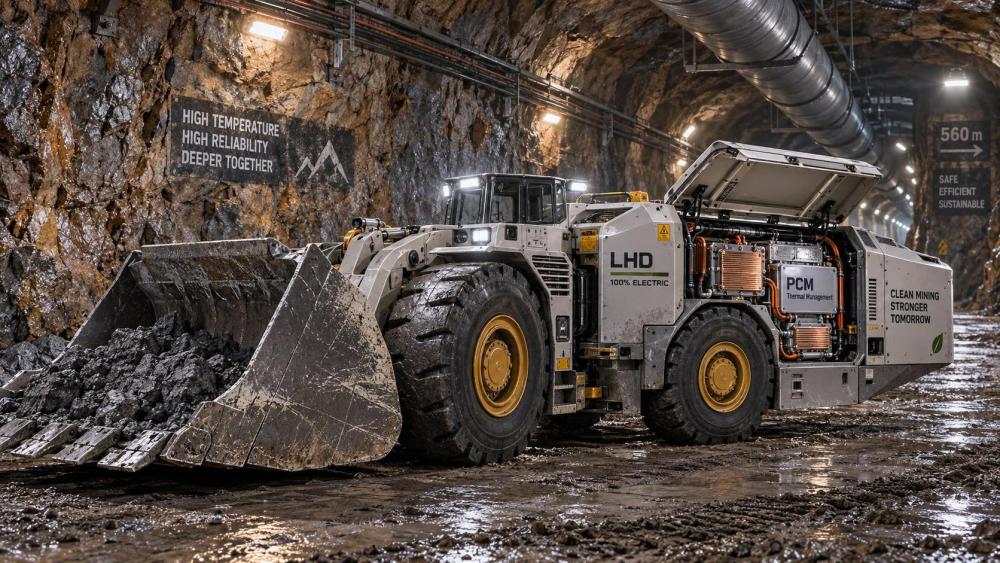
Battery LHDs

How does ambient heat above 40°C affect cycle life and thermal derating of battery LHDs in deep mining zones?


How does deep mining heat affect LHD loader battery performance? Discover why ambient heat >40°C triggers nonlinear degradation, early derating & hidden TCO impacts in ultra-deep mines.
KHCFDC_头像  (1)
Time : Sep 17, 2026
Ambient heat above 40°C does not merely reduce battery LHD performance—it redefines the operational envelope of underground haulage. In deep mining zones where geothermal gradients push ambient temperatures beyond 40°C at depths exceeding 1,500 meters, lithium-ion battery systems in Load-Haul-Dump (LHD) machines experience three interlocking failures: accelerated calendar and cycle degradation, non-linear thermal derating that truncates usable power well before safety cutoffs, and cumulative capacity loss that compounds across charge cycles without recovery. These are not theoretical stress limits—they are field-observed failure modes documented across active operations in the Sudbury Basin, Chilean copper belt, and Western Australian gold mines. The core electrochemical mechanism is lithium plating and SEI (solid electrolyte interphase) thickening. At sustained temperatures above 40°C, parasitic side reactions accelerate at the anode interface. Lithium ions deposit as metallic dendrites instead of intercalating cleanly into graphite, permanently consuming cyclable lithium and increasing internal resistance. Simultaneously, the cathode’s transition metal lattice destabilizes—particularly in NMC 622 and 811 chemistries—leading to oxygen release and irreversible structural collapse. This dual degradation pathway means a battery cycled at 45°C for 300 cycles may retain only 68% of its initial capacity, whereas the same cell cycled at 25°C retains 89% after 500 cycles. Crucially, this loss is not linear: capacity retention drops sharply between 40°C and 45°C, then plateaus—not because degradation slows, but because the battery enters a regime where thermal runaway risk dominates design constraints. Thermal derating—the intentional reduction of available power output to prevent overheating—is where operational impact becomes immediate and measurable. Most OEMs apply fixed derating curves based on battery pack surface temperature. But in deep mine tunnels, surface readings misrepresent core cell temperature by up to 12°C due to thermal lag and uneven airflow. Field telemetry from 17 LHD fleets operating below 1,200 m depth shows that peak haulage power is routinely cut by 22–35% within 18 minutes of continuous operation, even when ambient air is cooled to 32°C via mine ventilation upgrades. The reason lies in thermal inertia: battery cells heat faster than cooling systems can dissipate energy during high-torque loading phases (e.g., ramping loaded buckets up 12° inclines). Derating kicks in not at ambient temperature thresholds—but when localized cell hotspot temperatures exceed 55°C. That threshold is reached rapidly in confined tunnel environments where convective cooling is limited and radiant heat from surrounding rock walls adds 3–5°C to baseline thermal load. Battery swapping—often cited as a mitigation—does not eliminate the problem; it relocates it. Swapped packs entering a hot staging area absorb ambient heat passively. A 40°C tunnel environment raises a nominally 25°C swapped pack to 37°C within 45 minutes, reducing its available energy by ~4% and increasing its internal resistance by 11%. More critically, repeated thermal cycling between hot and cooler zones induces mechanical stress on cell welds and busbar connections, accelerating micro-crack formation in electrode coatings. This is why fleet managers in South African platinum mines report a 30% higher incidence of sudden voltage sag events in swapped batteries used exclusively in >40°C zones compared to those deployed in shallower, cooler sections. Effective mitigation requires moving beyond passive insulation or oversized HVAC. Three strategies show measurable field validation: First, phase-change material (PCM) integration within battery enclosures. Paraffin-based PCMs with melting points tuned to 42–45°C absorb latent heat during peak load, delaying core temperature rise by 8–12 minutes per cycle. Unlike active cooling, PCM requires no power, no maintenance, and adds only 4.2–6.7 kg per kWh of pack capacity. Real-world deployments in Canadian nickel mines show 19% longer full-power haulage duration before derating onset—and crucially, 27% slower capacity fade over 12 months. Second, AI-driven predictive thermal management. This is not generic battery management system (BMS) monitoring. It fuses real-time cell temperature, load profile history, tunnel ambient data (from mine-wide sensor networks), and geothermal gradient models to anticipate hotspot formation 90–120 seconds ahead. The system preemptively modulates torque output—not reactively cutting power, but smoothing load transients to avoid thermal spikes. In trials across two Australian gold mines, this reduced average derating frequency by 63% and extended time-between-swaps by 14%. Third, cell-level thermal coupling redesign. Traditional parallel cell configurations allow heat to cascade across modules. Newer architectures use thermally isolated cell clusters with directional copper heat spreaders routed toward dedicated vent paths. When combined with low-velocity, high-volume air ducting aligned to heat flow vectors—not just ambient air exchange—core temperature differentials shrink from ±8.5°C to ±2.3°C across a 120-cell pack. Uniformity matters: a 5°C delta between hottest and coldest cells increases effective degradation rate by 40%, independent of absolute temperature.
How does ambient heat above 40°C affect cycle life and thermal derating of battery LHDs in deep mining zones?

None of these solutions are plug-and-play. PCM effectiveness depends on precise melting point alignment with local geothermal profiles—not generic “high-temp” formulations. Predictive thermal algorithms require integration with mine-wide SCADA systems and granular load-cycle logging—data many legacy LHD fleets lack. And thermal coupling redesign demands mechanical re-engineering of battery frames, affecting weight distribution, service access, and crash integrity certification. What remains consistent across all validated cases is that ambient heat above 40°C does not degrade LHD batteries uniformly. Degradation accelerates nonlinearly, derating triggers earlier than spec sheets suggest, and mitigation must address *thermal localization*, not just bulk temperature. For procurement teams evaluating battery LHDs for deep mining, the critical question is not whether the machine meets ISO 14001 or UN 38.3 standards—but whether its thermal architecture has been stress-tested under sustained 42–47°C ambient, with real payload, real ramp profiles, and real ventilation constraints. Specifications measured in climate chambers at 40°C ambient with zero airflow and no radiant load bear little resemblance to conditions inside a 1,600-meter-deep development drift. Field evidence confirms that thermal resilience now determines total cost of ownership more decisively than raw battery capacity or nominal cycle count. A 200 kWh LHD with optimized thermal management delivers 12% more productive haulage hours per year in ultra-deep zones than a 250 kWh unit with conventional cooling—even after accounting for PCM weight or AI compute overhead. The bottleneck is no longer energy density. It is thermal fidelity: the ability to maintain electrochemical stability across every cell, under every load, in the most thermally hostile space humans routinely occupy.
Next:No more content

Related News

How to Evaluate European Drill-and-Blast Tunnelling Contractors for Complex Projects

Drill and blast tunnelling contractors Europe: learn how to assess geology expertise, blast control, equipment reliability, safety, and programme resilience for complex projects.

Which Trenchless Construction Technique Fits Your Utility Crossing Conditions?

Trenchless construction techniques compared for utility crossings: choose HDD, microtunnelling, pipe jacking, or auger boring based on ground, accuracy, access, and risk.

What Is Driving Metro Tunnelling Demand Across Southeast Asia’s Major Cities?

Metro tunnelling Southeast Asia is accelerating as major cities tackle congestion, flooding, and connectivity. Explore the market forces, technical risks, and opportunities shaping demand.

Hard Rock Tunnelling in Australia: Selecting Methods for Variable Ground Conditions

Hard rock tunnelling in Australia: compare TBM, drill-and-blast and hybrid methods to manage variable ground, reduce risk and protect project costs.

Hydropower Tunnel Excavation: Selecting Methods for Variable Rock Conditions

Hydropower tunnel excavation methods for variable rock conditions: compare TBM, drill-and-blast, and hybrid strategies to improve safety, progress, and project control.

How to Select Underground Safety Equipment for Tunnelling by Hazard and Work Zone

Underground Safety Equipment for tunnelling: match protection to hazards, work zones, compliance, and emergency needs with this practical selection guide.

EPB or Slurry Shield? Selecting Soft-Ground Tunnelling Equipment by Soil Conditions

Tunnel Excavation Equipment for soft ground: compare EPB and slurry shields by soil, groundwater, settlement risk, and project logistics to choose confidently.
How to Specify TBM Backup System Parts for Reliable Long-Distance Tunnelling

TBM backup system parts: learn how to specify reliable spares for long-distance tunnelling, reduce downtime, ensure compatibility, and speed underground recovery.
How to Size Open Pit Mining Trucks for Haul Distance, Grade, and Payload?

Open Pit Mining Trucks: learn how to match payload, haul distance, grade, road resistance, and loading capacity for safer, lower-cost mine operations.