
Underground Mine Electrification: How to Size Battery Fleets and Charging Capacity





A battery-electric underground fleet can fail on paper long before the first machine reaches the ramp. A production schedule may show that each LHD has enough battery energy for a shift, yet the fleet still queues at chargers, trips a feeder during shift change, or leaves a loading level short of available machines. The problem is usually not the vehicle alone. It is a mismatch between duty cycle, battery availability, charging power, electrical distribution, and the time buffers built into the operating plan.
For mining electrification for underground mines, fleet sizing should start with the required production hours at each activity area, then work backward through energy consumption, charging or swapping windows, charger occupancy, and mine power limits. The practical target is not “enough batteries for each unit.” It is enough usable energy and charging access to maintain planned availability during the busiest, least forgiving part of the shift.
Start with the production rhythm, not the battery nameplate
Battery fleet sizing becomes unreliable when planners begin with a catalog battery capacity and divide it by an assumed energy consumption rate. That calculation can be useful as an early screen, but it does not represent the operating environment underground. Haul distance, grade, payload, road condition, bucket loading time, ventilation layout, traffic conflicts, and operator behavior all change the real energy draw.
A more dependable approach is to map the production rhythm for each machine class. An LHD operating close to an ore pass may make short, repetitive cycles with frequent regenerative opportunities and short idle periods. Another unit hauling along a long decline may carry heavy loads uphill and return downhill, producing a very different energy profile. A utility vehicle that appears lightly used may still need reliable state of charge at unpredictable moments for maintenance or emergency support.
Break the schedule into operational blocks rather than treating a shift as one continuous number. For each block, identify:
- planned machine operating time;
- expected loaded and empty travel distance;
- average grade and road resistance;
- payload or material movement requirement;
- idling, waiting, spotting, and queue time;
- likely regeneration during downhill travel or deceleration;
- time when the machine can realistically leave production for charging or battery exchange.
The distinction between “can charge” and “can leave production” matters. A charger may technically be available during a meal break, but if the mine needs that machine to clear a loading point, support development, or cover a delayed truck, the charging window is not operationally reliable. Battery planning should use windows that production can actually protect.
Calculate usable battery energy rather than nominal capacity
Nominal battery capacity is not the same as energy available for dispatch. Operations generally preserve a lower state-of-charge reserve to avoid deep discharge, protect battery life, retain mobility for contingency movement, and prevent a unit from becoming stranded in a constrained heading. Charging behavior also changes near the upper end of the battery range, where charging power may taper.
For planning purposes, define a usable energy band between the upper state of charge routinely reached during charging and the minimum state of charge permitted before the unit must return to a charging point or exchange station. Then compare that usable energy with the energy needed for a complete production block, including a reserve for unplanned delay.
A simple planning relationship is:
Required usable energy per operating block = expected operating energy + access and return energy + contingency reserve.
The access and return component is often overlooked. A machine may complete its assigned loading cycles but still require meaningful energy to travel from a remote production area to a charger, negotiate traffic, and reach a safe waiting location. In a deep mine, that travel can be significant, especially when ramps and elevation changes are involved.
Use separate assumptions for normal and difficult conditions. Loose running surfaces, water, poor traction, additional road maintenance, cold battery conditions, extended tramming, or a change in ore density can move consumption beyond the average. Sizing from the average alone creates a fleet that works only when the mine operates exactly as planned.
Determine how many batteries or vehicles are needed at the same time
The core fleet question is not simply how many machines are required for tonnes moved. It is how many machines must be working, charging, travelling to charge, waiting for charge, or receiving a battery change at the same moment. Availability must be modeled as a time-based condition.
With opportunity charging, each machine may remain assigned to a specific battery pack. The fleet count must account for charging duration and the number of units unavailable while charging. With battery swapping, the operating machine count and the battery inventory count become separate decisions. A swap system can reduce vehicle downtime, but it needs enough charged packs, handling capacity, storage space, and electrical capacity to restore packs at the rate the fleet consumes them.
A useful first-pass calculation for battery inventory is:
Battery packs required = packs installed in active equipment + packs being charged + packs in transit or cooling + reserve packs.
The reserve is not a decorative margin. It covers battery packs temporarily unavailable because of inspection, thermal conditioning, charge interruptions, maintenance, abnormal consumption, or dispatch changes. Its appropriate size depends on whether the mine has one charging location or several, whether equipment can share pack types, and whether the production plan has alternative machines that can absorb a short interruption.
Where battery packs are not interchangeable across equipment classes, each fleet segment needs its own availability analysis. A spare pack for a light utility vehicle does not protect LHD production. Conversely, standardizing compatible packs across comparable machines can simplify inventory planning, but only where electrical interfaces, physical handling requirements, and duty demands genuinely align.
Do not confuse a spare machine with battery resilience
A diesel operation may use a standby machine to cover breakdowns or maintenance. In a battery-electric operation, a standby unit does not solve a charging bottleneck. If the unit enters service with insufficient energy or cannot access a charger without delaying active equipment, it is not an immediate production replacement.
Assess each standby asset in terms of readiness: its current battery state, distance to the work area, charging priority, operator availability, and compatibility with the assigned task. In tight underground layouts, a machine travelling to charge can also interfere with the machine it is meant to support.
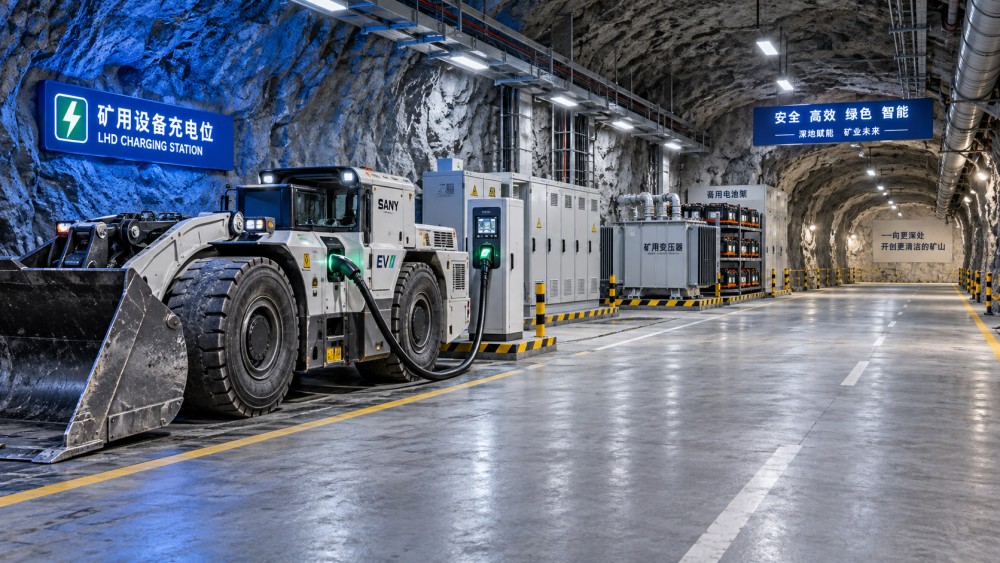
Size chargers from occupancy and turnaround time
Charging capacity is often underestimated because teams focus on charger power rating while ignoring charger occupancy. A high-power charger may restore energy quickly, but the actual turnaround includes driving into position, aligning the machine, connecting, completing safety checks, charging, disconnecting, and clearing the bay. At a battery-swap station, the equivalent time includes positioning, pack removal, pack installation, verification, and movement out of the exchange area.
For every charging point, calculate the expected service demand during the most congested period of the shift. This is usually more important than a daily average. A charger that has enough energy throughput across 24 hours may still be inadequate if several LHDs need charging within the same short window.
Charging strategy should also be matched to the production pattern. Opportunity charging works best where equipment naturally pauses at locations that are electrically accessible and do not create traffic restrictions. Dedicated longer charges may fit a disciplined shift pattern but can produce sharp electrical peaks. Battery swapping can support high utilization in repetitive heavy-duty work, yet the station itself becomes a production-critical asset that requires reliable pack flow and trained handling procedures.
Check the mine electrical system before fixing charger locations
A charging plan can look operationally sound and still be impossible to energize. Underground electrical networks must carry the added load through substations, transformers, switchgear, cables, protection systems, and distribution points. The critical question is not only whether installed capacity appears sufficient, but whether the network can support coincident demand at the required locations.
Charging loads can be highly concentrated. Several machines beginning fast charging after a production delay may create a local peak far above normal mine auxiliary demand. If that peak competes with pumps, fans, dewatering equipment, hoists, crushers, or development power, the site may face load shedding, voltage issues, nuisance trips, or production constraints.
Before finalizing charger count, test at least three electrical conditions:
- Normal production demand: planned charging occurs while routine mine loads are operating.
- Recovery demand: delayed equipment reaches chargers in a compressed period and multiple units request energy at once.
- Contingency demand: one charger, feeder section, or charging bay is unavailable and the fleet must use remaining infrastructure.
Load management can reduce the required electrical peak by staggering charge starts, limiting charging power during critical mine loads, or prioritizing machines by production value and state of charge. However, managed charging should not be used to hide an undersized system. If every delayed shift requires aggressive throttling, the fleet may recover too slowly to meet its operating plan.
Place charging assets where production can use them
Location changes utilization. A charger installed far from the active production zone may be electrically convenient but operationally expensive. Every extra travel minute consumes energy, reduces machine availability, adds traffic exposure, and can create congestion on declines or narrow levels. On the other hand, placing chargers too close to active faces can expose electrical equipment to blasting effects, water, dust, equipment strikes, or frequent relocation requirements.
Evaluate charging areas as working zones, not simply equipment pads. They need approach routes that do not conflict with haulage, adequate maneuvering room, visibility, drainage, communication, emergency access, and procedures for isolating equipment. The arrangement should allow a machine to enter and leave without trapping another unit or blocking a main travelway.
For mines with advancing development headings, fixed charging infrastructure may not remain close to the workfront. The plan should identify when infrastructure extensions are required, how temporary charging will be handled, and how much lost time is acceptable while the electrical network catches up with production. This is especially important where development progress changes faster than permanent power installations can be completed.
Use a dispatch model to expose hidden queues
Spreadsheet calculations are valuable, but they can miss interactions between equipment. A dispatch model, even a simple time-step simulation, can reveal whether two machines regularly arrive at one charger together, whether a loading point loses both active LHDs during the same period, or whether a delayed haul cycle forces a machine below its planned state-of-charge reserve.
Model the fleet using realistic events: variable cycle duration, charging travel, charging queue time, battery reserve rules, road restrictions, blasting exclusions, maintenance windows, and charger outages. The goal is not to predict every minute perfectly. It is to identify whether the plan remains workable when normal variation occurs.
Pay particular attention to synchronized behavior. Equipment assigned to similar routes often consumes energy at similar rates and reaches charging thresholds together. Staggering dispatch, assigning different charge triggers, or using more than one charging area may reduce congestion without adding a large number of chargers.
Set operating rules before commissioning the fleet
Infrastructure alone does not create availability. Operators, dispatchers, and maintenance teams need clear rules for battery state thresholds, charger priority, response to abnormal energy use, and the conditions under which a machine must leave its assigned area. Without those rules, equipment may continue working until its reserve becomes too small, then compete for the same charger at the least convenient time.
Useful operating controls include a minimum dispatch state of charge for remote work, an earlier return threshold for steep or high-resistance routes, priority access for production-critical machines, and escalation when actual energy use departs from the expected pattern. The thresholds should be reviewed after real operating data becomes available; initial assumptions are planning inputs, not permanent settings.
Battery condition, charger reliability, cable and connector condition, and electrical protection performance should also be included in routine maintenance planning. In an underground mine, a charging interruption can affect several machines within one shift, so the availability of the charging system deserves the same operational attention as mobile equipment availability.
A reliable electrification plan treats batteries, chargers, distribution equipment, and dispatch rules as one connected production system. When fleet count is based on real duty cycles, charging capacity is tested against peak arrivals, and electrical demand is checked under disruption as well as normal conditions, battery-electric equipment can be scheduled with far fewer surprises underground.
Related News

How to Evaluate European Drill-and-Blast Tunnelling Contractors for Complex Projects
Drill and blast tunnelling contractors Europe: learn how to assess geology expertise, blast control, equipment reliability, safety, and programme resilience for complex projects.

Which Trenchless Construction Technique Fits Your Utility Crossing Conditions?
Trenchless construction techniques compared for utility crossings: choose HDD, microtunnelling, pipe jacking, or auger boring based on ground, accuracy, access, and risk.

What Is Driving Metro Tunnelling Demand Across Southeast Asia’s Major Cities?
Metro tunnelling Southeast Asia is accelerating as major cities tackle congestion, flooding, and connectivity. Explore the market forces, technical risks, and opportunities shaping demand.

Hard Rock Tunnelling in Australia: Selecting Methods for Variable Ground Conditions
Hard rock tunnelling in Australia: compare TBM, drill-and-blast and hybrid methods to manage variable ground, reduce risk and protect project costs.

Hydropower Tunnel Excavation: Selecting Methods for Variable Rock Conditions
Hydropower tunnel excavation methods for variable rock conditions: compare TBM, drill-and-blast, and hybrid strategies to improve safety, progress, and project control.

How to Select Underground Safety Equipment for Tunnelling by Hazard and Work Zone
Underground Safety Equipment for tunnelling: match protection to hazards, work zones, compliance, and emergency needs with this practical selection guide.

EPB or Slurry Shield? Selecting Soft-Ground Tunnelling Equipment by Soil Conditions
Tunnel Excavation Equipment for soft ground: compare EPB and slurry shields by soil, groundwater, settlement risk, and project logistics to choose confidently.

How to Specify TBM Backup System Parts for Reliable Long-Distance Tunnelling
TBM backup system parts: learn how to specify reliable spares for long-distance tunnelling, reduce downtime, ensure compatibility, and speed underground recovery.

How to Size Open Pit Mining Trucks for Haul Distance, Grade, and Payload?
Open Pit Mining Trucks: learn how to match payload, haul distance, grade, road resistance, and loading capacity for safer, lower-cost mine operations.
Related News
- 00
0000-00
Underground Mine Electrification: How to Size Battery Fleets and Charging Capacity - 00
0000-00
How to Evaluate European Drill-and-Blast Tunnelling Contractors for Complex Projects - 00
0000-00
Which Trenchless Construction Technique Fits Your Utility Crossing Conditions? - 00
0000-00
What Is Driving Metro Tunnelling Demand Across Southeast Asia’s Major Cities? - 00
0000-00
Hard Rock Tunnelling in Australia: Selecting Methods for Variable Ground Conditions
Weekly Insights
Stay ahead with our curated technology reports delivered every Monday.