
Customs Revision Affects PPE Export for TBM/Mining Equipment





China’s General Administration of Customs (GACC) revised the Administrative Measures on Inspection and Quarantine Supervision of Imported and Exported Cosmetics, issued on May 11, with implementation scheduled for December 1, 2026. Though formally targeting cosmetics, the regulatory logic—particularly its emphasis on traceability, importer accountability, and labeling compliance for products contacting human skin—has begun shaping export requirements for protective equipment used in tunnel boring machine (TBM) and underground mining operations.
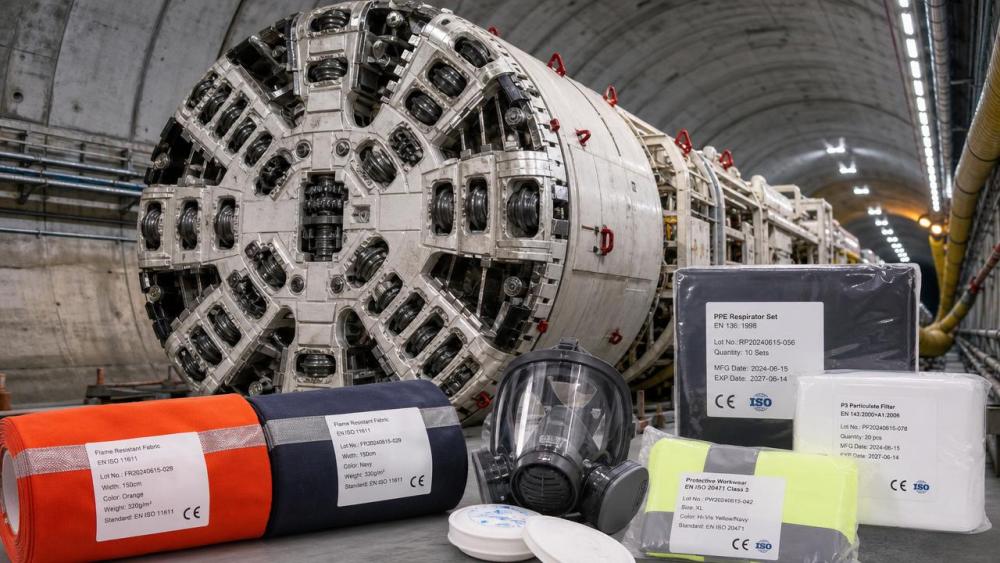
Event Overview
The GACC announced the revised Administrative Measures on Inspection and Quarantine Supervision of Imported and Exported Cosmetics on May 11. The new rules strengthen whole-chain supervision, explicitly assign legal responsibilities to importers, and impose strict traceability requirements for product labels. While the regulation’s scope remains limited to cosmetics under legal definition, its enforcement framework—including definitions of ‘dermal contact’, ‘intended protective function’, and ‘batch-level documentation’—is now being referenced by overseas buyers (notably in the EU, US, and Middle East) to update supplier audit checklists for industrial personal protective equipment (PPE).
Industries Affected
Direct Trading Enterprises
Exporters of TBM- or mining-specific PPE—such as tunnel face masks, dust respirators, and flame-retardant workwear—are now facing intensified pre-shipment compliance reviews. Because these products increasingly fall under buyer-defined ‘dermal-contact safety categories’, trading firms must now verify label accuracy (including bilingual ingredient/usage statements where applicable), maintain batch-level documentation, and demonstrate traceability from manufacturing to final packaging—requirements previously uncommon for industrial PPE exported from China.
Raw Material Procurement Enterprises
Suppliers of certified flame-retardant fabrics, filter media, or hypoallergenic lining materials are experiencing upstream pressure. Buyers now request material-level compliance certificates aligned with cosmetic-grade safety thresholds (e.g., heavy metal limits, formaldehyde content, and skin-sensitization test reports). This shift does not reflect a formal regulatory extension but rather a de facto harmonization driven by procurement risk mitigation.
Manufacturing Enterprises
Factories producing mining and tunneling PPE must adapt production records and quality control protocols to support full traceability—down to lot numbers of adhesives, dyes, and elastic bands. Labeling systems must accommodate both industrial use declarations and human-contact safety claims. Non-compliant labeling—such as missing CE-equivalent hazard symbols or absence of manufacturer contact details—now triggers buyer rejections, even if the item meets EN 149 or ISO 11612 standards.
Supply Chain Service Enterprises
Certification bodies, third-party testing labs, and logistics providers offering compliance support are seeing increased demand for integrated services: combined textile safety testing (per GB/T 18401 + ISO 10993-10), bilingual label verification, and digital traceability platform integration. However, no unified national guidance yet exists for applying cosmetic-style traceability to industrial PPE—creating interpretation variance across service providers.
Key Focus Areas and Recommended Actions
Review Product Classification Against ‘Dermal Contact’ Thresholds
Enterprises should assess whether their PPE items meet functional or design criteria that trigger buyer-mandated cosmetic-aligned scrutiny—e.g., prolonged skin contact (>4 hours), direct facial interface (respirators/masks), or incorporation of cosmetic-like components (moisturizing liners, antimicrobial coatings). Classification determines documentation depth required.
Upgrade Labeling and Documentation Systems
Labels must now include: (i) clear manufacturer identification and address; (ii) batch/lot number traceable to raw material intake; (iii) usage instructions in destination-market language; and (iv) safety warnings consistent with local PPE regulations and emerging cosmetic-style expectations (e.g., ‘for external use only’, ‘avoid contact with broken skin’). Digital QR-based traceability is increasingly expected.
Engage Early with Testing and Certification Partners
Testing labs accredited for both industrial PPE (e.g., EN 149, EN 14126) and textile safety (e.g., OEKO-TEX Standard 100, GB/T 18401 Class B) are preferred. Enterprises should commission joint test reports covering mechanical performance and dermal biocompatibility—not as regulatory mandates, but as competitive differentiators amid tightening buyer audits.
Editorial Perspective / Industry Observation
Observably, this is not a formal expansion of cosmetics regulation into industrial equipment—but rather a case of regulatory logic spillover. Analysis shows that global procurement standards are converging around ‘human interface risk profiling’, where any product designed for repeated or intimate skin contact faces layered scrutiny, regardless of original sectoral classification. From an industry perspective, this signals a broader shift toward ‘function-driven regulation’: compliance expectations now follow how a product is used—not just what it is labeled as. Current procurement trends suggest that TBM and mining PPE exporters who proactively align with cosmetic-grade traceability and labeling discipline will gain advantage in high-compliance markets—even before formal rulemaking catches up.
Conclusion
This development underscores a growing reality in global trade: regulatory influence increasingly flows laterally across sectors, driven less by statutory scope and more by end-use risk perception. For manufacturers and exporters of industrial PPE, the takeaway is not that they must comply with cosmetic laws—but that they must recognize and respond to the operational implications of overlapping compliance expectations. A rational observation is that proactive alignment with traceability, labeling, and material safety disciplines—originally developed for cosmetics—offers tangible resilience against future procurement volatility.
Source Attribution
Official source: General Administration of Customs of the People’s Republic of China, Administrative Measures on Inspection and Quarantine Supervision of Imported and Exported Cosmetics (Revised Edition), Notice No. 52 of 2024, issued May 11, 2024. Implementation date: December 1, 2026.
Noted for ongoing observation: Whether GACC or MIIT will issue supplementary guidance clarifying applicability to non-cosmetic dermal-contact industrial goods; evolution of EU/US customs classification practices referencing this framework; and adoption trends among Tier-1 mining equipment OEMs in updating supplier code-of-conduct annexes.
Related News
How to Evaluate Articulated Dump Trucks Payload for Haul Road Conditions and Cycle Efficiency
Articulated Dump Trucks payload evaluation starts with real haul road conditions, not brochure numbers. Learn how to balance payload, traction, grades, and cycle efficiency for safer, higher output.

What Drives TBM Excavation Cost in Urban Tunneling Projects?
tbm excavation cost in urban tunneling depends on geology, shafts, segment lining, logistics, and risk. Discover the key cost drivers and compare bids with greater confidence.

What Does Energy Metals Mining in Australia Mean for Supply, Cost, and Project Risk?
Energy metals mining Australia is reshaping supply, cost, and project risk. Discover what it means for buyers, investors, and operators.

EU Eases Dual CE and UKCA Path for Chinese Tunnel Boring Equipment
EU eases CE and UKCA certification for Chinese tunnel boring equipment, cutting compliance time and helping importers move faster.
Flameproof Underground Safety Equipment: What Mine Teams Should Check Before Buying
Underground Safety Equipment flameproof buying guide: learn how mine teams should verify certification, durability, serviceability, and supplier support before purchase.

China-UAE Direct Sea Route Cuts TBM and Large Tunneling Equipment Lead Times
China-UAE direct sea route shortens TBM and large tunneling equipment lead times by 12–15 days, improving delivery predictability for major infrastructure projects. Read the full impact.

What Is a TBM Guidance System Gyroscope, and Why Does It Matter Underground?
TBM Guidance Systems gyroscope improves underground accuracy, reduces drift, and helps tunnel boring machines stay on line in harsh conditions.

China to Roll Out Nationwide Local and Foreign Currency Cash Pools for Multinationals on Sept. 14
China will roll out nationwide local and foreign currency cash pools for multinationals on Sept. 14, streamlining cross-border treasury management and boosting liquidity efficiency.

How to Choose a Reliable Underground Mining Equipment Supplier for Harsh Site Conditions
Find a reliable underground mining equipment supplier for harsh site conditions with rugged, maintainable solutions that boost uptime, reduce risk, and support long-term production.
Related News
- 00
0000-00
How to Evaluate Articulated Dump Trucks Payload for Haul Road Conditions and Cycle Efficiency - 00
0000-00
What Drives TBM Excavation Cost in Urban Tunneling Projects? - 00
0000-00
What Does Energy Metals Mining in Australia Mean for Supply, Cost, and Project Risk? - 00
0000-00
EU Eases Dual CE and UKCA Path for Chinese Tunnel Boring Equipment - 00
0000-00
Flameproof Underground Safety Equipment: What Mine Teams Should Check Before Buying
Weekly Insights
Stay ahead with our curated technology reports delivered every Monday.