
Hydrogen Fuel Cells for Mining Trucks: How Do They Handle Heavy Loads?





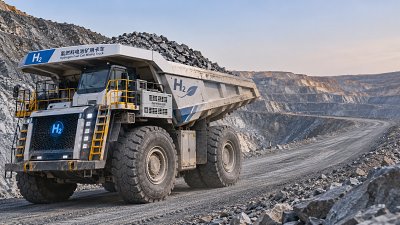
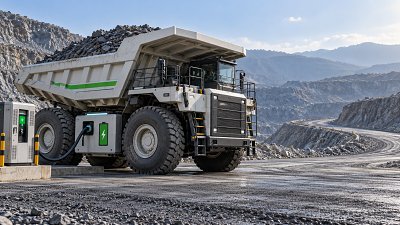
Hydrogen fuel cells can move heavily loaded mining trucks by supplying electricity to traction motors, but the fuel cell rarely has to meet every acceleration or grade demand on its own. A Hydrogen Mining Equipment fuel cell powertrain generally combines a fuel-cell system with a battery, power electronics, and electric drive motors: the fuel cell supports sustained output while the battery handles short power peaks and absorbs usable braking energy.
Whether that arrangement can sustain a given payload depends on the complete duty cycle, not payload rating alone. Gross vehicle mass, road gradient, rolling resistance, climb duration, thermal limits, hydrogen storage, and refueling availability determine whether the truck can maintain the required speed and complete its shift.
How a Hydrogen Mining Equipment fuel cell powertrain moves a heavy load
In a fuel-cell electric truck, stored hydrogen is supplied to a fuel-cell system, where an electrochemical reaction with oxygen produces electricity, water, and heat. Electricity passes through power-conditioning equipment to a common DC bus, which supplies traction inverters and motors; a battery is connected to the same electrical system through appropriate controls.
The motors turn the wheels through the vehicle’s driveline, generating the tractive effort needed to overcome grade, rolling resistance, and acceleration. Motor torque determines the immediate force available at the wheels; sustained electrical and thermal capacity determines how long the truck can deliver it.
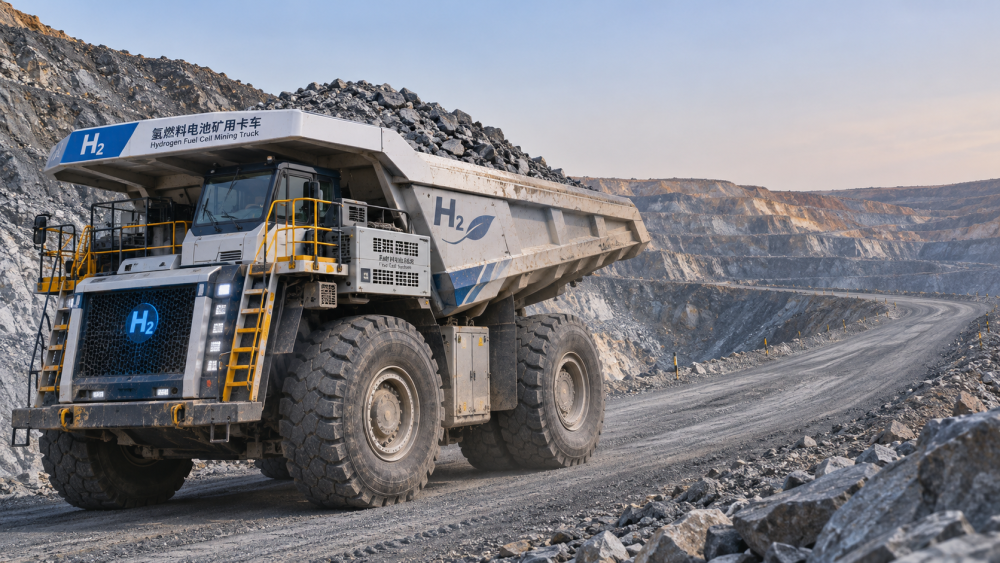
The battery makes the architecture more flexible. During a steep start or acceleration, it can supplement fuel-cell output. During braking, the motors can act as generators and return some energy to the battery, provided the battery has sufficient charge acceptance and the truck’s control and braking systems allow regeneration.
These functions do not eliminate the need for mechanical or friction braking. If the battery is full, cold, hot, or otherwise unable to accept the available power, regenerative braking must be reduced and another approved braking method must dissipate the remaining energy.
Heavy-load performance starts with force and power
A truck climbing at constant speed must overcome the component of its weight acting down the slope, plus rolling and other resistances. A useful first approximation for a straight climb is:
Wheel power ≈ vehicle mass × gravity × speed × gradient, plus power for rolling resistance and other losses.
Here, gradient is expressed as rise divided by horizontal distance, and the approximation is most useful at modest road angles. Electrical power demand at the DC bus will be higher than wheel power during traction because of motor, inverter, gearing, and other losses; cooling and auxiliary loads add further demand.
Consider an illustrative gross vehicle mass of 400 tonnes climbing an 8% grade at 20 km/h. The grade component alone is approximately 1.74 MW at the wheels, before rolling resistance, acceleration, and drivetrain losses. This is an engineering illustration, not a truck rating or a statement that any particular fuel-cell system can deliver that output.
The calculation explains why an impressive peak power figure can be misleading. A battery can bridge a temporary gap between required power and fuel-cell output, but its state of charge will fall if that gap persists. For a long climb, the relevant question is whether fuel-cell output, permitted battery discharge, and cooling capacity can sustain the required power for the full duration.
Peak power and energy are different constraints
Battery power, measured in kW or MW, governs how strongly it can assist at a given moment. Usable battery energy, measured in kWh, governs how long that assistance can continue. Both must be evaluated at the expected state of charge and cell temperature, rather than at an unrestricted nameplate condition.
For example, a 500 kW battery contribution sustained for 10 minutes requires approximately 83 kWh at the relevant electrical interface, before allowing for losses and operating reserves. Repeating such climbs without adequate recharge requires a larger usable energy margin or a higher average contribution from the fuel-cell system.
What controls sustained operation?
Fuel-cell output and transient response
Fuel-cell stack ratings must be distinguished from net system output. Compressors, coolant pumps, hydrogen circulation equipment, and other balance-of-plant components consume electricity, while system controls may limit output to protect components or manage temperature.
The truck’s energy-management strategy decides how quickly the fuel-cell system changes output and when the battery should assist. A smoother fuel-cell operating profile can reduce rapid load changes, but that strategy only works if the battery has enough power and energy headroom for the actual route.
Heat rejection at low speed
Both the fuel-cell system and the electric drivetrain reject heat. A loaded truck climbing slowly can face high power demand with limited natural airflow through its cooling package, making fan capacity, radiator cleanliness, coolant temperature, and ambient conditions important.
Thermal derating can reduce available power before hydrogen or battery energy is exhausted. A credible assessment therefore needs continuous and transient power curves across relevant ambient temperatures, altitudes, and cooling conditions—not only a peak output measured under favorable conditions.
Hydrogen storage and shift range
Onboard hydrogen inventory sets an energy limit, but usable shift range depends on route-specific consumption, auxiliary loads, reserve requirements, and the efficiency of the complete powertrain. Tank capacity stated as mass of hydrogen is not equivalent to energy delivered at the wheels.
Storage pressure, tank packaging, protective structures, and the mass of the fuel-cell and battery systems also affect payload and vehicle integration. The comparison should use net payload at the permitted gross vehicle mass, rather than assuming that two trucks with similar nominal capacities carry the same material.
Why the haul route can change the result
Route direction is especially important. A truck that descends loaded and returns uphill empty has a different energy balance from one that climbs loaded. Regeneration can improve efficiency on a suitable descent, but it cannot recover all potential energy because conversion losses and charge-acceptance limits remain.
The duty cycle should include loading and queue times, intersections, speed restrictions, road deterioration, seasonal temperature changes, and the required production rate. A simulation based on an idealized continuous loop can overstate shift performance if it omits these operational constraints.
Refueling and infrastructure are part of the powertrain decision
Hydrogen availability at the truck depends on production or delivery, storage, compression, dispensing, and maintenance of the complete supply chain. The relevant production metric is not simply dispenser flow rate; it is whether the station can replenish the required fleet inventory within the available operating windows.
Refueling time must be specified with starting and final tank conditions, delivered hydrogen mass, pressure, temperature limits, connection and safety checks, and any queue or station recovery time. A nominal dispensing time alone does not establish truck availability.
Hydrogen has a wide flammability range in air and can accumulate in poorly ventilated spaces if released. Facility design must address leak detection, ventilation, ignition control, separation distances where applicable, emergency isolation, hazardous-area classification, and response procedures under the governing local requirements.
For underground operation, confined geometry and ventilation arrangements make a separate hazard assessment essential. Hydrogen should not be treated as automatically acceptable underground merely because the vehicle produces no tailpipe pollutants during fuel-cell operation.
Standards and evidence to include in a technical review
Standards help structure a review, but applicability depends on the vehicle, installation, jurisdiction, and edition adopted by the relevant authority. The following are useful starting points rather than a complete compliance list:
- ISO 17757: Safety requirements for autonomous and semi-autonomous earth-moving and mining machine systems, relevant where automated operation is included.
- ISO 3450: Braking system performance and test procedures for specified earth-moving machinery; confirm applicability to the vehicle and its configuration.
- ISO 19880-1: General requirements for gaseous hydrogen fueling stations, relevant to station design and risk assessment.
- ISO 23273: Fuel-cell road vehicle safety specifications; assess relevance to the vehicle and regulatory context rather than assuming direct applicability to an off-road mining truck.
- IEC 62282 series: Fuel-cell technology standards covering specific system and testing topics; select the parts applicable to the equipment under review.
Request test reports that identify the standard edition, test configuration, pass criteria, and any exclusions. For storage vessels, electrical systems, functional safety, pressure equipment, and site fire protection, additional requirements may apply under local mining and industrial regulations.
Minimum technical evidence
- Gradeability and speed: Gross mass, road resistance, ambient conditions, climb length, and sustainable speed—not just a peak grade percentage.
- Power and energy balance: Net fuel-cell output, battery usable energy, charge and discharge limits, auxiliary consumption, and state-of-charge trajectory over a complete shift.
- Thermal performance: Continuous operating limits, derating thresholds, cooling-system assumptions, and response to blocked or dusty heat exchangers.
- Braking and regeneration: Retarding performance across battery states of charge, fallback braking capacity, and thermal limits on long descents.
- Hydrogen supply: Usable onboard inventory, reserve policy, refueling protocol, station throughput, and consequences of dispenser or supply outages.
- Reliability and maintainability: Inspection intervals, component replacement assumptions, diagnostic access, and the effects of fuel-cell or battery derating on production.
How hydrogen compares with diesel and battery-electric haulage
The comparison should use the same payload, route, production target, reserve policy, and environmental conditions. It should also include upstream energy supply where lifecycle emissions are relevant: a hydrogen truck has no combustion exhaust from its fuel cell, but hydrogen production and delivery can have associated emissions.
The decisive test is a full-shift energy and power balance under the actual haul profile. A hydrogen truck is technically credible for heavy loads when its net fuel-cell output can support the sustained demand, its battery can cover peaks and accept available regeneration, and its cooling and hydrogen infrastructure can maintain that performance throughout the required operating window.
Share your questions or requirements, and our team will get in touch.
We respect your privacy. Your information is strictly confidential.
Related News
 Hydrogen Mining Truck Price: What Drives the Purchase Cost?Hydrogen mining truck price depends on more than payload. Explore key cost drivers, fueling infrastructure and lifetime expenses to compare quotes with confidence.
 CiDi Unveils Cabless Electric Mining Truck and Agentic AI SolutionCiDi unveils a cabless electric mining truck and Agentic AI solution. Explore what the announcement could mean for autonomous mining and procurement.
 Boonray and Vale Indonesia Deepen Electric Mining Truck CooperationBoonray and Vale Indonesia deepen electric mining truck cooperation. Explore what the project could mean for procurement, delivery and ongoing support.
 Hydrogen Fuel Cells for Mining Trucks: How Do They Handle Heavy Loads?Hydrogen Mining Equipment fuel cell systems combine fuel cells and batteries to haul heavy loads. Explore grade performance, cooling, range, and refueling needs.
 Battery-Electric Underground Mining Trucks: Range and Charging SelectionBattery underground mining transport depends on more than range. Learn how to select truck batteries and charging strategies that support reliable production.
 World's First 176-Tonne Battery-Electric Rigid Mining Truck Rolls Off Production LineDiscover the world's first 176-tonne battery-electric mining truck, featuring a 2,400-kWh battery and a 20-minute charging target.
 BHP and Rio Tinto Complete First Megawatt Charging Test for Cat 793 XEBHP and Rio Tinto complete the first megawatt charging test for Cat 793 XE. Discover what charging above 1 MW could mean for electric mining trucks and future fleet deployment.
 Battery-Electric Mining Trucks: Matching Payload, Range, and Charging to Duty CyclesEvaluate battery mining transport equipment with confidence. Discover how to match payload, range, and charging to haul cycles, reduce downtime, and meet production targets.
Related News
- 00
0000-00
Dinghai Shield Machine Passes 5,000 Metres in Jintang Undersea Tunnel - 00
0000-00
Pipe Jacking Machine Cost: Key Price Factors and What to Budget - 00
0000-00
Bauma China 2026 Closes as Visitor Numbers Rise 21% - 00
0000-00
Chinese-Made 16-Meter Shield Machine Completes Yangtze River Crossing - 00
0000-00
Hydrogen Mining Truck Price: What Drives the Purchase Cost?
Weekly Insights
Stay ahead with our curated technology reports delivered every Monday.